 WHAMBOX
01What is the hidden tube inside a toilet?
Look at a toilet and you see a bowl and a tank. The most important part is the one you cannot see, and it is molded right into the ceramic. Behind the bowl, a tube curves up, arcs over a hump, and bends back down toward the drain. From the side it looks like the letter S lying on its back. Plumbers call it the trap.
That shape is the whole secret. To leave the bowl, water has to climb up and over that internal hump before it can fall to the sewer. And because the water has to go up before it goes down, some water always stays behind in the low part of the bend.
That standing water is the pool you see in the bottom of the bowl. It is not leftover. It is there on purpose, and every flush destroys it and rebuilds it in seconds.
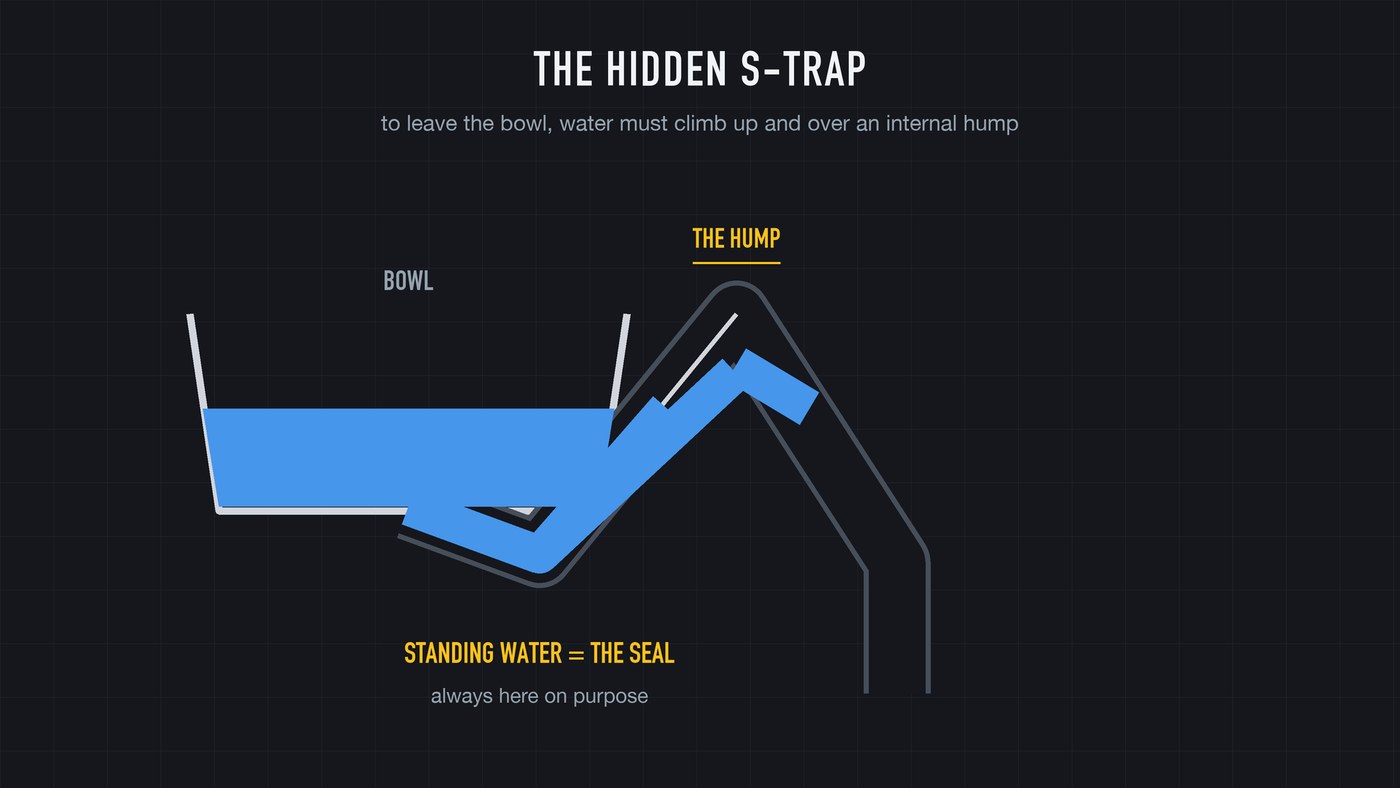
The extra bend is the entire invention.
02What actually happens when you push the handle?
You are not pushing anything down the drain. You are dumping water into the bowl, fast. The handle lifts a rubber stopper at the bottom of the tank called the flapper, and the tank empties into the bowl in a few seconds.
Most of that water rinses down through holes around the rim, but some is aimed through a jet at the base of the bowl, fired straight into the trap. It is not a trickle, it is a dump. A large volume of water arrives all at once, and that matters.
The flood raises the bowl's water level faster than the trap can drain it normally. Water climbs the inside of the S-tube, reaches the top of the hump, and spills over the crest toward the drain. That is the moment the real trick starts.
03How does a siphon pull water uphill?
Once water pours down the far side of the bend, the tube fills completely, with no air gap. Now there is one connected column of water arcing up and over the hump. Gravity pulls down on the long downhill side, and because the column is connected, the falling water drags the water behind it along too, up the short side and over the top.
That is a siphon. A filled tube plus gravity will lift water uphill, as long as the outlet sits below the water level back in the bowl. No pump is sucking. The weight of the falling water, plus normal air pressure pushing down on the bowl, does all the work.
This is where the loud, fast whoosh comes from. The bowl empties in seconds, far faster than it could ever just drain.
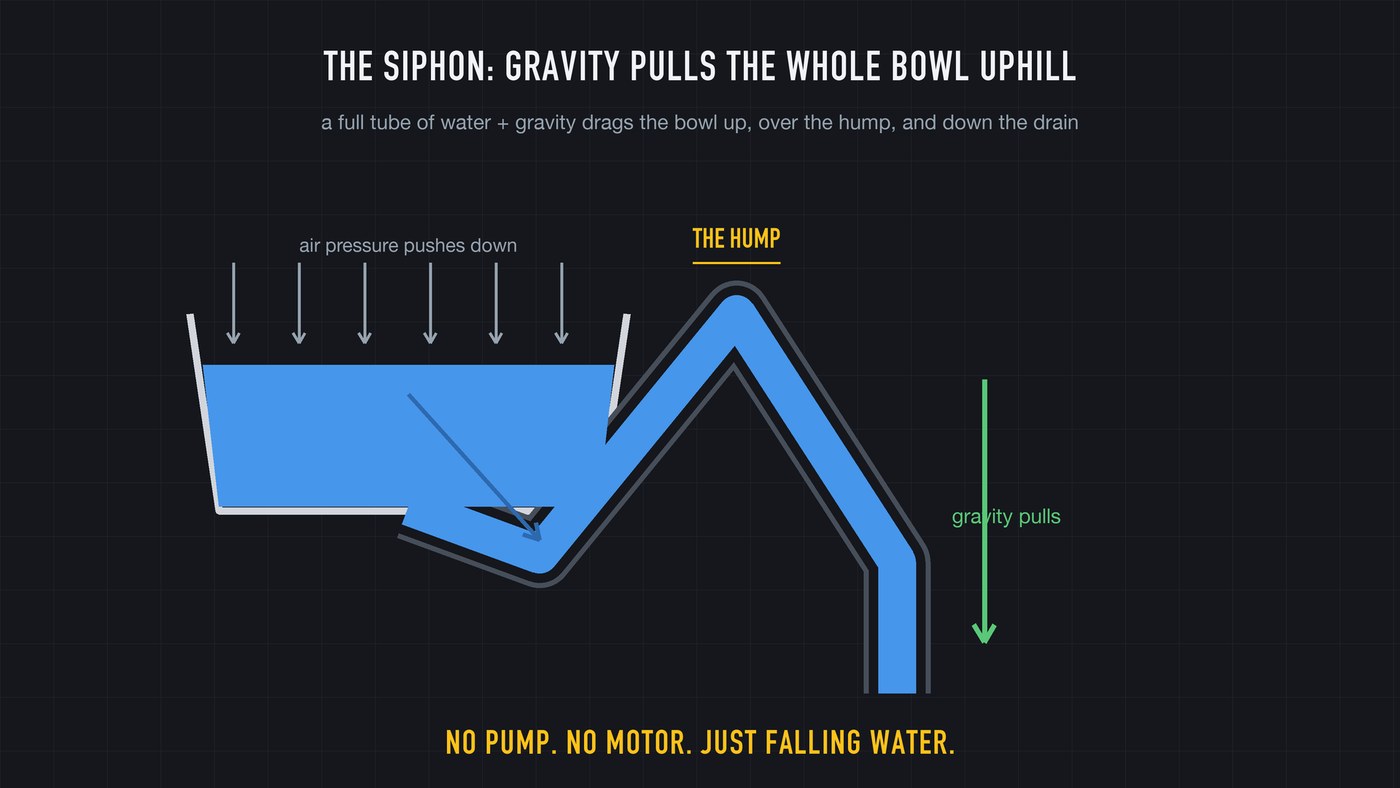
It isn't falling. It's being yanked over a hidden hump.
04Why does a toilet gurgle at the end of a flush?
A siphon only works while the tube stays full of water, so every flush is a race. It runs great right up until the bowl runs low and the trap starts pulling in air instead of water.
The moment air gets in, the water column breaks. The connected chain snaps and the pulling stops instantly. That glug-glug at the end of a flush is the sound of air breaking the siphon. The show is over, and the bowl is nearly empty.
05Why is there always water sitting in the bowl?
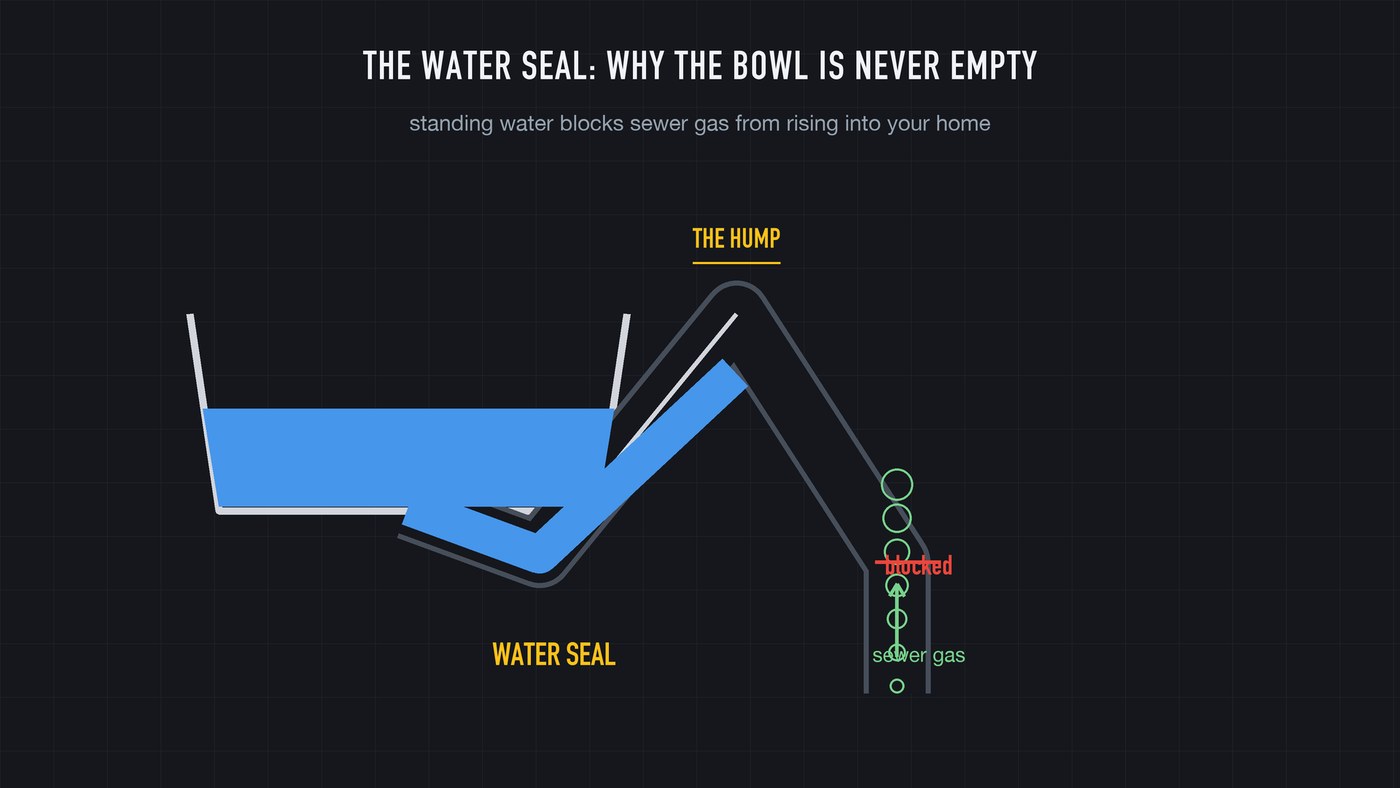
That pool in the trap works every second of the day. It is a seal. Below the toilet is a pipe to the sewer, and the sewer is full of gas: hydrogen sulfide, the rotten-egg smell, plus methane, which is odorless but flammable. That gas wants to rise into your house.
The standing water blocks it. Gas cannot push through the pool, so it stays down where it belongs. The water is the door, and it stays shut as long as the water is there.
This is why every drain in your home has a trap of some kind. The toilet just has its trap built into the porcelain instead of hanging underneath in the cabinet.
06What do the parts inside the tank do?
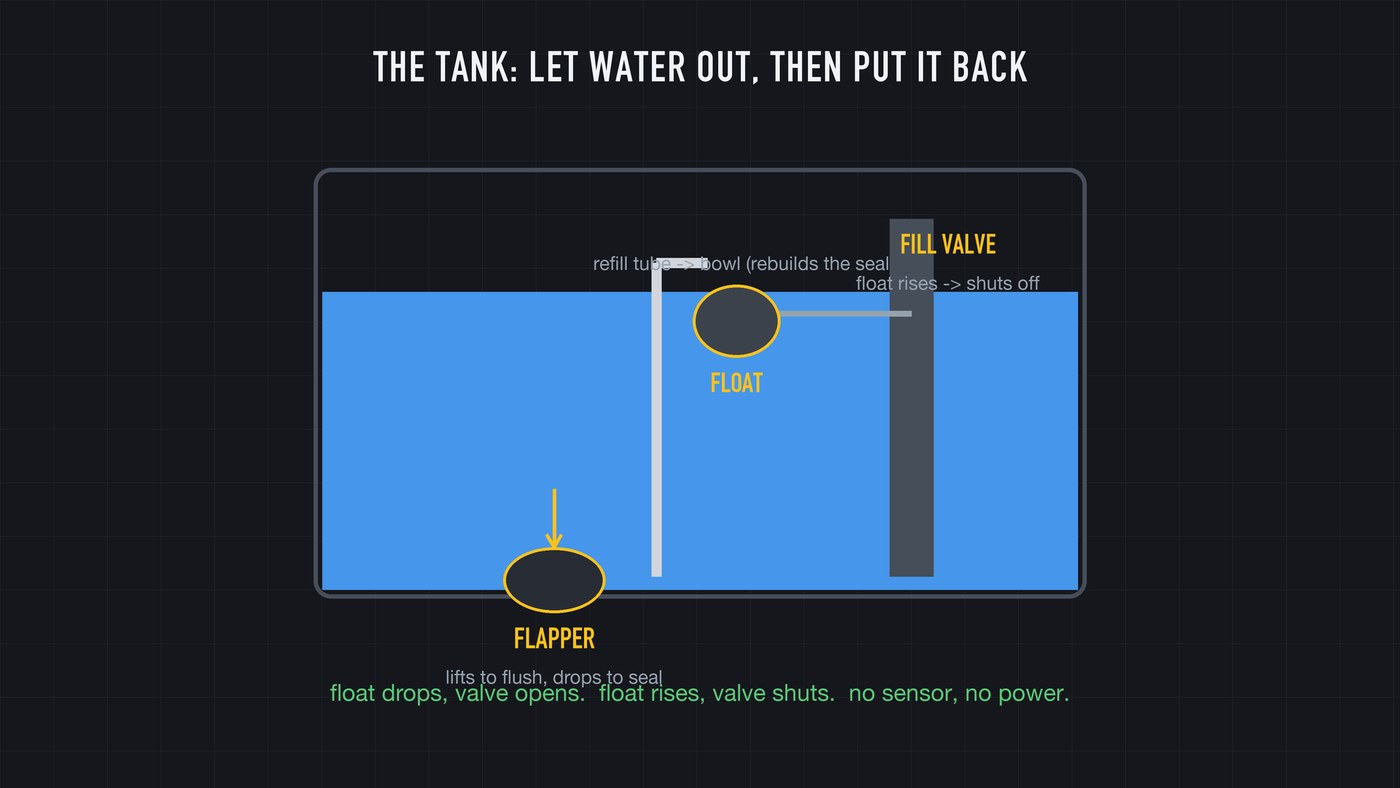
Lift the tank lid and it looks like a mess of plastic, but there are only two jobs: let water out, then put water back.
The flapper is job one. It lifts when you flush and drops back to plug the hole once the tank empties. Job two is the fill valve and the float. As the tank empties, the float drops, which opens the fill valve. As the tank refills, the float rises and shuts the valve off. No sensor, no electronics, just a float turning water off like a lever.
One detail people miss: while the tank refills, a small tube also squirts water down into the bowl on purpose. That is what rebuilds the water seal in the trap, so sewer gas stays blocked and the toilet is ready for the next flush.
07What goes wrong: phantom flushes, clogs, and dry traps
The leaky flapper. If the flapper does not seat perfectly, water sneaks from tank to bowl, the float slowly drops, and the fill valve kicks on to top it off. That is the toilet that hisses or seems to flush itself at three in the morning. Phantom flushes can quietly waste a surprising amount of water, and a worn flapper is the usual culprit.
Clogs. Everything has to climb over the trap, so the trap is the choke point. Anything too big jams in the bend, the siphon cannot form, and the bowl will not clear. A plunger works by shoving water back and forth to force the blockage through the hump. No suction, just push.
Water use. The fast dump is not free. Older toilets used roughly 3.5 gallons or more per flush. Modern ones do the same job on about 1.6, and high-efficiency models near 1.28. The engineering challenge is starting a reliable siphon with less water, which is exactly why the jet and bowl shape are designed so carefully.
And the dry trap. If a toilet sits unused long enough, the seal water evaporates and sewer smell drifts in. The fix is almost funny: flush it, and the seal is back.
08Is a toilet just a drain?
No. A drain lets water fall straight down. A toilet forces water up and over a hump so it can hold a seal and trigger a siphon. That extra bend is the entire invention.
And it needs no power. There is no motor, no impeller, nothing electric in a standard toilet. It is a tank of stored water, a rubber flap, a float, and a very cleverly bent tube. Gravity does the work. You just pull the trigger.
A bucket of water, dumped at the right speed, into a tube bent at the right angle.
- A toilet has no motor, no pump, and no power. Gravity and a bent tube do everything.
- The flush is a dump: the tank floods the bowl fast enough to fill the S-shaped trap.
- Once the trap runs full, a siphon forms and yanks the whole bowl up and over the hump.
- The end-of-flush gurgle is air breaking the siphon, and the pool that returns is a seal against sewer gas.
- Flapper lets water out, float and fill valve put it back, and a small tube rebuilds the bowl's seal every time.
More how it actually works
Frequently asked
How does a toilet flush without a pump?
The tank dumps water into the bowl fast enough to fill the S-shaped trap behind the bowl. Once that tube runs full, gravity pulling water down the far side drags the rest of the bowl up and over the hump. That siphon empties the bowl in about four seconds with no pump and no power.
Why does my toilet gurgle at the end of a flush?
The gurgle is air breaking the siphon. When the bowl runs low, the trap starts pulling in air instead of water, the connected water column snaps, and the siphon stops instantly. It is the normal sound of a flush finishing.
Why is there always water in the toilet bowl?
That standing water sits in the low bend of the trap and works as a seal. Sewer gas rising up the pipe cannot push through it, so it stays out of your house. A small refill tube rebuilds the pool after every flush.
What causes a phantom flush?
A worn flapper that no longer seals the tank. Water leaks slowly into the bowl, the float drops, and the fill valve turns on by itself to top the tank off. Replacing the flapper usually fixes it.