 WHAMBOX
01Height is pressure: the one idea the whole thing runs on
A tall column of water pushes down hard, and it pushes harder the taller it is. Stack water up and its own weight becomes pressure at the bottom. That's the entire principle, and the number is surprisingly clean: every 2.3 feet of height gives you about 1 psi of pressure.
So a tank of water sitting about 100 feet up delivers a little over 40 psi at the ground below. And 40 to 60 psi is almost exactly what a house wants: strong enough for a good shower, gentle enough not to hammer your pipes apart.
The height isn't for the view, and it isn't really about volume. A tower 100 feet tall makes the same pressure whether the tank holds fifty thousand gallons or a million. Fill level barely matters. What matters is how high the surface of the water sits above your tap.
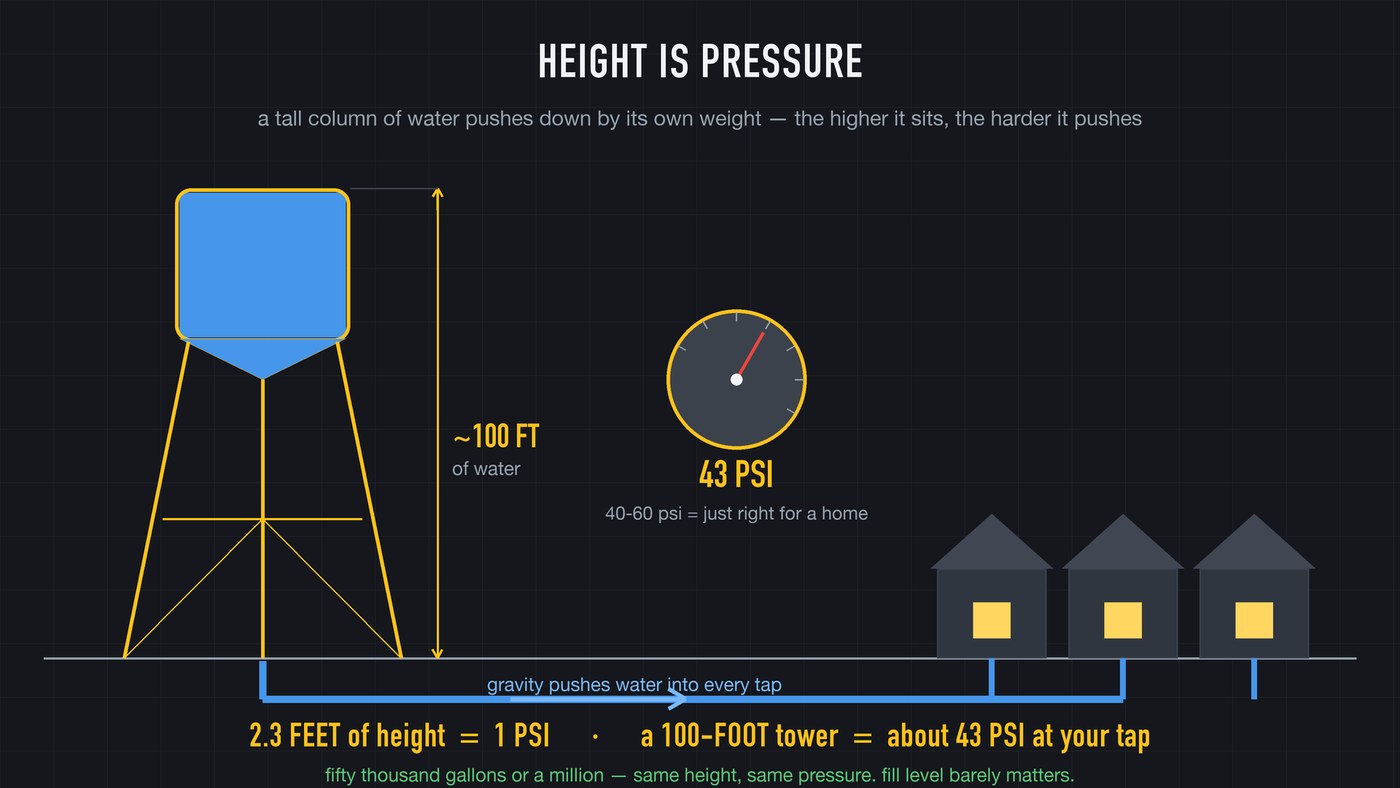
The height is the pressure.
02How does one tower feed a whole town?
Connect that tower to the web of pipes running under every street. Because the water up top is higher than every faucet in town, it wants to flow downhill into all of them at once. Open any tap and water comes out, not because something is pushing it to you at that moment, but because it's simply falling toward the lowest open exit.
This is a gravity-fed system, and the beauty of it is that the tower feeds everybody at the same time, automatically, with no moving parts between the tank and your kitchen. One tower can pressurize an entire neighborhood or a whole small town.
The water level in that tank is basically a promise: your pressure stays steady as long as the tank stays full.
03Why doesn't the tank run empty?
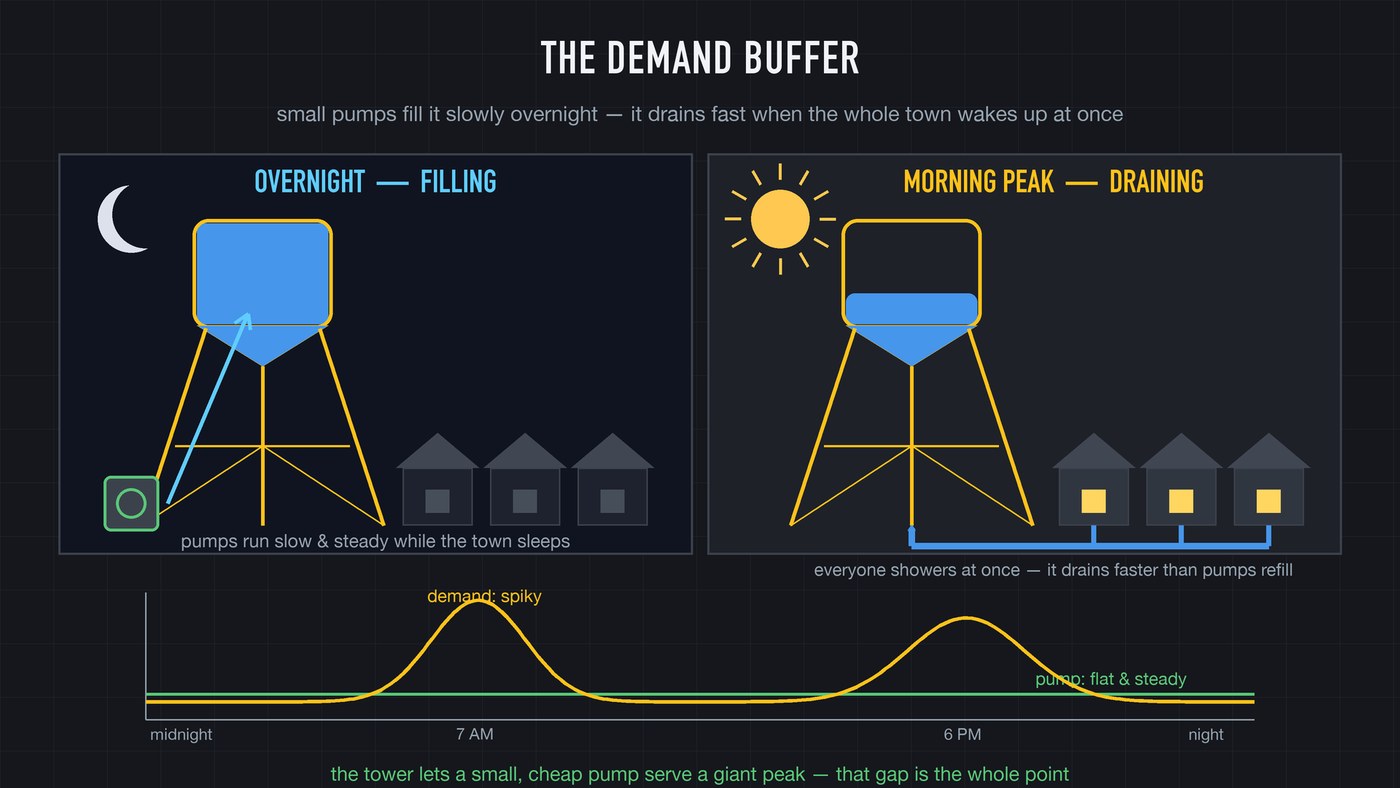
There are pumps in this system, but they're not the ones fighting your shower. They sit down at the treatment plant or a well, and their only job is to slowly lift water up into the tower. And they do most of it at night, when the town is asleep and barely using water.
Then during the day, demand spikes. Everybody wakes up, showers, flushes, and makes coffee in the same 45-minute window. No reasonably sized pump could keep up with that surge in real time. So it doesn't try. The tower does. During the morning rush, water pours out of the tank faster than the pumps refill it, and the level drops. In the quiet middle of the day and overnight, the pumps catch back up and top it off.
The tower is a buffer between steady, cheap, slow pumping and the spiky, unpredictable way people actually use water. It lets a small pump serve a big peak, and it lets those pumps run at night when electricity is often cheaper.
04Why is it on a hill or up on tall legs?
Everything comes back to one rule: the height of the water surface sets your pressure. So the whole design is just a hunt for height.
If a town has a good hill, that's the jackpot. Put a tank on top and the hill does the lifting for free, which is why so many reservoirs and tanks sit on the highest ground around.
But most towns are flat. No hill means you have to build the height, and that's what the legs are for. They aren't decoration and they aren't a pedestal. They exist purely to hold the water up around 100 to 150 feet so it makes the right pressure. The tank could sit on the ground and hold the exact same water; it just wouldn't push.
On flat land, the legs are the pressure. On a hill, the hill is.
05What happens when the power goes out?
This is where the design really pays off, and it's the reason engineers still love towers in an age of electric pumps. In a system that relies on pumps to make pressure in real time, a blackout is a disaster: the pumps stop, the pressure dies, and taps run dry within minutes.
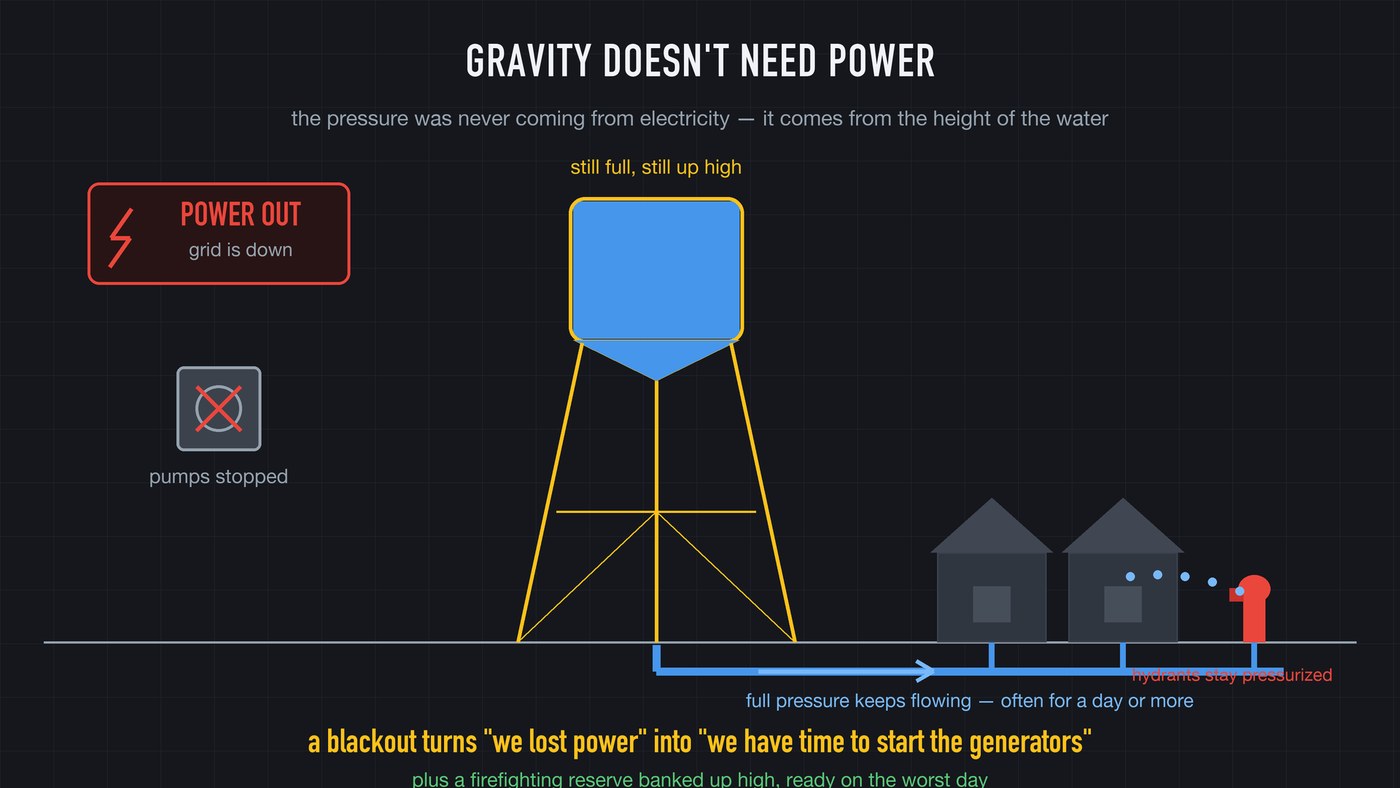
A gravity tower doesn't care. The pressure was never coming from electricity; it was coming from the height of the water. When the grid goes down, the pumps stop refilling, but the tank is already full and sitting up high. Gravity doesn't need power. Water keeps flowing to every home at full pressure straight through the outage, often for a day or more, on the water already banked in the tank.
That built-in ride-through is a genuine safety feature. It keeps hospitals, homes, and fire hydrants pressurized exactly when a storm has knocked the power out. The tower turns "we lost electricity" into "we have plenty of time to get generators running," instead of an instant crisis.
06Why is the tank bigger than the town seems to need?
Firefighting. When a fire truck hooks up to a hydrant, it can pull water at a ferocious rate, far more than a few houses ever would. That sudden, massive draw has to come from somewhere without the whole town's pressure collapsing. The tower is that somewhere.
A good chunk of its volume is deliberately held in reserve so that on the worst day, there's both the water and the pressure to fight a fire, even while everyone else is still using taps as normal.
So a tower is quietly sizing itself for three jobs at once: cover the daily peak, hold a cushion for emergencies, and keep enough head of water up high that hydrants blast hard. The height gives the pressure; the volume gives the time.
07The catch: freezing, maintenance, and the storage myth
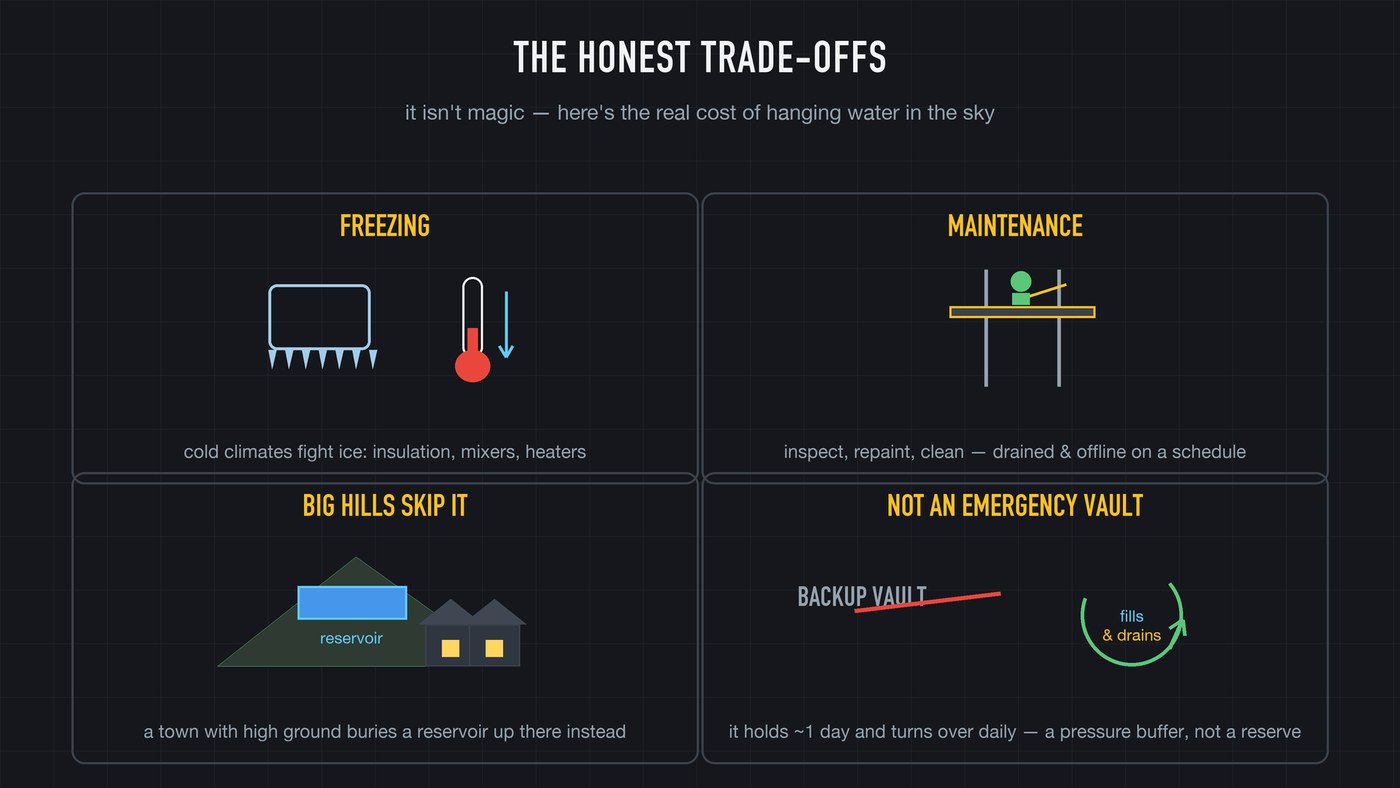
So simple it seems foolproof. It isn't. Freezing is the first problem: a giant tank of water sitting exposed in the air is a liability in cold climates. Still water freezes, and ice can damage the tank and block the pipes. Cold-climate towers fight this constantly with insulation, mixing systems that keep the water moving, and sometimes heaters. It's a real ongoing cost of putting water in the sky.
Maintenance is the second. That steel is holding hundreds of tons of water a hundred feet up, forever, in the weather. It has to be inspected, repainted, and cleaned inside on a schedule, which means occasionally draining a tower and taking it offline. It's a big, heavy, long-term commitment.
Geography is the third. Towers make the most sense on flat land. A town blessed with tall hills often skips the tower entirely and buries a big reservoir on high ground instead, getting the same gravity pressure without building a landmark on legs. The tower is one answer to the height problem, not the only one.
And the big myth: people picture a water tower as the town's deep backup supply. It really isn't. Most towers hold only about a day of a town's water, and that water turns over constantly, filling every night and draining every day. It's not a vault of backup water. It's a pressure buffer that happens to be full of water, and the whole point is that the water keeps moving.
08Myth vs mechanism
Myth one: a water tower stores the town's water. Storage is almost a side effect. Its real job is to convert height into steady pressure for everyone at once. If storage were the goal, you'd dig a cheap tank in the ground. It's up in the air on purpose.
Myth two: it needs pumps running to push water to you. It doesn't, not moment to moment. The pumps only refill it, slowly, mostly at night. The push that reaches your shower is pure gravity, which is exactly why it keeps working when the power goes out.
That's the whole machine. A tank of water, lifted about a hundred feet into the sky, so its own weight quietly pressurizes an entire town, buffers the morning rush, feeds the fire hydrants, and rides straight through a blackout, all without a single motor fighting your faucet.
- A water tower's real job is pressure, not storage: every 2.3 feet of height adds about 1 psi, so 100 feet delivers roughly 43 psi.
- It gravity-feeds the whole town at once, with no moving parts between the tank and your tap.
- Pumps refill it slowly, mostly at night; the tank drains during the morning rush and acts as a buffer between steady pumping and spiky demand.
- Because the pressure comes from height, not electricity, taps and hydrants keep full pressure through a blackout, often for a day or more.
- It's not an emergency vault: most towers hold about a day of water, and it turns over completely every day.
More how it actually works
Frequently asked
How does a water tower work?
It converts height into pressure. Water gains about 1 psi for every 2.3 feet of height, so a tank roughly 100 feet up delivers 40-plus psi to every faucet below it by gravity alone. Pumps only refill the tank, slowly and mostly at night.
How much pressure does a water tower make?
About 1 psi for every 2.3 feet of height. A tank 100 feet up delivers a little over 40 psi at the ground, which lands right in the 40 to 60 psi range a house wants. Fill level barely matters; the height of the water surface sets the pressure.
Does a water tower work during a power outage?
Yes. The pressure comes from the height of the water, not from electricity, so a full tank keeps every tap and fire hydrant at full pressure straight through a blackout, often for a day or more. Only the refilling stops.
How much water does a water tower hold?
Typically about one day of the town's water use, and it turns over constantly, filling overnight and draining during the day. It's a pressure buffer, not a deep emergency reserve; part of its volume is held back for firefighting.