 WHAMBOX
01How can a stove cook without making heat?
Every other stove works the same way: something gets hot, then hands the heat to your pan. A gas burner makes a flame. An electric coil glows red. In both cases the stove heats up first, and most of that heat leaks into the air, the kitchen, your face.
An induction cooktop does none of that. Under the smooth glass there is no flame and no heating element. There's a flat coil of copper wire, wound in a spiral like a loose clock spring. That coil never gets hot on purpose. It doesn't glow. It doesn't burn.
All it does is push electricity around in a very particular way, and that turns the pan itself into the heat source. The stove stays a bystander. So how does a cool coil boil a pot of water it never touches? Magnetism.
02What is the coil under the glass actually doing?
Run electricity through a coil of wire and it becomes a magnet. Same trick as every doorbell and junkyard crane. Send current one way, the field points up. Reverse the current, the field flips.
An induction cooktop sends an alternating current that reverses twenty to sixty thousand times every second. So the magnetic field above the coil isn't sitting there. It's slamming back and forth, up and down, faster than you could ever sense.
To your hand it's invisible and completely still. To a piece of metal sitting in it, it's a hurricane. That flipping field is the whole engine of the machine.
To your hand, invisible. To a piece of metal, a hurricane.
03How does the pan cook itself?
A changing magnetic field pushes on electric charges, and metal is full of loose electrons free to move. The flipping field grabs those electrons and drives them in circles inside the metal of the pan. These whirlpools of current are called eddy currents, like eddies in a river.
Here's the payoff. No metal is a perfect conductor; every pan fights the current a little. That resistance is friction for electricity, and pushing current against resistance makes heat, the same effect that makes a toaster wire glow. Except here the resistance is inside the pan, so the heat is born inside the pan.
The field does the pushing, the pan's own metal does the resisting, and the pan bottom heats directly, in seconds. The cooktop is just a machine for making a magnetic field. The pan turns that field into heat.
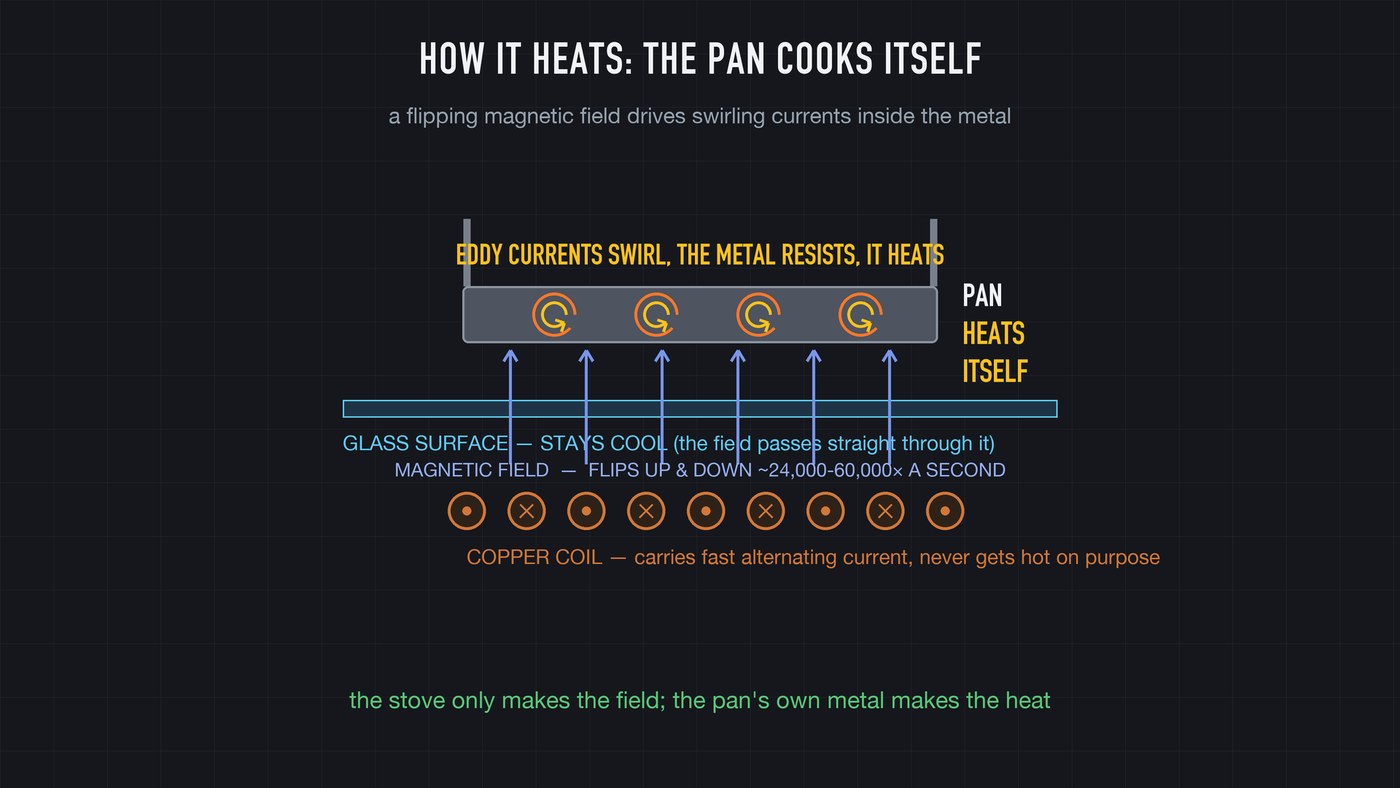
The pot genuinely cooks itself.
04Which pans work on induction? The fridge-magnet test
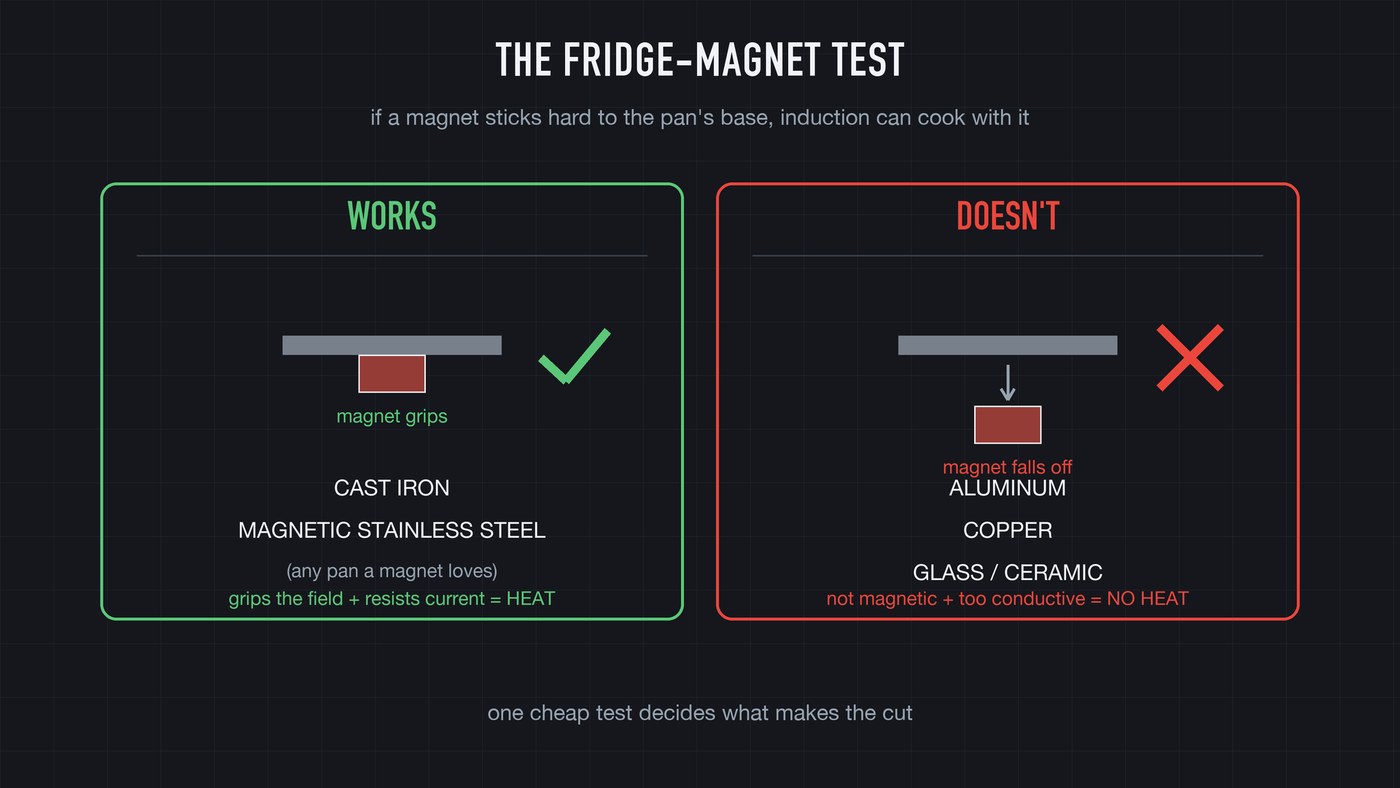
Stick a fridge magnet to the bottom of your pan. If it grabs on hard, that pan works on induction. If it slides off, it won't. That cheap test tells you everything, because it checks the property that actually matters: the pan must be ferromagnetic, meaning it grips a magnetic field the way iron does.
Two things have to be true for the field to dump real heat into a pan: it has to grip the field strongly, and it has to have enough electrical resistance to turn the swirling currents into heat. Iron and the magnetic grades of stainless steel do both beautifully. Cast iron is ideal.
The failures are instructive. Aluminum and copper are superb conductors, which is exactly wrong here: they barely resist the current, so eddy currents swirl without making much heat, and they don't grip the field in the first place. Even some stainless steel fails: common 18/8 stainless is full of iron but isn't ferromagnetic, so induction can't heat it well. The magnet test catches that too, which is why it beats reading the label.
05Why does the glass stay cool, and why is it faster?
Nothing is trying to heat the glass. The coil is cool, and the field passes straight through glass without heating it, the same way it passes through your hand. The only thing in the kitchen that responds is the pan. The patch of glass directly under a hot pot does warm up, but only by contact, the way a hot mug warms a table. Lift the pan and it cools fast.
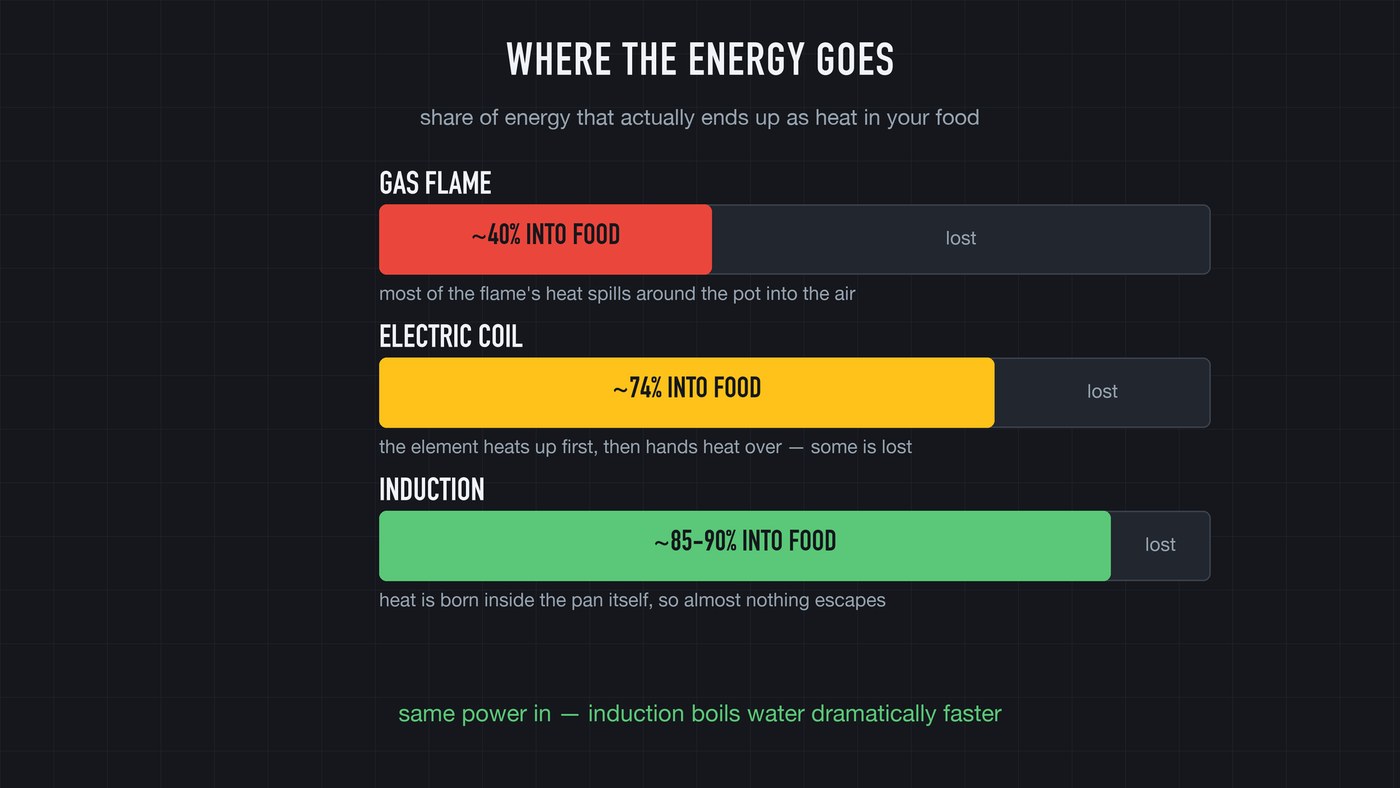
Because the heat is made inside the pan, induction skips a whole chain of waste. A gas flame throws most of its heat into the air; only about 40 percent of the energy reaches your food. Induction lands roughly 85 to 90 percent of the electricity as heat in the pan. Same power, dramatically faster boil.
Control is instant, too. There's no element that has to warm up and cool down. The heat is the field, and you throttle it like a dimmer. It's the responsiveness cooks love about gas, without the flame.
06What are the trade-offs?
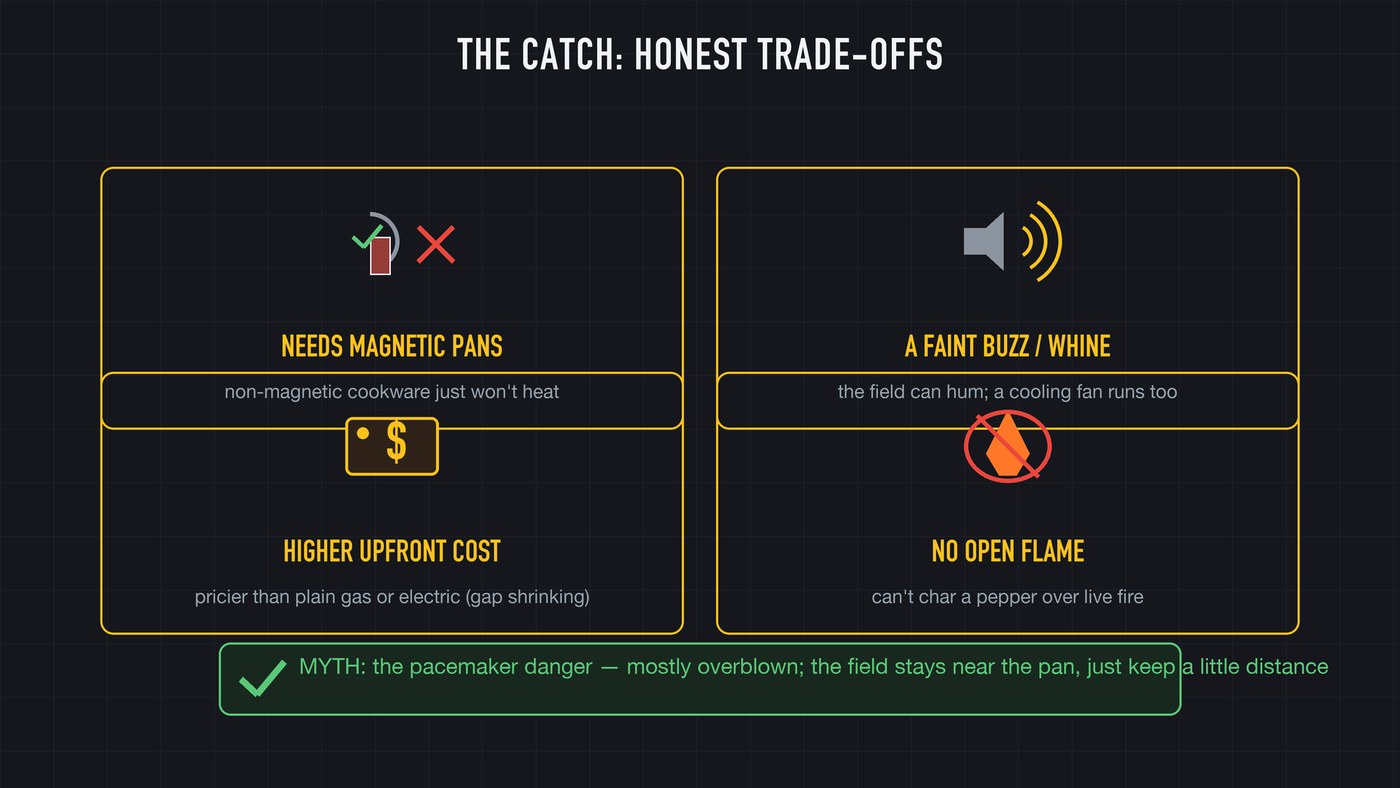
The cookware problem is the big one. If your pans aren't magnetic they simply don't work, and you may have to replace part of your kitchen. The fridge magnet decides what makes the cut.
The buzz is real. A field vibrating tens of thousands of times a second can make pans hum, usually louder on high power or with lighter multi-layer pans, plus a cooling fan inside the unit. Upfront cost still runs higher than plain gas or electric, though the gap keeps shrinking.
The pacemaker worry is mostly a myth for modern devices: the field falls off steeply with distance and is mostly contained to the pan. The standard advice is to keep a little distance and check with a doctor. And there's no flame, so no charring a pepper over open fire. Induction only heats what it can grip magnetically, and open air isn't a pan.
07Myth vs mechanism
Myth one: the stove heats the pan. On induction the stove makes a fast-flipping magnetic field and nothing more. The pan heats itself from eddy currents swirling in its own metal. That's the entire counterintuitive heart of the thing.
Myth two: it's exotic new technology. The physics is over a century old, the same electromagnetism behind doorbells, transformers, and the meter on the side of your house. The only new part is doing it fast enough, and cheaply enough, to sit under a sheet of kitchen glass.
A cool copper spiral, an invisible field slamming back and forth tens of thousands of times a second, and a magnetic pan that turns that field into its own heat. The stove doesn't cook your food. It hands the pan the power to cook itself.
- An induction cooktop makes almost no heat. A copper coil under the glass flips a magnetic field 20,000-60,000 times a second.
- That field drives eddy currents inside the pan's metal, and the pan's own resistance turns them into heat. The pan cooks itself.
- Only ferromagnetic pans work: cast iron and magnetic stainless. The fridge-magnet test is the reliable check.
- Induction puts 85-90% of its energy into the pan versus ~40% for gas, which is why it boils water so much faster.
- The glass stays cool because nothing heats it. The warm patch under a pot is just contact heat from the pan.
More how it actually works
Frequently asked
Why does induction need special pans?
The pan is the heating element. The cooktop's field can only dump energy into metal that grips a magnetic field (is ferromagnetic) and has enough electrical resistance to turn eddy currents into heat. Cast iron and magnetic stainless steel qualify; aluminum, copper, glass, and non-magnetic stainless don't. If a fridge magnet sticks firmly to the base, the pan works.
Why does the glass stay cool while the water boils?
Nothing heats the glass. The coil stays cool and the magnetic field passes through glass without warming it. Only the pan responds to the field, so only the pan gets hot. The patch under a hot pot warms by simple contact and cools quickly once the pan is lifted.
Is induction cooking safe with a pacemaker?
For most modern implants the risk is considered overblown: the field weakens steeply with distance and is mostly contained to the pan area. Standard advice is to keep some distance from the hob while it runs and to confirm with your doctor.
Is induction faster than gas?
Yes, substantially, at the same power. Roughly 85-90% of induction's electricity becomes heat in the pan, versus around 40% of a gas flame's energy, because the heat is generated inside the pan instead of thrown at it through the air.
Why does my induction cooktop buzz?
The magnetic field vibrates the pan tens of thousands of times a second, which can produce a faint hum or whine, most audible at high power and with lightweight multi-layer pans. There's also a cooling fan in the unit. Heavier flat-bottomed cookware is usually quieter.