 WHAMBOX
01There's no such thing as cold to make
Your refrigerator has no way to make cold. None. There is no cold sitting in there waiting to be blown at your milk. There is a machine quietly stealing the heat out of your food and shoving it out the back into your kitchen. Right now, your fridge is warming your kitchen to keep your milk cold. Once you see that, you can't unsee it.
Cold is just what's left over when the heat leaves. And here is the one rule that makes the whole machine make sense: heat only ever flows on its own from warmer to cooler. Left alone, nature would warm your food up to room temperature, never cool it down. So to make food colder than the room, you have to actively pull the heat out and carry it uphill, against its natural direction. That takes a pump, and it takes energy.
Cold is just what's left over when the heat leaves.
02Why is the back of your fridge warm?
Put your hand near the back of your fridge, or the grille along the bottom. It's warm. People find that strange for a machine whose entire job is cold. But you already know why. Those are the condenser coils, and that warmth is literally the heat that used to be in your food, leaving the building.
Your fridge is a heat conveyor belt. It picks heat up inside the box and sets it down outside. The inside gets colder only because the outside gets warmer. That warm back is not the machine straining or overheating. It is the product being delivered, just pointed at your kitchen instead of your food.
03One lap around the loop
Inside is a sealed loop with a special fluid called refrigerant, chosen for one talent: it boils at a very low temperature. And because the coil inside the fridge is held at low pressure, the refrigerant can boil colder than your freezer. The boiling is the whole trick. Follow the refrigerant around four parts and the machine clicks into place.
Evaporator (inside the fridge). The refrigerant arrives cold, low-pressure, and liquid. Your food and air are warmer than it is, so heat flows into the refrigerant and makes it boil into a gas. This is the actual moment of cooling. Boiling sounds hot, but it's just a substance drinking up energy to change from liquid to gas, the same move as sweat cooling your skin.
Compressor. This is the pump, and this is the part that hums. It grabs the low-pressure gas and squeezes it hard, which concentrates its energy and makes it hot, now hotter than your kitchen air. That squeeze is the hum you hear.
Condenser (back or underneath). The hot, high-pressure gas flows through coils exposed to your room. Because it's now hotter than the kitchen, heat flows out of it the natural direction, and the gas condenses back into a liquid. All the heat from your food, plus the energy the compressor added, radiates off the back.
Expansion valve. The warm high-pressure liquid gets forced through a tiny restriction into the low-pressure side. The sudden pressure drop lets it expand and flash very cold, and it arrives back at the inside coil ready to drink up more heat. The loop closes and runs again.
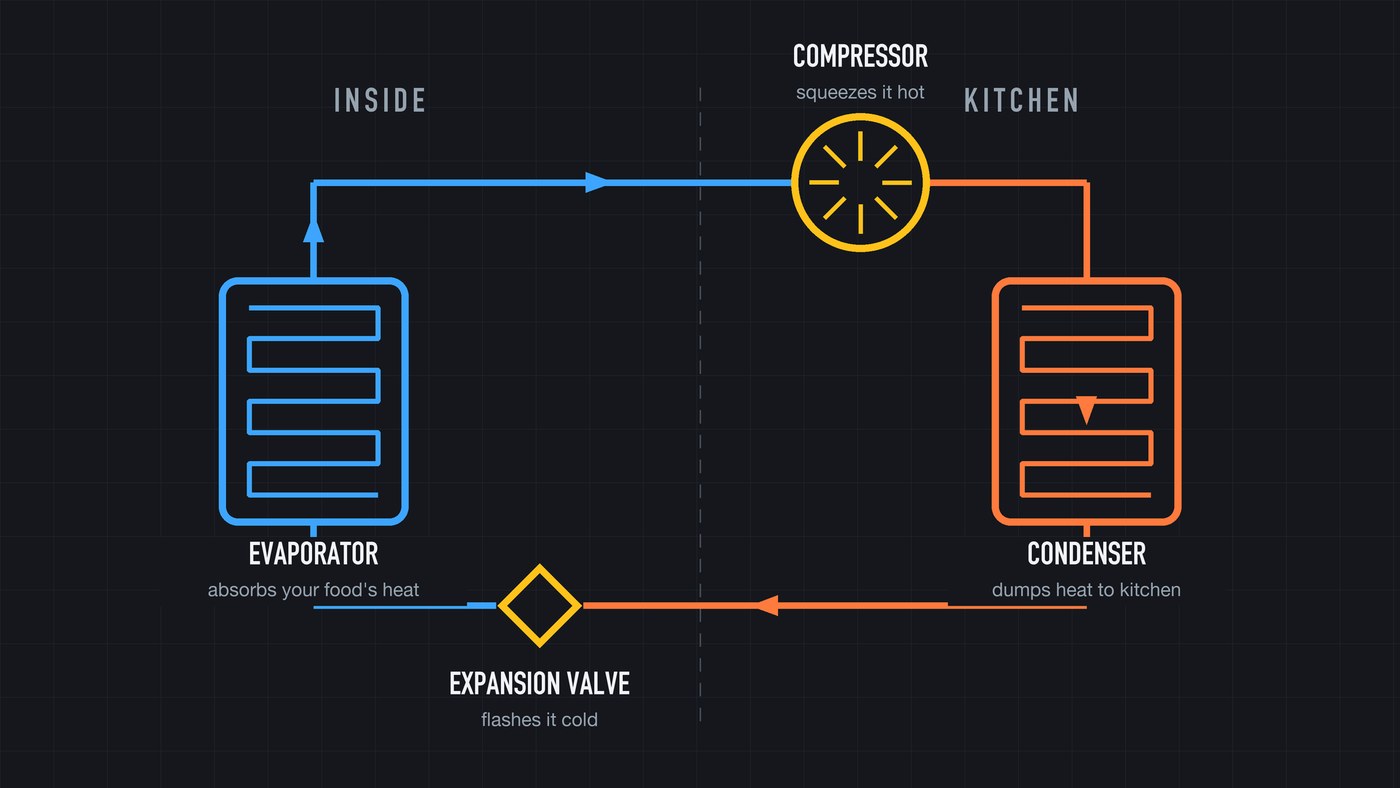
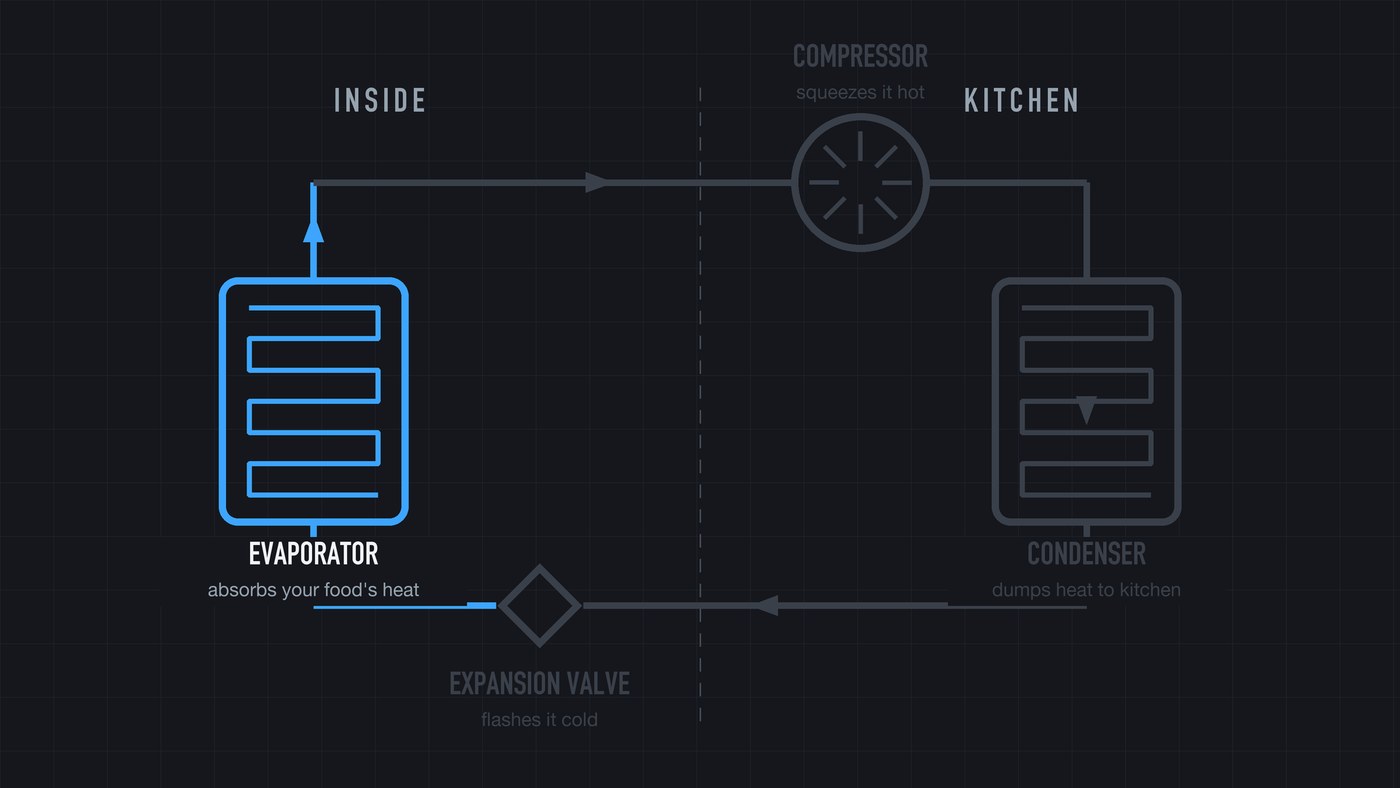
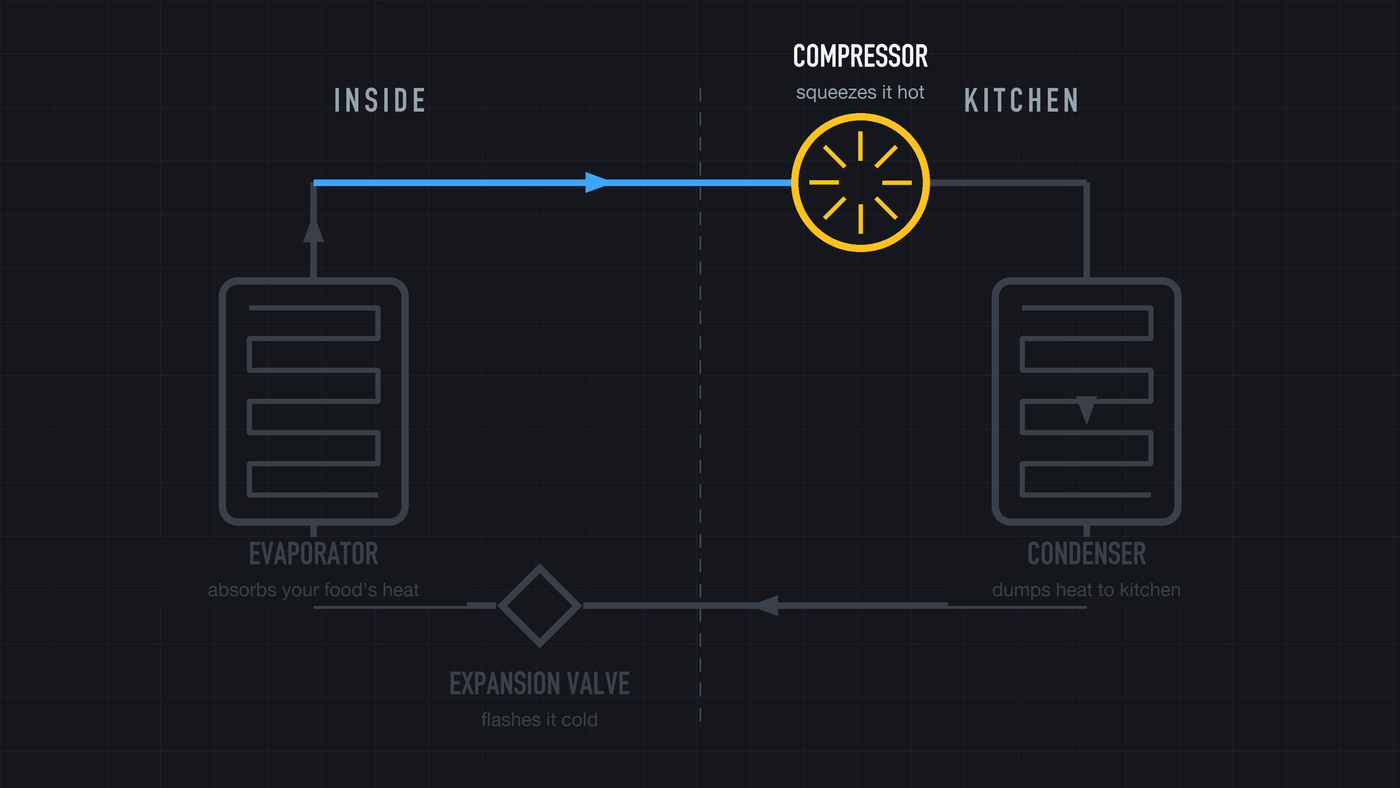
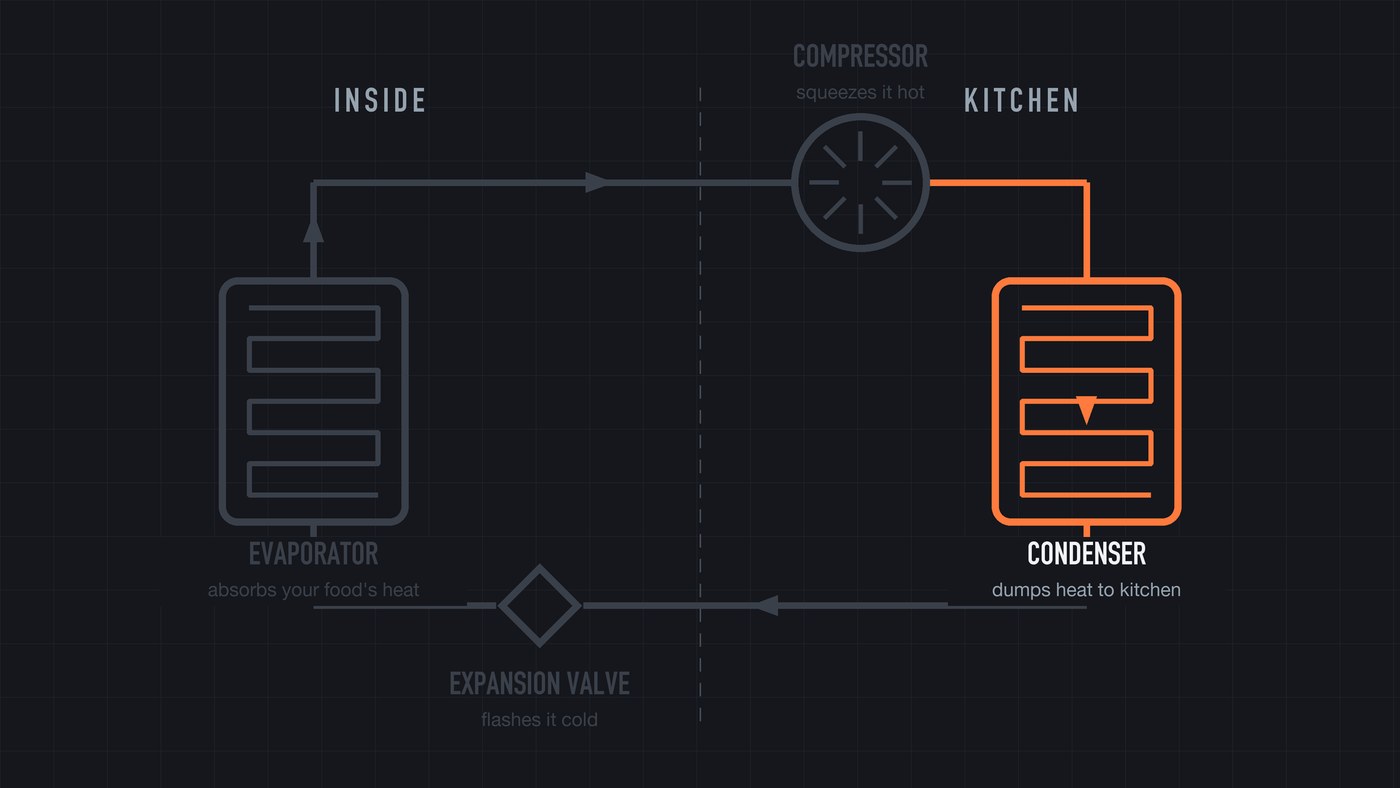
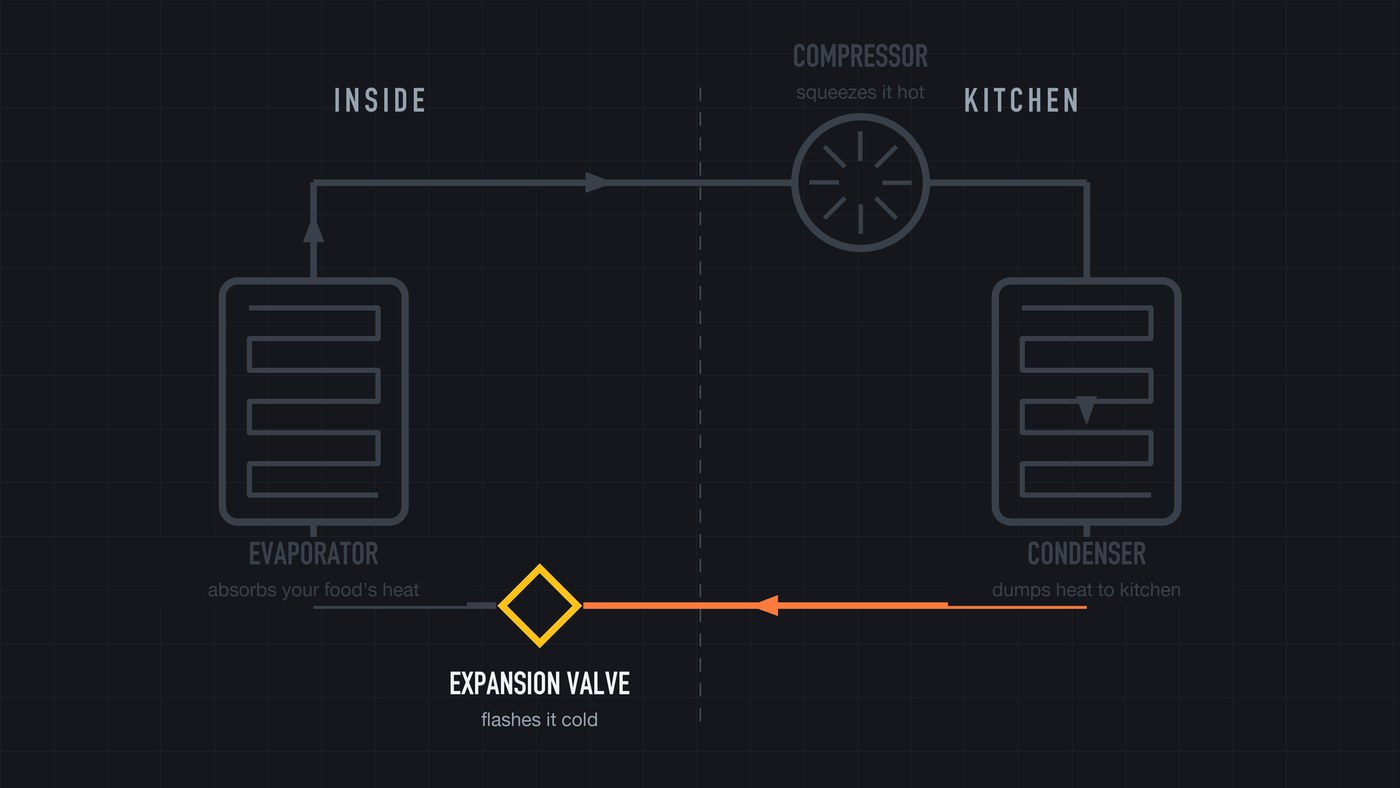
Absorb heat inside, squeeze, dump heat outside, expand cold, repeat.
04Why does the fridge hum on and off all night?
If it's just moving heat, why does it keep switching itself on and off? Inside is a thermostat watching the temperature. When the air drifts up past the target, it fires the compressor on, the loop runs, the box cools back down, and the thermostat shuts it off. Then heat slowly leaks back in through the walls and seals, the temperature drifts up, and the cycle repeats.
That on-off pattern is called a duty cycle. It's why your fridge is quiet for a while, then hums for a while, then clicks off. It isn't broken and it isn't straining. It's holding a temperature by running in bursts.
05Does turning the dial colder cool food faster?
Here is the myth almost everyone believes: if the milk isn't cold enough, crank the dial colder and it'll cool down faster. It won't. The dial does not control speed. It controls the target temperature, the thermostat setpoint, and in most fridges the compressor has only one speed: on.
Turning the dial colder does not make the loop run harder or pull heat faster. It just moves the finish line lower, so the compressor runs more often and for longer to hold that colder target. Your food cools at essentially the same rate either way. All you've changed is the destination, and how much electricity you burn getting there and staying there. Colder is not faster. Colder is just colder.
06Is the freezer a different machine?
The freezer is not a separate machine. In most fridges it's the same loop, or a close sibling of it, simply run to a colder target, usually around minus 18 degrees Celsius, about zero Fahrenheit. Same refrigerant, same compressor, same condenser dumping heat out the back.
The refrigerant just gets run to a lower temperature, and often the coldest air is made in the freezer section and shared with the fridge compartment beside it. Colder target means more heat to move, so the compressor runs a bigger share of the time. Same four steps you already understand.
07It's the same machine as your AC and heat pump
Here's the reveal. A refrigerator, an air conditioner, and a heat pump are the same machine. The only difference is which way you point the heat. A fridge moves heat from inside the box to your kitchen: small cold space, dumps into the room.
A window air conditioner does the identical thing at room scale. The evaporator coil faces your room and drinks its heat, the condenser hangs out the window and dumps that heat outside. An AC is a refrigerator for a room, and the outdoors is its kitchen, which is why the outdoor unit blows hot. A heat pump adds one part: a valve that reverses the flow, so in winter it runs backward and pulls heat out of cold outdoor air to warm your house. One machine, heating or cooling, chosen by direction.
The fridge in your kitchen is a one-direction version of the system that heats and cools whole buildings.
08The honest catch
This is the Whambox part where we tell you the catch. First, your fridge is a net heat source for your kitchen. It dumps out more heat than it pulls from the food, because the compressor's own energy gets added to the pile. A running fridge makes your kitchen slightly warmer, not cooler, so leaving the door open to cool a hot room does the exact opposite of what you want.
Second, dusty coils quietly cost you. The condenser sheds heat by touching room air, so caked in dust and pet hair it can't dump heat as easily and the compressor runs longer and harder. Vacuuming the coils once or twice a year is one of the few genuinely useful maintenance moves there is. And third, it's a meaningful always-on load: any single moment it isn't drawing much, but it runs part of every hour of every day for a decade, which makes the fridge one of the larger always-on electricity users in a typical home. It's a heat pump with a duty cycle and an electric bill, not a magic cold box.
- There is no cold, only heat. Your fridge doesn't make cold, it moves heat.
- It boils a refrigerant to grab your food's heat, then dumps that heat out the back.
- That's why the back is warm and why the compressor hums on and off in bursts.
- Turning the dial colder only lowers the target, it doesn't cool faster.
- A fridge, an AC, and a heat pump are one machine pointed three different directions.
More how it actually works
Frequently asked
Does a refrigerator make cold?
No. Cold is not a substance you can make. A fridge uses a boiling refrigerant to absorb the heat inside the box and pump it out the coils on the back, so the food is left colder.
Why is the back of my fridge warm?
Those are the condenser coils releasing the heat pulled out of your food, plus the energy the compressor added. The warm back is the fridge dumping that heat into your kitchen.
Does turning the fridge dial colder cool food faster?
No. The dial sets the target temperature, not the speed. Most compressors have one speed, so a colder setting just makes it run longer to hold a lower target, not cool any faster.
Is a refrigerator the same as an air conditioner?
Yes, it's the same vapor-compression loop with the same four parts. A fridge cools a small box and an AC cools a whole room, and a heat pump adds a valve to run the loop in reverse.