 WHAMBOX
01There's no such thing as cold
Your air conditioner has never made cold air. Not once, not today, and not in any AC ever built. Because cold isn't a thing you can make. You can't bottle it or blow it into a room. Cold is just a word for a place with less heat.
So what is that machine in your window actually doing? It's grabbing the heat that's already in your room and hauling it outside. That's the whole job. And it's exactly why the outdoor unit blows hot, why it drips water, and why it wrecks your bill every July.
Cold is just a word for a place with less heat.
02Why does the outdoor unit blow hot air?
Here's the fastest way to prove it. Stand next to the big outdoor unit while the AC runs. It's blowing hot air, hair-dryer hot on a 90° day. People assume that's just the machine heating up from working hard, like a laptop. It isn't.
That's your living room's heat. The warmth from your body, your lights, the sun through your windows. The AC collected it from inside and is dumping it into your yard. The outdoor unit is hot for the exact same reason your bedroom is now cool: the heat simply moved from one place to the other.
03The liquid that loves to boil
Inside your AC is a special fluid called refrigerant. The one thing to know about it: it boils at a ridiculously low temperature. Water boils at 212°F. Refrigerant, at normal pressure, boils around 50° below zero, colder than your freezer. So at room temperature this stuff is desperate to turn from liquid into gas.
And that boiling is the secret. When any liquid boils into a gas, it soaks up a huge amount of heat from whatever's around it. You've felt this: step out of a pool and you get a chill as the water evaporates off your skin, stealing your body heat to make the jump. Rubbing alcohol feels ice cold for the same reason. The liquid isn't cold. It's grabbing your heat.
04One lap around the loop
The refrigerant runs in a sealed circle through four parts: two coils and two gatekeepers. Follow one lap and the whole machine clicks into place.
Evaporator (indoor). Cold refrigerant meets your warm room air and boils, drinking up the heat. The air leaving the coil has lost its heat, so it's cool. That's the "cold" air from your vents. Your room heat is now trapped in the gas.
Compressor. It squeezes the gas hard, and squeezing a gas makes it hot, hotter than the outside air. That matters: to dump heat outdoors, the refrigerant has to be hotter than outdoors.
Condenser (outdoor). The fan blows air across the coil. Now that the refrigerant is hotter than the yard, its heat flows out, and the gas condenses back to liquid. That's the hot air you felt.
Expansion valve. The impossible-sounding step. The warm high-pressure liquid passes through a tiny valve into a low-pressure space, some of it instantly flashes to vapor, and that partial boiling steals heat from what's left. It comes out cold, ready to soak up room heat again.
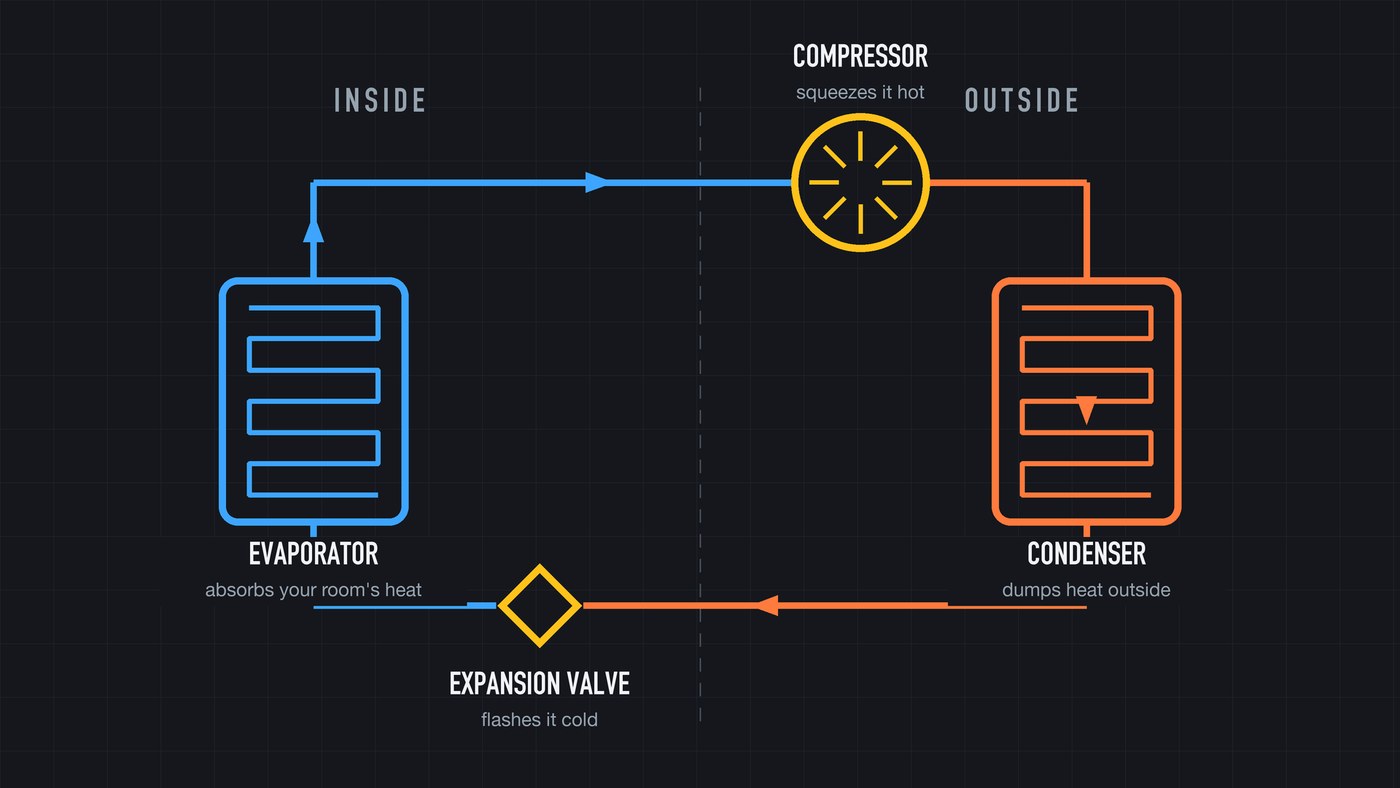
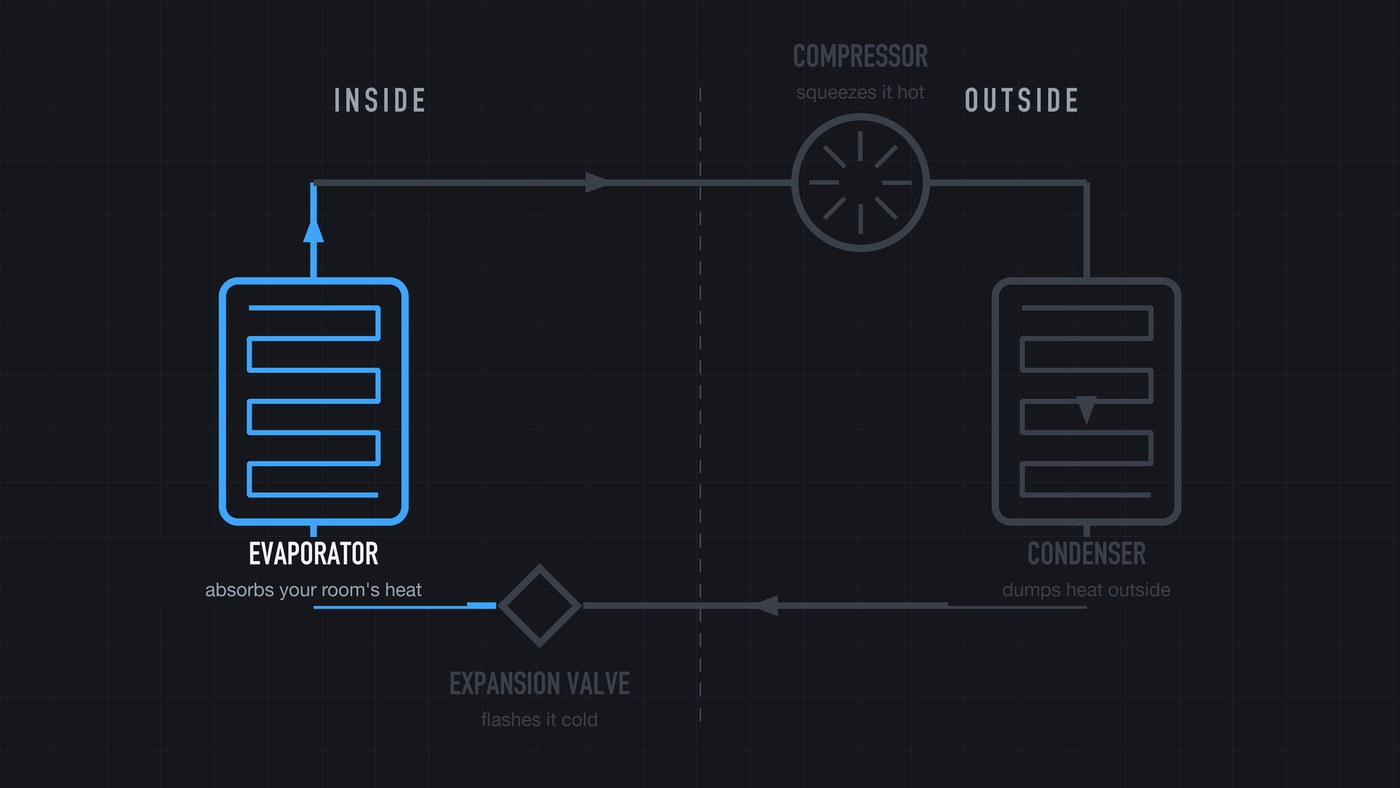
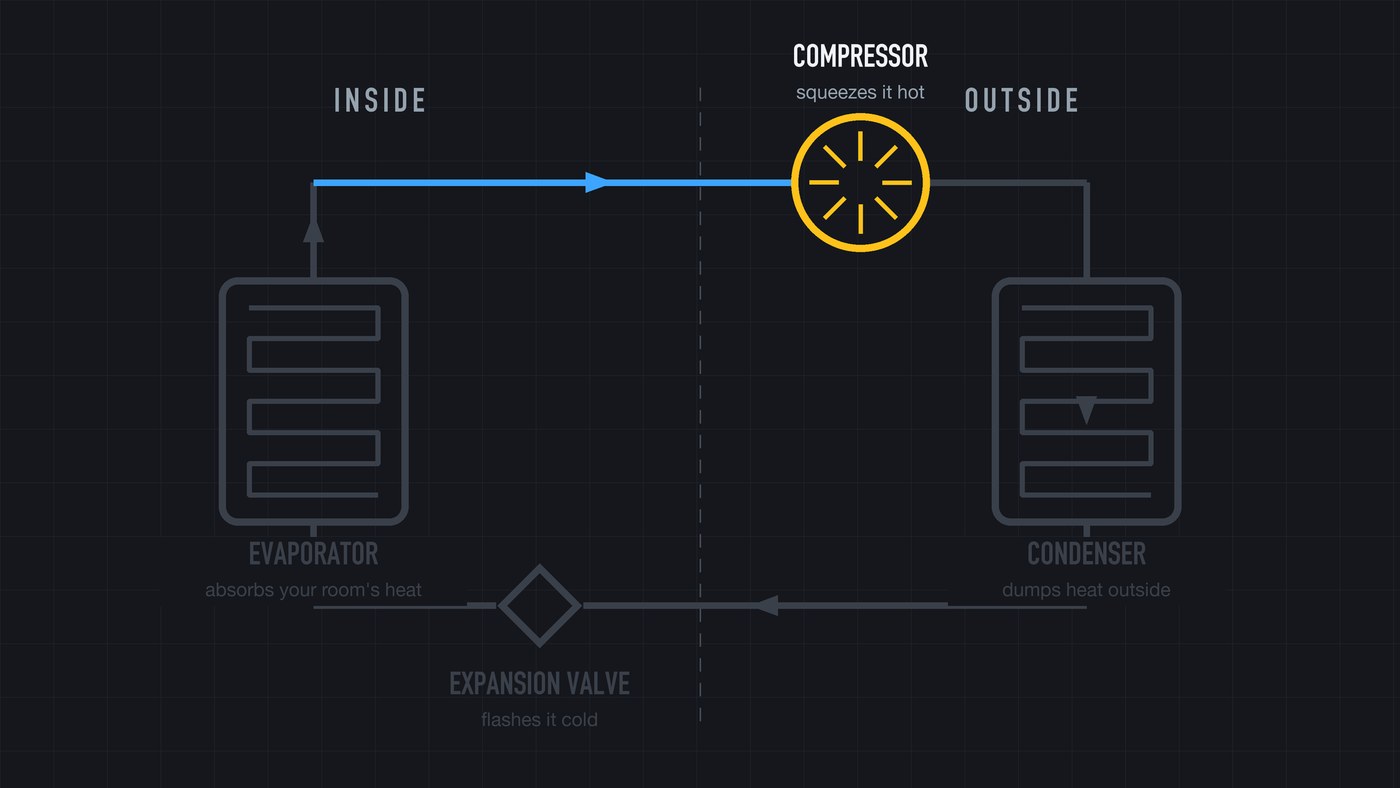
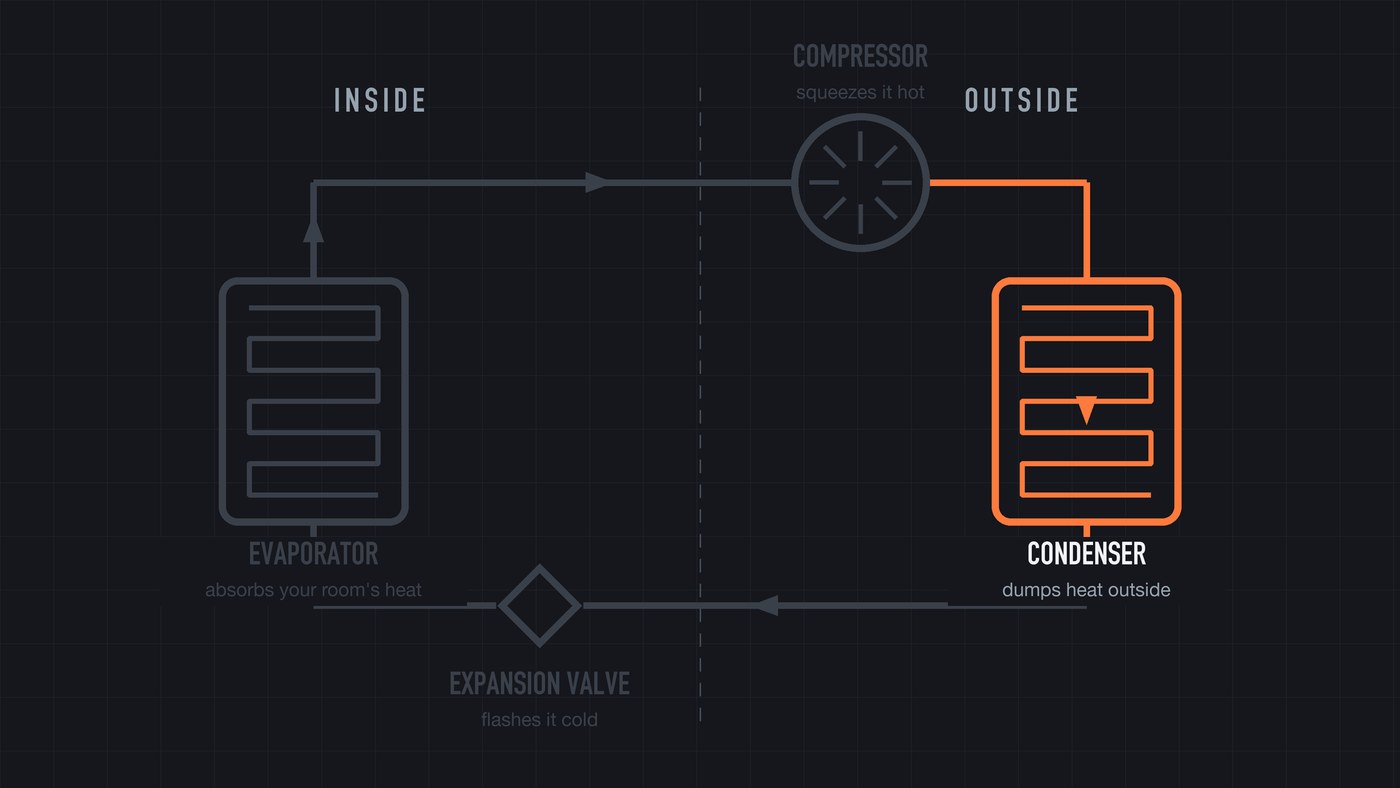
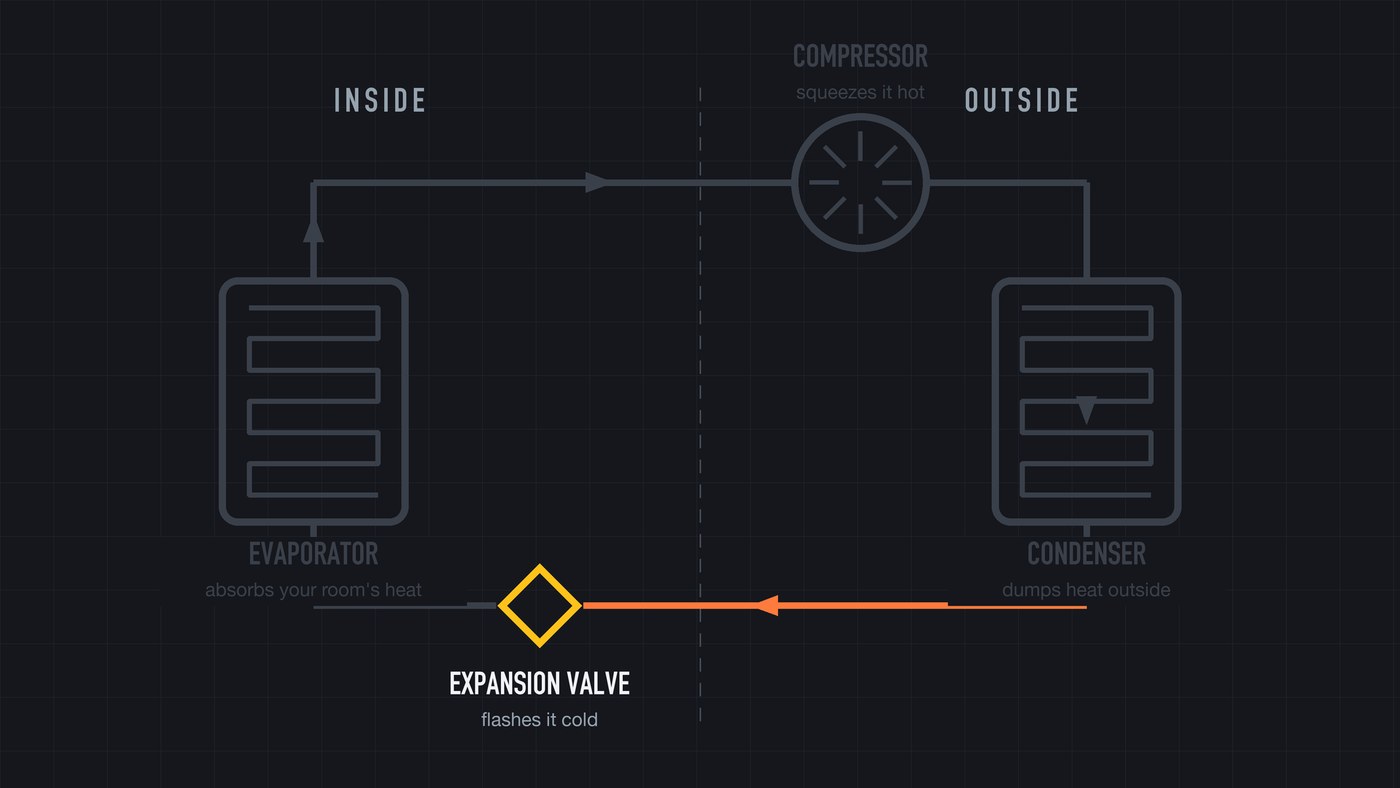
Boil inside. Squeeze it. Dump the heat outside. Flash it cold. Repeat.
05Why does an AC drip water?
A bonus your AC does for free: it dries your air. That little drip line outside? That water didn't come from the machine. It came out of your air. Think of a cold glass of iced tea sweating on a humid day, that water was invisible vapor in the room until it touched the cold glass and condensed.
Your indoor coil is that cold glass, much bigger. Humid air blows across it, the vapor condenses onto the metal, drips into a pan, and runs out a drain. So your AC is quietly a dehumidifier, and that's a big part of why a cooled room feels so much better. Not just cooler, less muggy.
06It's the same machine as your fridge
Here's the payoff. Everything above is the exact same machine as the refrigerator in your kitchen, and the heat pump some homes use. One idea, pointed in different directions.
A fridge grabs heat from the food compartment and dumps it out the back, feel the warm coils. A heat pump adds one part: a valve that runs the loop backward, so the box that cools you in July can heat you in January by harvesting heat from cold winter air. Even freezing air has heat in it, because cold is just less heat, not zero heat.
07Does setting it colder cool the house faster?
You walk into a hot house and crank the thermostat to 60 to cool it faster. It doesn't work. Your AC has no faster gear. The compressor removes heat at basically one fixed rate. Set it to 72 or 60 and the room cools at the exact same speed, the only difference is where it stops.
08The honest catch
Moving heat isn't free, and it isn't perfect. Your AC doesn't destroy heat, it relocates it, plus extra heat from the electricity it burns. So it literally makes the outside warmer, dense cities of running units are measurably hotter, part of the urban heat-island effect.
And it's weakest exactly when you need it most. On a brutally hot day the outdoor air is already hot, so there's less room to dump into, like pouring water into a full glass. Peak heat is peak inefficiency. That's not a defect, it's physics, and it's why AC hits your bill so hard: you're not powering a fan, you're powering a pump forcing heat uphill all day.
- There is no cold, only heat. Your AC doesn't make cold air.
- It captures your room's heat with a boiling liquid, squeezes it, and dumps it outside.
- That's why the outdoor unit runs hot and the drain drips water.
- It's the same machine as your fridge and heat pump, just pointed a different way.
- Setting it colder won't cool you faster. It only ever moves heat, never destroys it.
More how it actually works
Frequently asked
Does an air conditioner make cold air?
No. Cold is not a substance you can make. An air conditioner removes heat from your room's air and moves it outside, so the air left behind is cooler.
Why does the outdoor AC unit blow hot air?
That hot air is your room's heat being dumped outside. The outdoor coil releases the heat the refrigerant collected indoors, which is why it feels like a hair dryer.
Does setting the thermostat lower cool the house faster?
No. The compressor removes heat at one fixed rate, so the room cools at the same speed regardless of the setting. A lower setting only makes it run longer and cost more.
Why does my air conditioner drip water outside?
The cold indoor coil condenses water vapor out of your humid room air, like a cold glass sweating. That water drips into a pan and out a drain, so the AC also works as a dehumidifier.