 WHAMBOX
01How does a dead card power up the instant you tap?
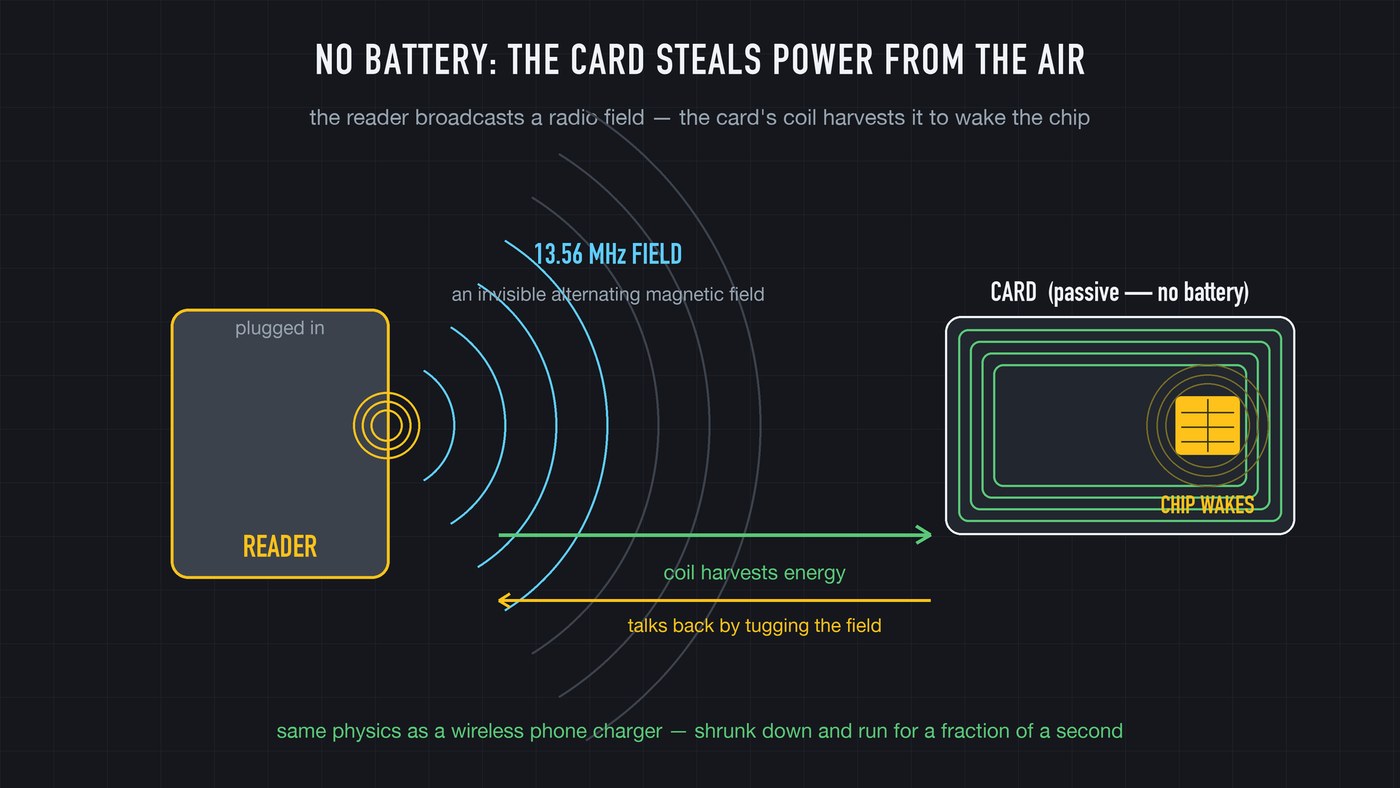
Inside your card is a chip, the same gold square you push into a reader when you dip it. But tap-to-pay never touches it. Running around the inside edge of the card, hidden in the plastic, is a thin loop of wire. Several turns of it, circling the whole card. That loop is an antenna, and it is the key to everything.
The card is passive. It has no power of its own and no way to make a signal. The terminal is the active one: it is plugged into the wall and does all the heavy lifting. The card just waits, dead, until it is brought close enough to borrow what it needs.
Engineers call this passive NFC, near-field communication. The reader powers the card, the card wakes up for the second or two it is in range, and then it goes right back to sleep.
02Where does the power actually come from?
The terminal broadcasts a magnetic field. Its own coil runs an alternating current that flips back and forth about 13.56 million times a second, a frequency set aside worldwide for exactly this. That flipping current creates a rapidly changing magnetic field right at the surface of the terminal.
Bring your card's coil into that field and physics takes over: a changing magnetic field passing through a loop of wire pushes a current through the wire. It is the same law that runs every power plant on Earth. The antenna harvests that current, feeds the chip, and the chip flickers to life.
It is the exact same idea as a wireless phone charger or the transformer on a power pole, shrunk down and running fast. The terminal is wireless-charging your card for a fraction of a second, just long enough to have a conversation.
The card is stealing energy straight out of the air to boot itself up.
03How does the card talk back with no transmitter?
First, the reader checks whether more than one card is in the field: a transit card, a second credit card, a hotel key. If it senses a crowd it runs an anti-collision step, a quick roll call, and locks onto exactly one card. That is why tapping a fat wallet sometimes just fails instead of charging the wrong card. The reader refuses to guess.
Then the clever part. The card has no transmitter and no power to broadcast anything. So it answers by changing how much energy it pulls from the field, loading and unloading the reader's coil, on, off, on, off. The reader feels those tiny tugs as ones and zeros.
The card is speaking by flickering the terminal's own power draw. The whole exchange, wake up, identify, authorize, is thousands of bits flying back and forth in well under a second.
04Why is tapping safer than swiping?
The old magnetic stripe hands over your real card number, and it never changes. Same digits, every swipe, forever. Copy the stripe once and you can clone the card. That is exactly how stripe fraud worked for decades.
Tap is built differently. When the chip wakes up, it runs a calculation and generates a one-time cryptogram, a signed code unique to that single transaction, stamped with a counter and the exact amount. Your bank checks the math and the payment goes through.
That cryptogram is useless the second it is used. If a thief captured everything flying through the air, they would have a code for a coffee you already paid for. They cannot replay it, cannot bump the amount, cannot reuse it tomorrow. The chip signs a fresh one every single time.
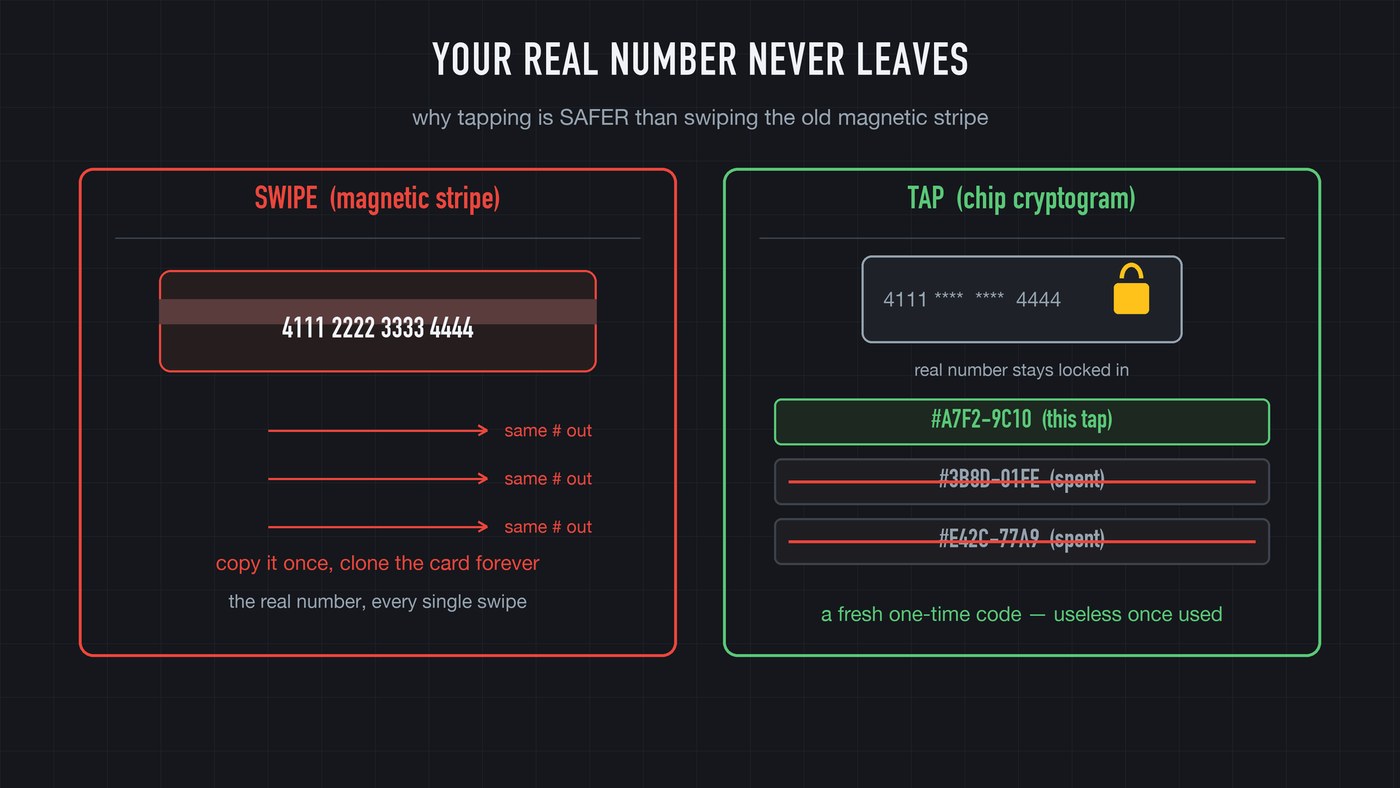
Every tap is a fresh code that dies on use.
05Why does tap-to-pay only work a few centimeters away?
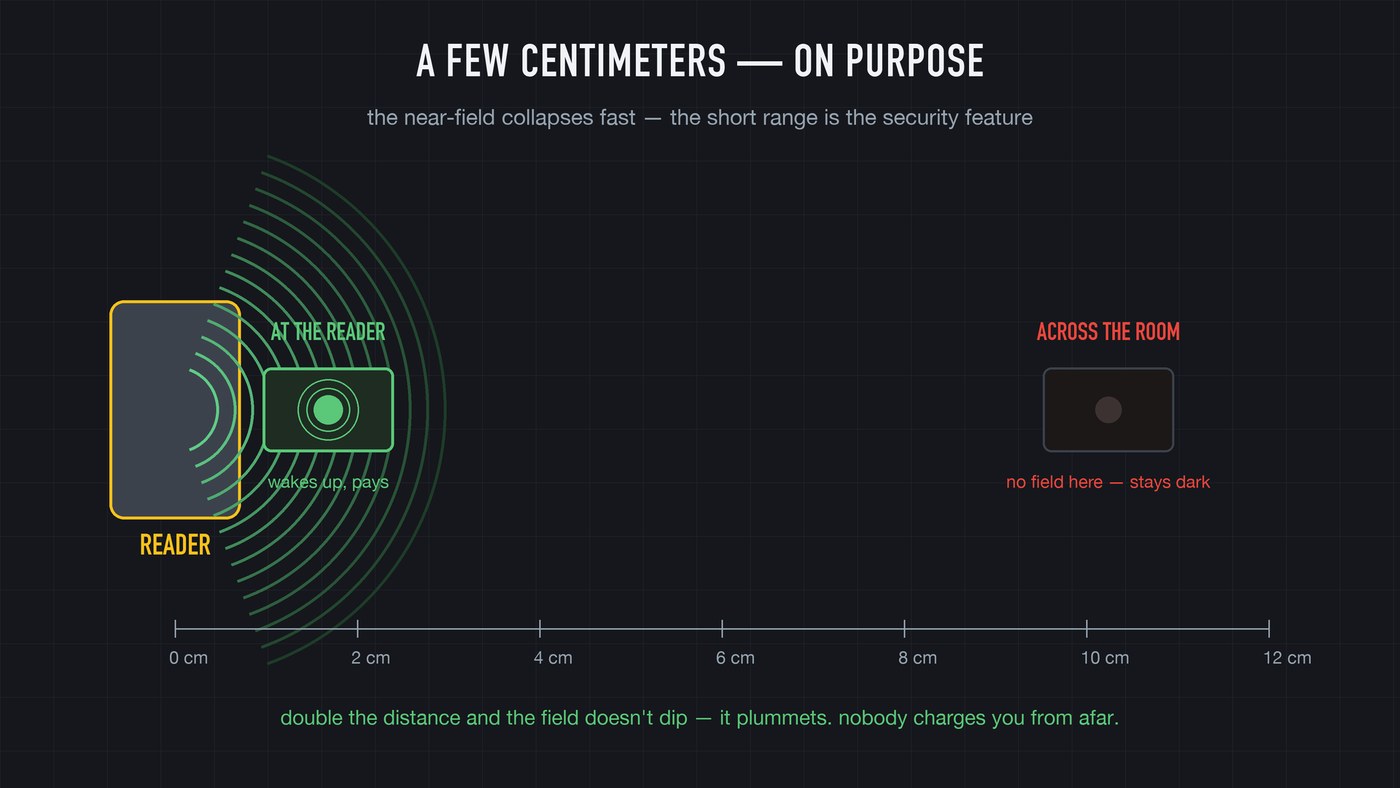
People assume the short range is a limitation the engineers could not solve. It is the opposite. The range is short on purpose, and it is a security feature.
This is not a radio broadcast radiating across a room. It is near-field magnetic coupling, and the field strength collapses steeply as you pull away. Double the distance and the field does not drop a little, it plummets. A few centimeters out, there is essentially nothing left to power a card or carry a signal.
A payment can only happen when you deliberately hold your card against the reader. Nobody can charge you from across the room, because there is no field over there to wake your card up in the first place.
06Why is your phone an even better card?
Your phone taps the same way, same 13.56 MHz, same magnetic handshake, except the phone is powered, so it can talk louder and do more. The real upgrade is what is stored inside.
When you add a card to a phone wallet, your actual card number never gets copied onto the phone. The card networks issue a device-specific token, a different string of digits that only works from that one phone. It lives inside a hardened chip called the secure element, walled off from apps and even from the operating system.
When you pay, the phone makes you prove it is you first, with a face, a fingerprint, or a passcode, then the secure element signs the same kind of one-time cryptogram a chip card does. If a merchant gets breached, what leaks is a token tied to your phone, not your real number. Your true number never left your bank.
07Can someone skim your card in a crowd?
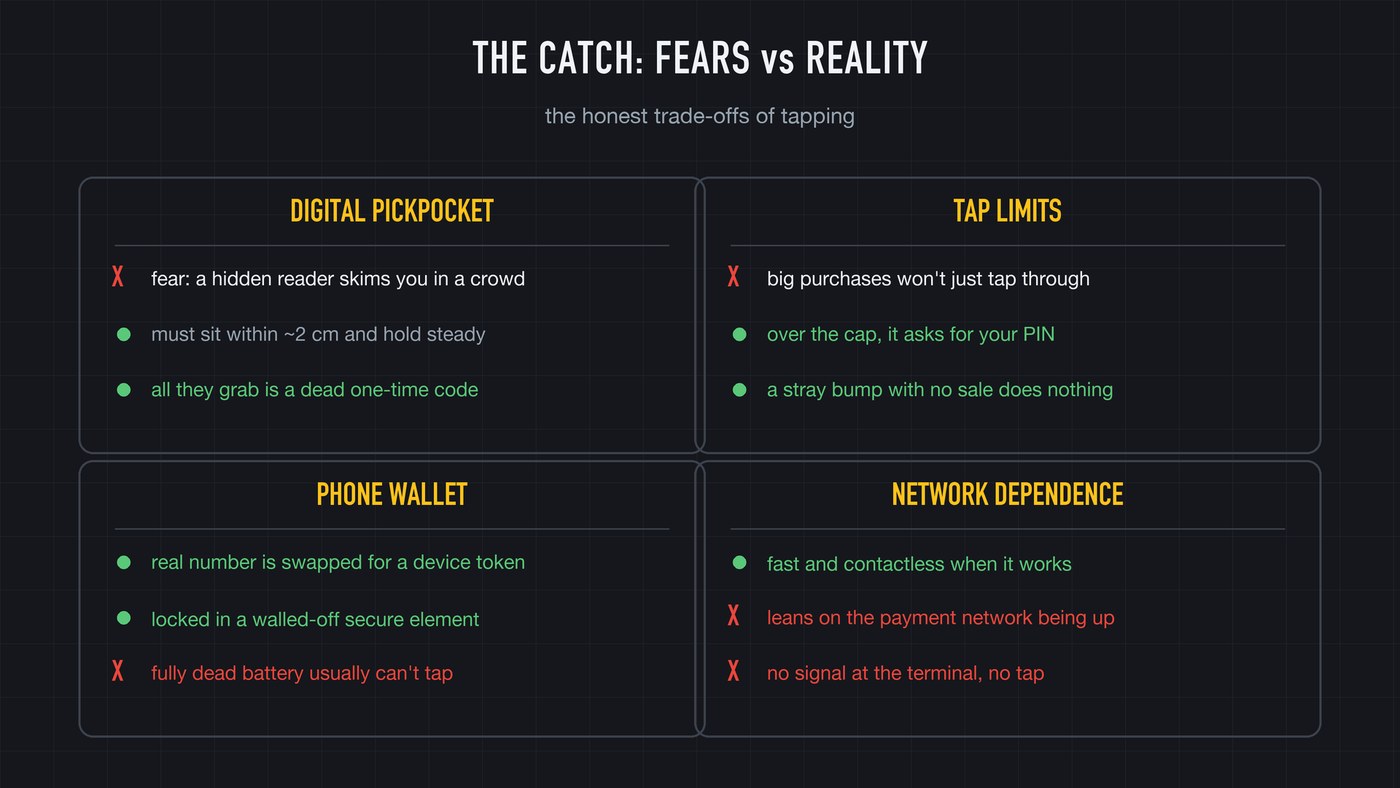
The digital pickpocket, someone brushing past with a hidden reader: physically possible, practically almost pointless. They would need to hold a reader within a couple of centimeters, steady, and all they would walk away with is a one-time code they cannot reuse. Documented real-world losses from walk-by skimming are vanishingly small. The blocking wallets are mostly selling peace of mind, not protection.
Getting charged twice by an accidental bump also does not happen. No money moves until a cashier or machine rings up a specific amount and the terminal starts a transaction for that sale. A stray tap with no sale waiting does nothing.
There are real limits, though. Many places cap how much you can tap without a PIN. A phone with a fully dead battery usually cannot tap, though some keep a small reserve alive for transit and cards for a few hours. And all of it leans on the payment network being up: no signal at the terminal, no tap.
08Myth vs mechanism
Myth one: tapping is risky because it is wireless and invisible. Backwards. Tap replaced a stripe that coughed up the same copyable number every swipe. Every tap is a fresh one-time code that dies on use. Wireless made it safer, not less safe.
Myth two: the card must run on some hidden battery. It does not. It is a chip and a coil of wire, dead until a terminal's magnetic field reaches out and powers it for a single second. It borrows the energy, does the math, hands back a code good for exactly one purchase, and goes dark.
A loop of wire that catches power out of the air and answers with a secret that's already worthless.
- Your card has no battery. A hidden coil harvests power from the terminal's 13.56 MHz magnetic field, like a tiny wireless charger.
- The card answers with no transmitter by flickering how much energy it pulls from the field.
- Every tap mints a one-time cryptogram that is useless after a single use, which is why tap beats swipe on safety.
- The few-centimeter range is a security feature: the near field collapses steeply with distance.
- Phone wallets go further with a device-specific token locked in a secure element, so your real number never leaves the bank.
More how it actually works
Frequently asked
How does a credit card work without a battery?
A thin coil of wire hidden around the card's edge harvests energy from the payment terminal's 13.56 MHz magnetic field, the same physics as a wireless phone charger. That borrowed power wakes the chip for the second or two the card is in range.
Can someone steal my card info by walking past me?
It is physically possible but practically almost pointless. A skimmer would need to hold a reader within a couple of centimeters, and what they would capture is a one-time code that is useless after a single transaction. Documented losses from walk-by skimming are vanishingly small.
Is tap-to-pay safer than swiping?
Yes. A magnetic stripe repeats your real, unchanging card number on every swipe, so one copy clones the card. A tap sends a one-time cryptogram stamped with the amount and a counter, and it cannot be replayed, altered, or reused.
Why does tap-to-pay only work when the card is right at the terminal?
The short range is deliberate. Tap uses near-field magnetic coupling, and that field collapses steeply with distance, so a few centimeters away there is nothing left to power a card. Nobody can start a payment from across a room.