 WHAMBOX
01Is wifi just invisible light?
Right now your house is glowing. Invisible light is pouring out of the router in the corner, filling every room, passing through your walls and through you. You cannot see it because your eyes are tuned to catch only a narrow slice of energy. But if they could, your router would glow like a lamp.
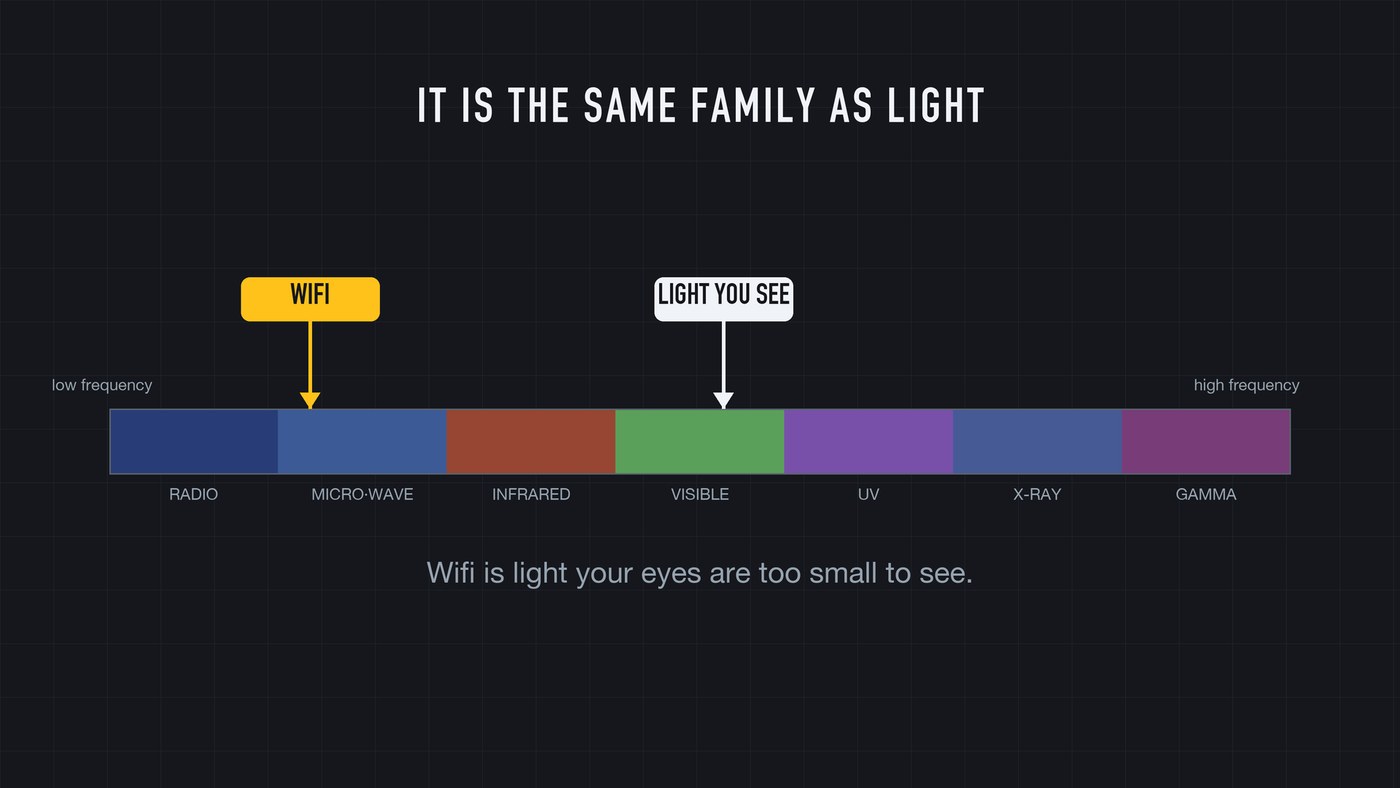
That glow is your wifi. Visible light and wifi are the same phenomenon, electromagnetic waves, living on the same spectrum. What separates them is frequency and wavelength. Wifi sits far below visible light, at a much lower frequency with much longer waves. Same family of energy, different size.
So the first step to understanding wifi is to stop thinking of it as a special digital signal and start thinking of it as a kind of light you cannot see. Everything else follows from that.
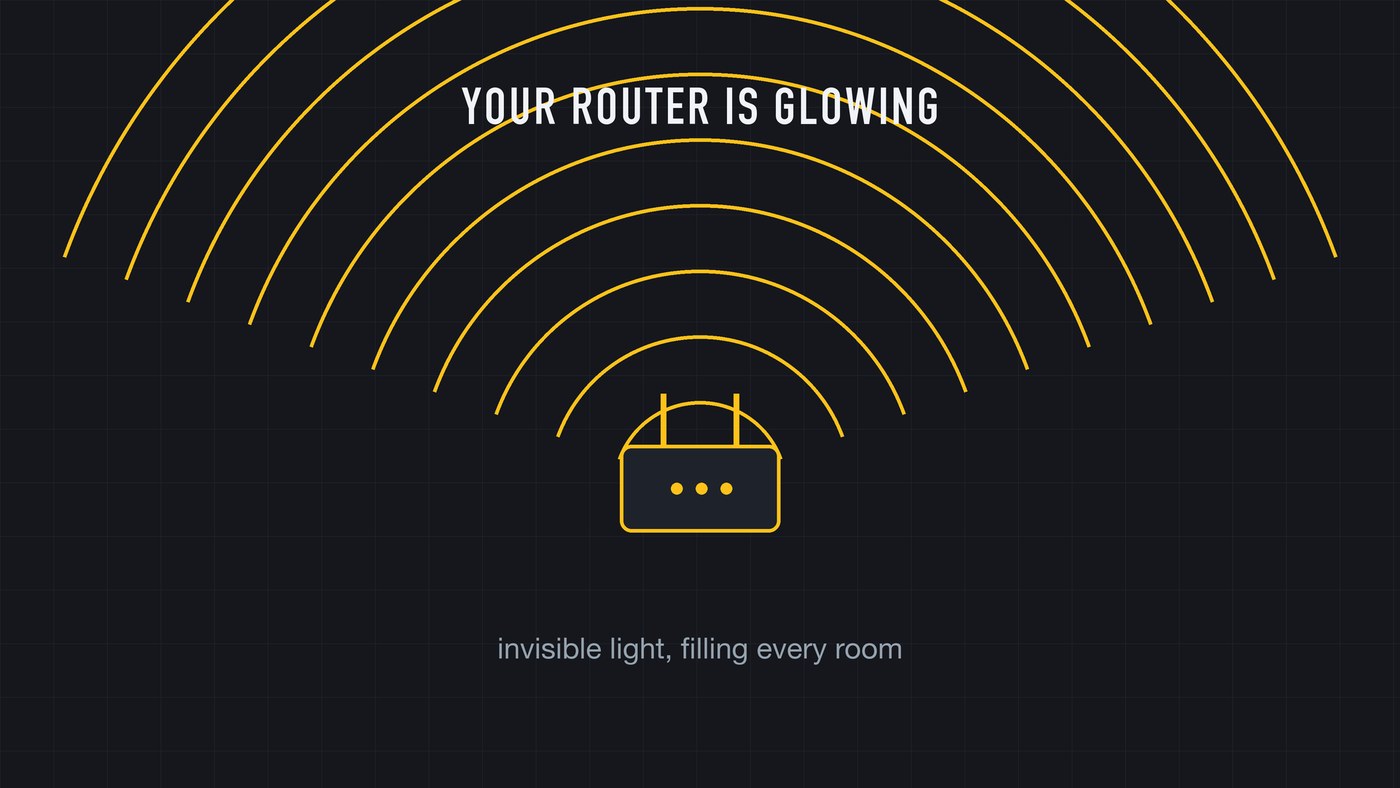
Your router would glow like a lamp.
02How does a wave carry a photo or a video call?
If wifi is just a wave, how does it carry a song, a photo, or a call? Start with the wave itself. Your router broadcasts at specific frequencies, most commonly around 2.4 gigahertz and 5 gigahertz. Gigahertz just means billions of cycles per second, so a 2.4 GHz wave is wiggling roughly 2.4 billion times every second.
That steady wave on its own carries no information. It is a blank carrier, like a hum holding a single note. To send data, your router rapidly changes the wave: it nudges the height, shifts the timing, tweaks the shape, millions of times a second. Every one of those tiny changes is a piece of information. This is called modulation, and it is the heart of the whole thing.
Your device is listening for exactly those changes. It reads the pattern, decodes it back into ones and zeros, and rebuilds your video pixel by pixel. And it runs both ways. Your device talks back the same way, sending its own modulated waves to the router thousands of times while you read a single sentence.
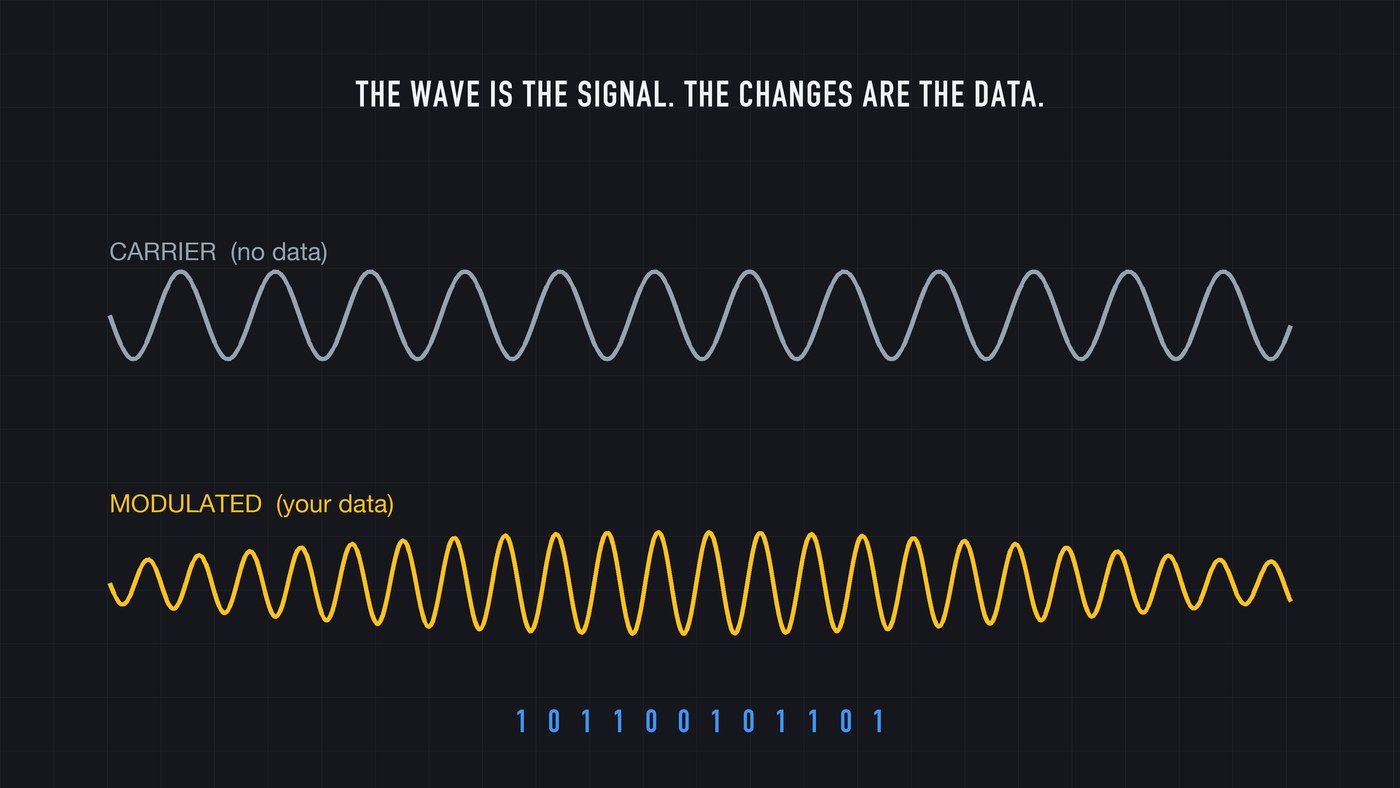
The wave is the signal. The data is the pattern of changes you stamp onto it.
03What's the difference between 2.4 GHz and 5 GHz?
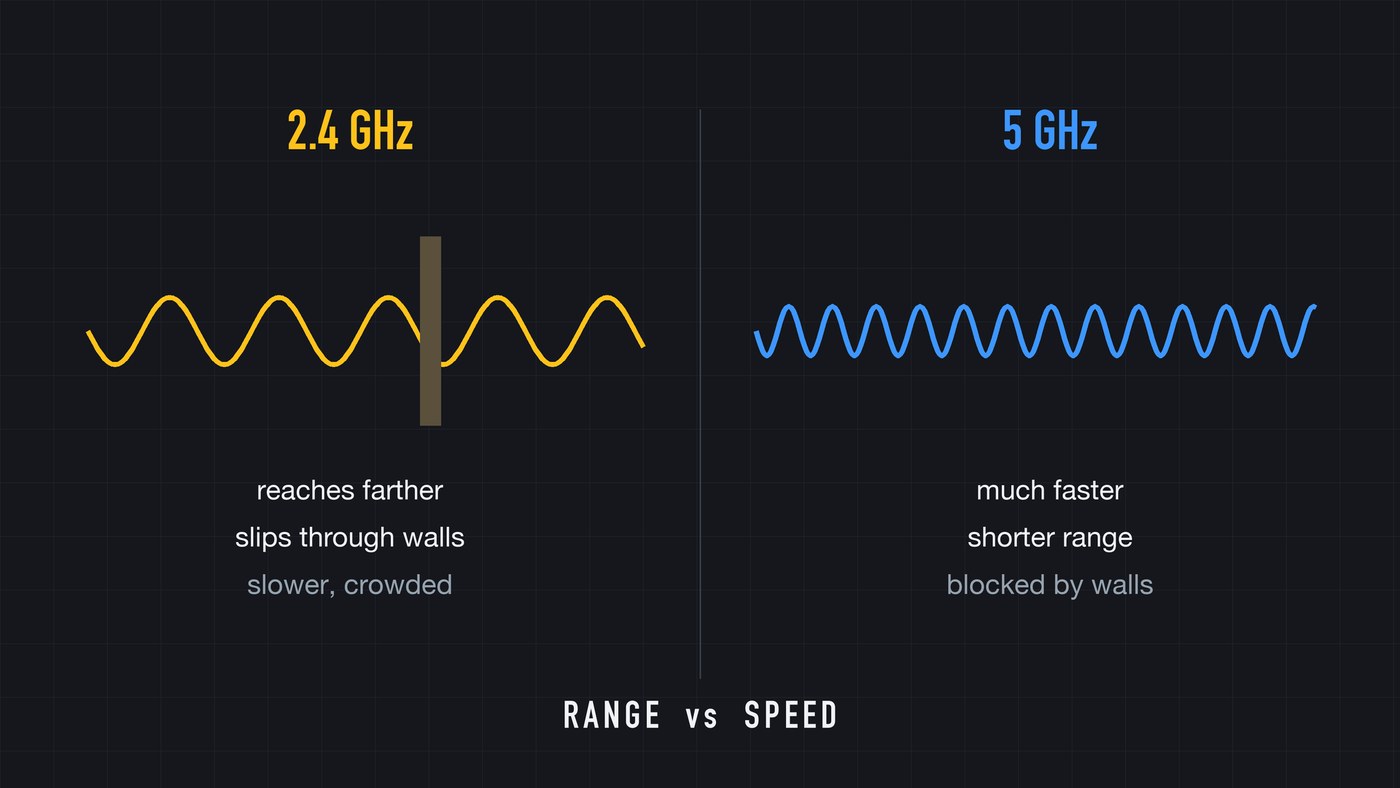
Routers use two frequencies because each is good at a different thing, and the tradeoff is baked into the physics. Lower-frequency waves, the 2.4 GHz band, are longer and looser. They travel farther and slip through walls and floors more easily. The catch is they generally carry data more slowly, and the band is crowded because so many devices share it.
Higher-frequency waves, the 5 GHz band, are shorter and tighter. They can carry a lot more data, so they feel faster. But they fade over shorter distances and get blocked by walls more easily. Great in the same room as the router, weaker two floors away.
That is the core tradeoff of home wifi: range versus speed. It is also why modern routers offer both bands and often hand your device to whichever one works best where you happen to be standing.
04Why does the microwave slow down your wifi?
This one is not a coincidence, it is a frequency collision. A microwave oven heats food using electromagnetic waves at about 2.45 gigahertz. Look at that number again. It sits right on top of the 2.4 GHz wifi band.
A microwave is shielded to keep most of that energy inside, but a small amount leaks, and even a little noise at that frequency can drown out the far weaker wifi signal trying to cross your kitchen. Your router is whispering at 2.4 GHz. Your microwave, for a few seconds, is effectively shouting near the same pitch.
So your 2.4 GHz devices can struggle to hear over the racket. Your 5 GHz connection, sitting at a totally different frequency, usually shrugs it off.
05Does more bars mean faster internet?
No. This is the myth worth tattooing on the inside of your eyelids. The bars measure the signal strength between your device and your router. That is all they measure. Full bars mean your phone and your router are hearing each other loud and clear across the room. They say nothing about how fast the internet behind that router actually is.
You can have five perfect bars and a painfully slow connection, because your internet plan is slow, or the wider network is congested, or the far end is overloaded. And you can have two bars and stream just fine. A strong signal to your router is necessary, but it is not the same thing as a fast connection.
Bars are about the last few feet, not the whole journey.
06Is wifi the same as the internet?
No, and this is the single most important idea here. Wifi is not the internet. Wifi is only the last hop. Think about the full path your data takes.
Your phone talks to your router over wifi, that invisible light, across your house. But your router is usually plugged into a cable. That cable connects to wires and fiber-optic lines running under your street, across your city, between cities, and along cables on the ocean floor to servers around the world. That vast physical network is the internet. Wifi is just the wireless bridge for the final stretch inside your walls.
When people say the internet is wireless, they have it backwards. The internet is overwhelmingly wires and fiber and glass. Wifi is the short, convenient hop at the very end so you do not have to plug your phone into the wall.
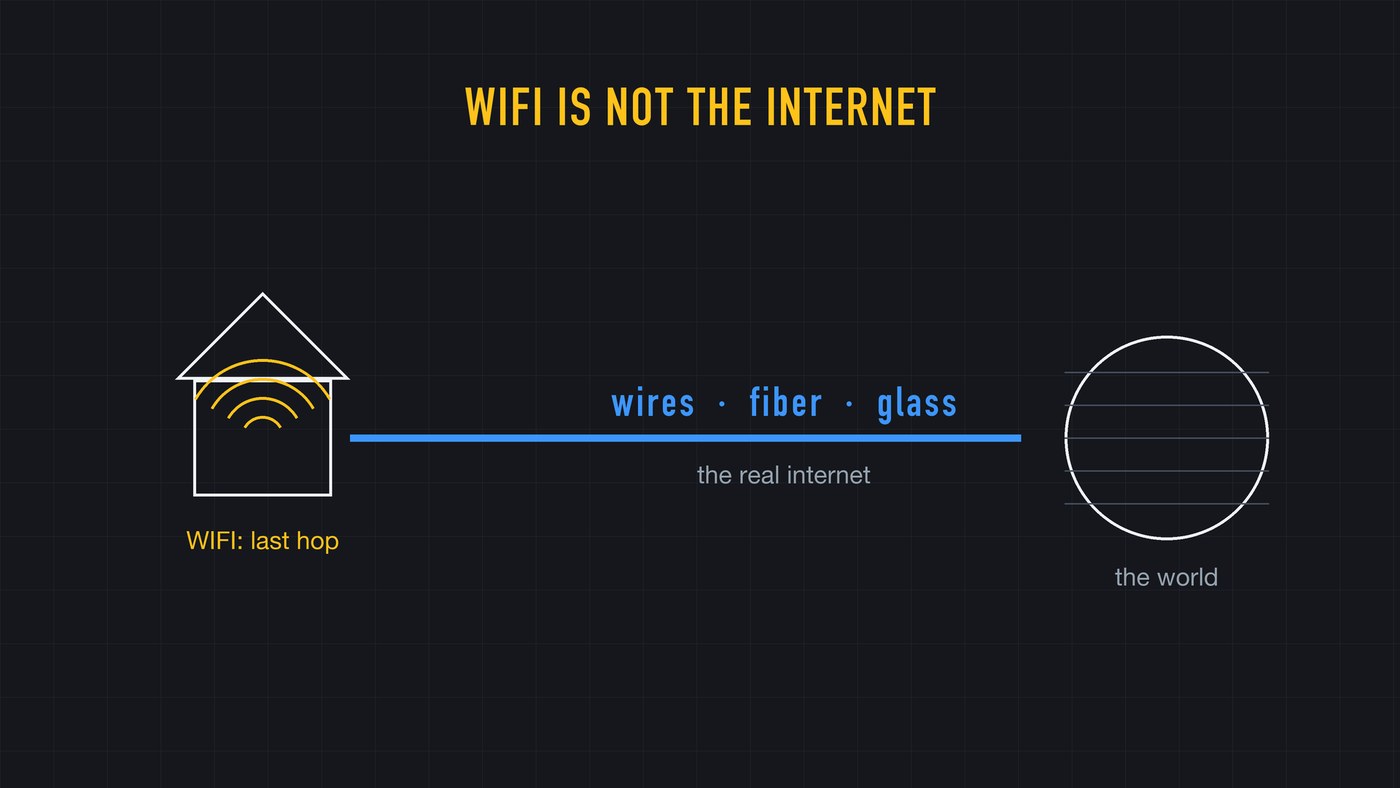
The internet is overwhelmingly wires and fiber and glass. Wifi is the last hop.
07Why does wifi drop when a room fills up?
If wifi is this elegant, why does it still choke in a crowd? Three reasons nobody mentions. First, your own body. Water soaks up wifi, and you are mostly water, so human bodies absorb the signal. A crowded room can measurably weaken a connection that was perfectly fine when it was empty. The people are the interference.
Second, congestion. Wifi devices share a limited set of channels and have to take turns. Cram enough phones, laptops, TVs, and smart gadgets onto one network and they start waiting in line for airtime. Everyone slows down, even with a strong signal.
Third, your neighbors. Their networks broadcast on the same handful of frequencies as yours. In an apartment building, dozens of routers can be shouting over each other in the same slice of spectrum, and your signal has to compete with all of them.
- Wifi is invisible light, a radio wave on the same spectrum as the light you see, just lower and longer.
- Your router hums out a carrier wave and stamps data onto it by changing it millions of times a second.
- 2.4 GHz reaches farther, 5 GHz runs faster, and a microwave jams the 2.4 band because it lives at nearly the same pitch.
- Your bars only measure the reach to your router, not the speed of the world beyond it.
- The actual internet is wires and fiber. Wifi is just the last invisible hop across your living room.
More how it actually works
Frequently asked
Is wifi the same as the internet?
No. Wifi is only the wireless link between your device and your router, the last few feet of the path. The internet is the much larger network of wires, fiber, and undersea cables behind the router that carries data around the world.
Does more bars mean faster internet?
No. Bars only measure signal strength between your device and your router. You can have full bars and a slow connection if your internet plan or the wider network is the bottleneck.
Why does my microwave slow down my wifi?
A microwave oven runs at about 2.45 GHz, almost exactly on top of the 2.4 GHz wifi band. Leaked energy from the oven adds noise that can drown out the weaker 2.4 GHz signal. A 5 GHz connection usually shrugs it off.
What is the difference between 2.4 GHz and 5 GHz wifi?
2.4 GHz uses longer waves that travel farther and pass through walls better but carry data more slowly. 5 GHz uses shorter waves that carry more data and feel faster but fade over shorter distances. Range versus speed.