 WHAMBOX
01There's nuclear material above your head right now
A few feet above your head there is a piece of radioactive material. It has been sitting there for years, and it is the only reason you'd wake up if your house caught fire tonight. It's smaller than a grain of sand, sealed inside your smoke detector, and it is quietly ripping the air apart, atom by atom, all day.
Pop open the most common type, called an ionization detector, and inside you'll find a small metal chamber holding a trace of a man-made element: americium-241. It's radioactive, and that is not a defect. That is the entire point. As it decays it throws off alpha particles, tiny fast-moving bullets far too small to see, and it uses them to stand guard against fire.
It is doing something genuinely strange: ripping the air apart, atom by atom, to stand guard against fire.
02How does an ionization smoke detector work?
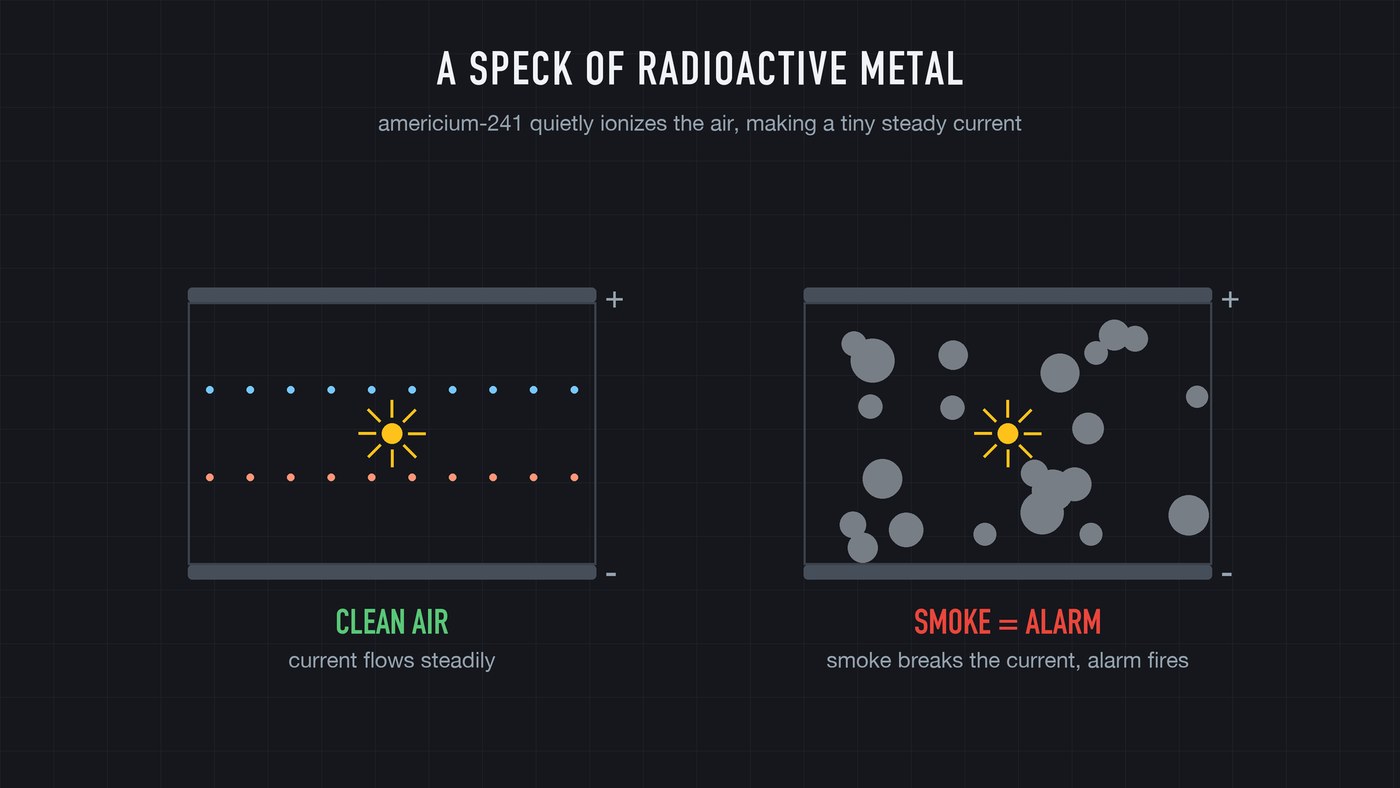
The chamber has two small metal plates, and a battery pushes a voltage across them: one positive, one negative. As the alpha particles shoot through the air, they slam into air molecules and knock electrons loose. That's called ionization, and it's where the detector gets its name.
Knock an electron off a molecule and you're left with two charged pieces: a negative electron and a positive molecule. The negative pieces drift toward the positive plate, the positive pieces drift toward the negative plate, and that drift is a tiny, steady electric current flowing across the chamber.
The detector's circuit measures that current constantly and knows exactly what normal looks like: a calm, unbroken flow. That flow is the detector saying, over and over, everything is fine.
03What does smoke actually do to set it off?
Here's the part most people get backwards. Smoke doesn't set off the alarm by being hot, or by being seen. It sets off the alarm by getting in the way.
Smoke particles are big and heavy compared to those charged bits of air. When they float into the chamber, the charged particles collide with them and cling on. Suddenly weighed down, they move slower, and fewer of them make it across to the plates. The steady current drops.
The circuit notices the flow falling off, and when it sinks below a set threshold, the detector does the one thing it exists to do. It screams. That piercing alarm is the sound of a broken electric current, interrupted by smoke you probably can't even smell yet.
04How is a photoelectric detector different?
The radioactive detector has a rival that never ionizes a single atom. It's called a photoelectric detector, and instead of charging the air, it uses a beam of light.
Picture a small chamber with an LED shining a beam straight across it, and off to the side, tucked out of the beam's path, a light sensor. In clean air the beam shoots straight across and the sensor sees nothing but darkness. All quiet.
Then smoke drifts in. The light hits the smoke particles and scatters, bouncing off in every direction, and some of that scattered light now lands on the sensor that was sitting in the dark. The moment it catches light that shouldn't be there, it triggers the alarm.
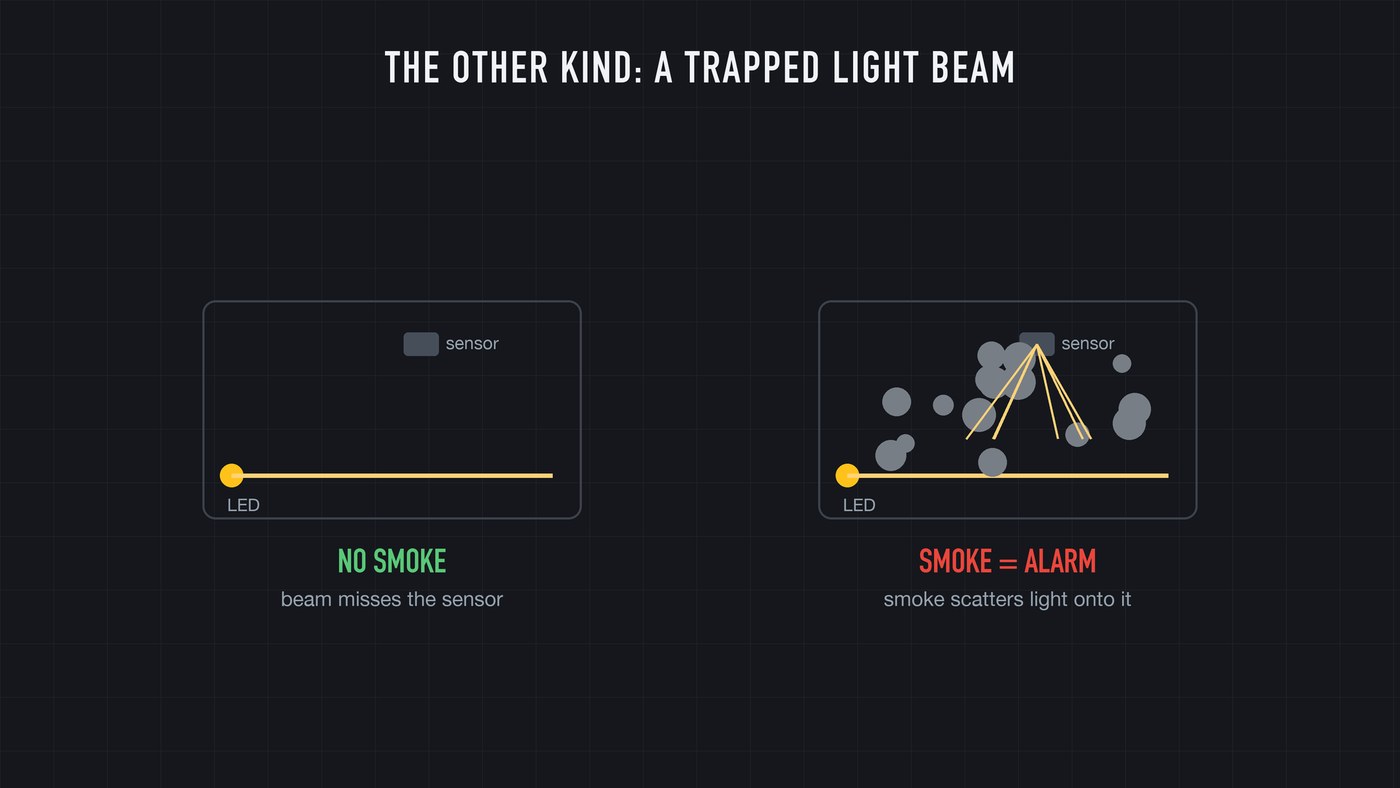
One watches an electric current for a drop. The other watches a dark corner for a flash of light.
05Ionization vs photoelectric: which is better?
If they both catch fire, why want one over the other? Because fires don't all behave the same way. Some flame up fast, like a grease fire or paper catching. They burn hot and quick and give off smaller, fewer smoke particles early on.
Others smolder, like a cigarette dropped in a couch or wiring overheating behind a wall. These creep along cool and quiet for a long time, pumping out thick, big, sooty smoke particles.
Each detector has a specialty, and test after test the pattern holds. Ionization wins the race on fast flaming fires. Photoelectric wins on slow smoldering ones. Which sets up an obvious problem: your house doesn't get to pick which kind of fire it has.
06Is the radiation in a smoke detector dangerous?
This is the big fear, and the myth worth busting. In normal use, no, and the reason is genuinely reassuring. Those alpha particles are powerful, but they have almost no range and almost no ability to penetrate.
Alpha particles are stopped by a few centimeters of air. They're stopped by a sheet of paper, by the plastic housing of the detector, and by the outer layer of your own skin. So they can't even escape the device. The source is sealed inside, and the particles die within centimeters.
The americium also gives off a faint gamma ray that can slip through the housing, but the dose reaching you is a few millionths of a sievert per year, far below the natural background radiation you're already bathed in every day from the ground and the sky. Living in the same house as your smoke detector is, by any reasonable measure, harmless.
Left sealed in its housing on your ceiling, it's one of the safest pieces of nuclear technology you'll ever own.
07The honest catch
It's safe, but it's not perfect. First, the false alarms. The ionization detector is sensitive to small particles, and guess what else makes small particles: cooking, steam from a shower, burnt toast. That's why the detector nearest your kitchen is the one always shrieking at dinner. The photoelectric type is generally less twitchy about cooking, which is why it's often recommended near kitchens and bathrooms.
And whatever you do, don't pull the battery to stop the noise and forget to put it back. A disconnected detector is just a plastic disc on your ceiling.
Second, these things don't last forever. The sensors degrade, dust builds up, and the unit slowly gets less reliable. The guidance is to replace the whole unit about every ten years, not just the battery. Flip yours over, there's usually a manufacture date on the back. If it's older than a decade, it has done its tour. And because it's radioactive, don't just toss the old one in the trash. The amount is tiny and sealed, but many manufacturers ask you to send it back, so check your local drop-off rules.
08So what should you actually do?
Since fast fires and slow fires each favor a different sensor, the smart move is not to pick a side. It's to cover both. Use both types of detector in your home, or buy a dual-sensor alarm, a single unit with both an ionization and a photoelectric sensor built in. That way you're covered whether the fire flames up or smolders.
Test them. Replace them on schedule. And the next time the one by the kitchen goes off over your cooking, be a little less annoyed. That is a splinter of a man-made element, quietly splitting the air apart, doing exactly what it was built to do. A speck of the atomic age, sitting on your ceiling, keeping watch.
A speck of the atomic age, sitting on your ceiling, keeping watch.
- A tiny sealed speck of radioactive americium-241 gives the air inside the detector a steady electric charge.
- Smoke particles cling to the charged air, the current drops, and that drop is what triggers the alarm.
- Ionization detectors catch fast flaming fires best; photoelectric detectors catch slow smoldering ones.
- The radiation is harmless in normal use, because the source is sealed and its particles can't escape the housing.
- Cover both fire types with a dual-sensor alarm, and replace the whole unit about every ten years.
More how it actually works
Frequently asked
Is the radiation in a smoke detector dangerous?
No, not in normal use. The alpha particles from the americium-241 can't penetrate a sheet of paper or the plastic housing, and the faint gamma dose reaching you is a few millionths of a sievert per year, far below natural background radiation. It's only a hazard if the sealed source is broken open and the material is inhaled or swallowed.
How often should you replace a smoke detector?
Replace the whole unit about every ten years, not just the battery. The sensors degrade and dust builds up over time, so a decade-old detector is less reliable. Check the manufacture date printed on the back.
Which is better, an ionization or photoelectric smoke detector?
Neither is simply better. Ionization detectors react faster to fast flaming fires, while photoelectric detectors react faster to slow smoldering fires. The safest choice is to use both types or a single dual-sensor alarm.
Why does my smoke detector go off when I'm cooking?
Ionization detectors are sensitive to the small particles given off by cooking, steam, and burnt toast, which is why the alarm nearest the kitchen is the one that shrieks at dinner. Photoelectric detectors are less prone to these false alarms, so they're often recommended near kitchens and bathrooms.