 WHAMBOX
01What's actually inside a door lock?
The lock on most front doors is a pin tumbler lock, and the modern design is over 150 years old. It is still on your door tonight, and still just as beatable.
Only two parts matter. The housing is the fixed outer shell mounted in your door. The plug is the cylinder in the middle, the part with the keyhole, and it is the piece that rotates when you turn your key. Turn the plug and a tailpiece on the back throws the bolt.
So the entire job of a lock comes down to one question: what stops the plug from turning whenever it feels like it? Right now, sitting in your door, that plug is jammed. Something is physically blocking it. That something is the pins.
02What is the shear line?
Drilled down through the housing and into the plug is a row of little vertical shafts, usually five. Inside each is a stack of two pins: the key pin on the bottom, the one your key actually touches, and the driver pin on top, with a small spring pressing the whole stack down.
That spring is the whole trick. It shoves the stack low enough that it bridges two parts at once: part in the housing, part in the plug. One solid pin, crossing from the fixed shell into the rotating cylinder.
The seam it crosses, the exact circle where the plug rubs against the housing, is called the shear line. If nothing crosses that line, the plug spins freely. If anything crosses it, the plug is locked. With no key in the lock, all five stacks straddle the line. Five little bars, five reasons the plug will not turn. To open, every single stack has to break cleanly at that line. Miss one and it stays jammed.
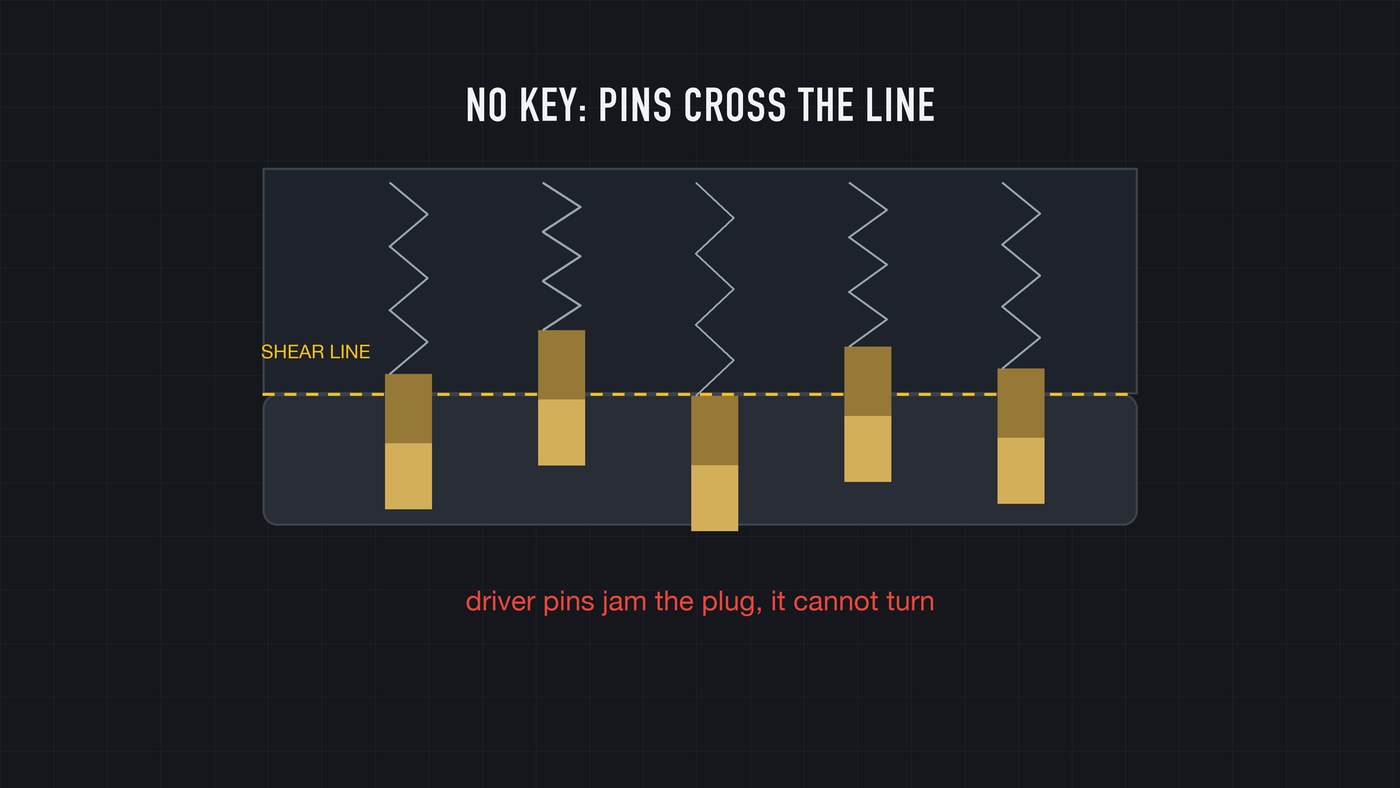
All five or nothing.
03What does the key actually do?
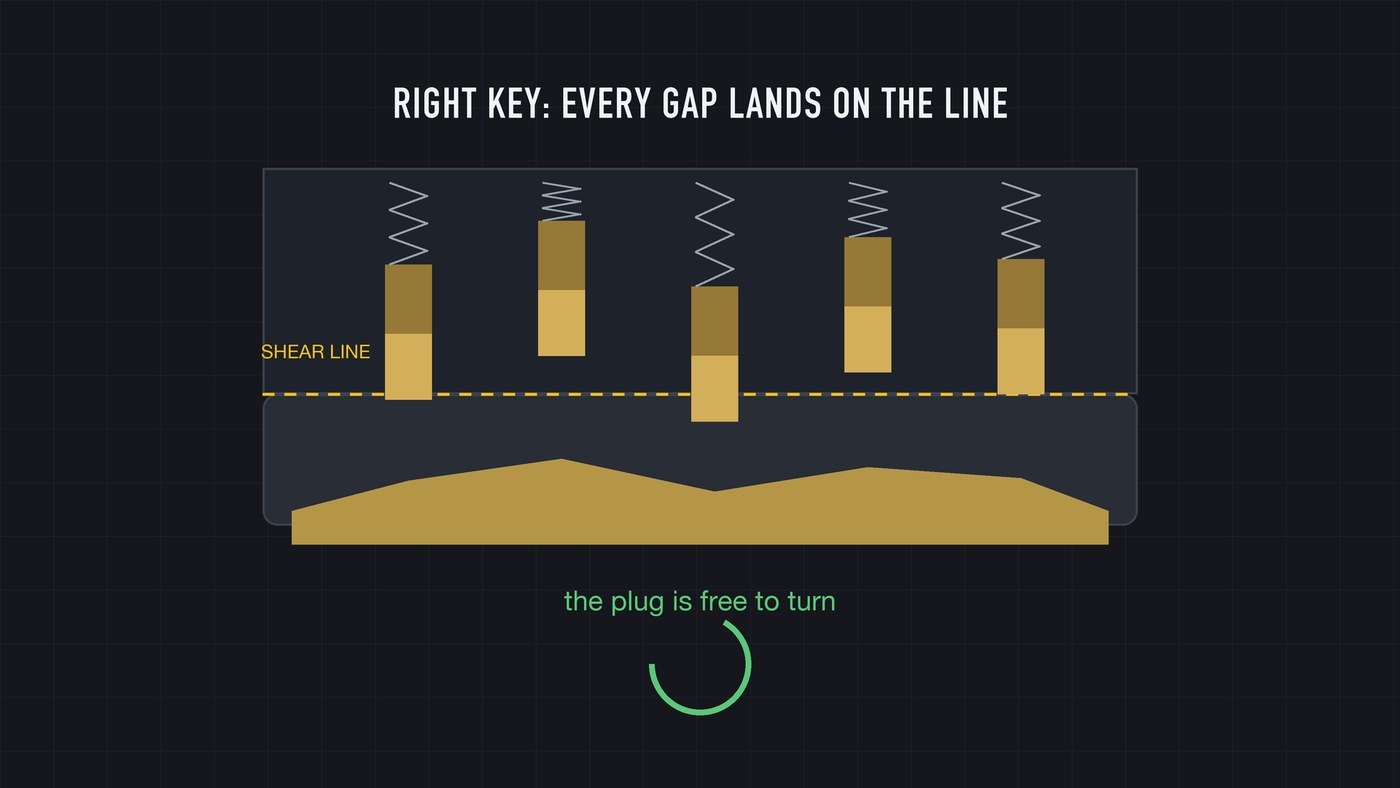
The jagged peaks and valleys along your key are a code, and each cut lines up under one pin stack. Push the key in and each cut lifts its key pin by a precise amount. A deep valley lifts a pin a little, a tall peak lifts it a lot.
The elegant part: each stack is two pins with a split between them. The correct key lifts every stack so that split lands exactly on the shear line, all at the same instant. Key pins entirely in the plug, driver pins pushed entirely into the housing, nothing crossing the seam. The plug is free, the cylinder turns, the door opens.
A wrong key lifts the stacks too high or not high enough, so at least one split misses the line. One is all it takes. That is the entire difference between your key and every other key on Earth: whether the splits land on the line.
04Why does lockpicking work?
If the key just lifts pins to the right heights, do you actually need the key? The uncomfortable answer is no. You need the heights. The key is just a convenient way to deliver them.
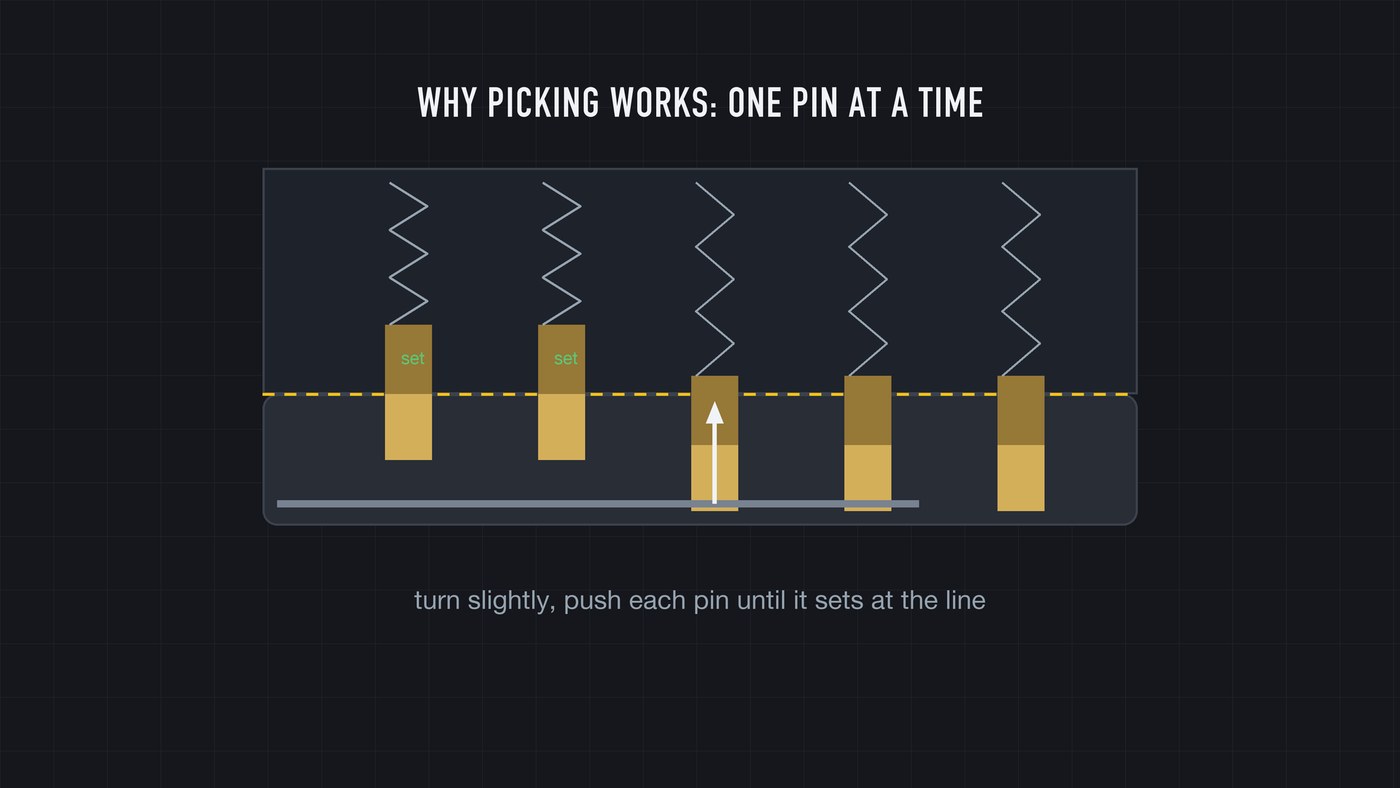
The exploit is manufacturing imperfection. The pin shafts are never drilled in a flawless line; one is always a hair off center. A picker puts a whisper of turning pressure on the plug with a tension wrench, which pinches the tightest stack against the edge of the shear line. Then a thin pick pushes that one pin up. The moment its split reaches the line, the plug rotates a microscopic amount and catches the driver pin on the ledge. That pin is set, often with a tiny click.
Then the tension shifts to the next tightest pin, and again, click by click, until every driver pin is caught above the line and the plug turns. The key solves all five at once. A picker solves them one at a time, using the lock's own tiny imperfections as a ledge to rest each solved pin on.
05How secure is a normal door lock, really?
The honest part, where most explainers go quiet: a standard pin tumbler lock is not a serious obstacle to a skilled person. Picking a basic lock takes seconds to a couple of minutes with cheap tools and practice. And bump keying is faster still: a specially cut key, tapped sharply, knocks all the driver pins past the shear line at once. A basic lock can fall to a ten dollar bump key almost instantly.
Does that make locks pointless? No. It means being honest about what a lock is for. A lock mainly keeps honest people honest, and it buys time. Most break-ins are not skilled picking jobs. They are someone trying an unlocked door, forcing a weak one, or breaking a window, and moving on fast if it looks like trouble.
Higher-security locks fight back with anti-pick driver pins, spools and serrated shapes that false-set and lie to a picker's fingertips, plus tighter machining, sidebars, and restricted keyways. Picking goes from a two minute job to a genuinely hard one. Never impossible. Just not worth it.
06What actually makes a door more secure?
Not a fancier keyhole. More friction. A solid deadbolt. A reinforced strike plate so the door cannot simply be kicked in, which is far more common than picking. Good lighting. And for the truly motivated, a higher-security cylinder with anti-pick pins.
You are not buying an unbreakable barrier, because nobody sells one. You are buying time and hassle, and against almost everyone who will ever touch your door, time and hassle are enough.
That little row of spring-loaded pins is a beautifully simple machine. Just know what it is, and what it is not.
You are buying time and hassle, and time and hassle are enough.
- A pin tumbler lock is a rotating plug jammed by five spring-loaded pin stacks crossing the shear line.
- Your key's cuts lift every stack so the split between its pins lands exactly on that line, all at once.
- Picking solves the same puzzle one pin at a time, using tiny manufacturing imperfections as ledges.
- A bump key knocks every driver pin past the line in one tap, which is why basic locks fall in seconds.
- A lock buys time and deters casual intruders. Deadbolts, strike plates, and lighting matter more than fancier keyholes.
More how it actually works
Frequently asked
How does a key open a lock?
Each cut on the key lifts one spring-loaded pin stack a precise amount, so the split between its two pins lands exactly on the shear line, the seam between the rotating plug and the fixed housing. When all five splits line up at once, nothing crosses the seam and the plug can turn.
Can any lock be picked?
Essentially yes, given time and skill, because every lock has manufacturing imperfections a picker can exploit. High-security locks with anti-pick pins, sidebars, and restricted keyways make picking slow and difficult enough that it stops being worth it.
What is a bump key?
A key cut to the deepest position on every pin, tapped sharply while turning. The impact knocks all the driver pins up past the shear line at the same instant, letting the plug turn. Basic pin tumbler locks can open to one almost instantly.
What is the best way to make my front door more secure?
Add friction rather than a fancier keyhole: a solid deadbolt, a reinforced strike plate so the door cannot be kicked in, good lighting, and if warranted a high-security cylinder with anti-pick pins. Most break-ins use force or an unlocked door, not picking.