 WHAMBOX
01Why can't the motor lift the door?
Look at the unit hanging from your ceiling. Most home openers are rated around half a horsepower, some far less. That is genuinely feeble. It is nowhere near enough to yank a heavy panel door straight up against gravity, over and over, for twenty years. If it had to hoist the full weight, it would stall, cook itself, and quit.
So how does it get away with it? Because it was never asked to lift the door. Its actual job is tiny: nudge a door that is already almost weightless, and guide it along a track.
The heavy lifting is handled before the motor ever switches on, by a completely separate system that stores up energy and hands it back exactly when the door needs it. That system is the real machine here. The motor is just the finger on the trigger.
02What actually lifts the door?
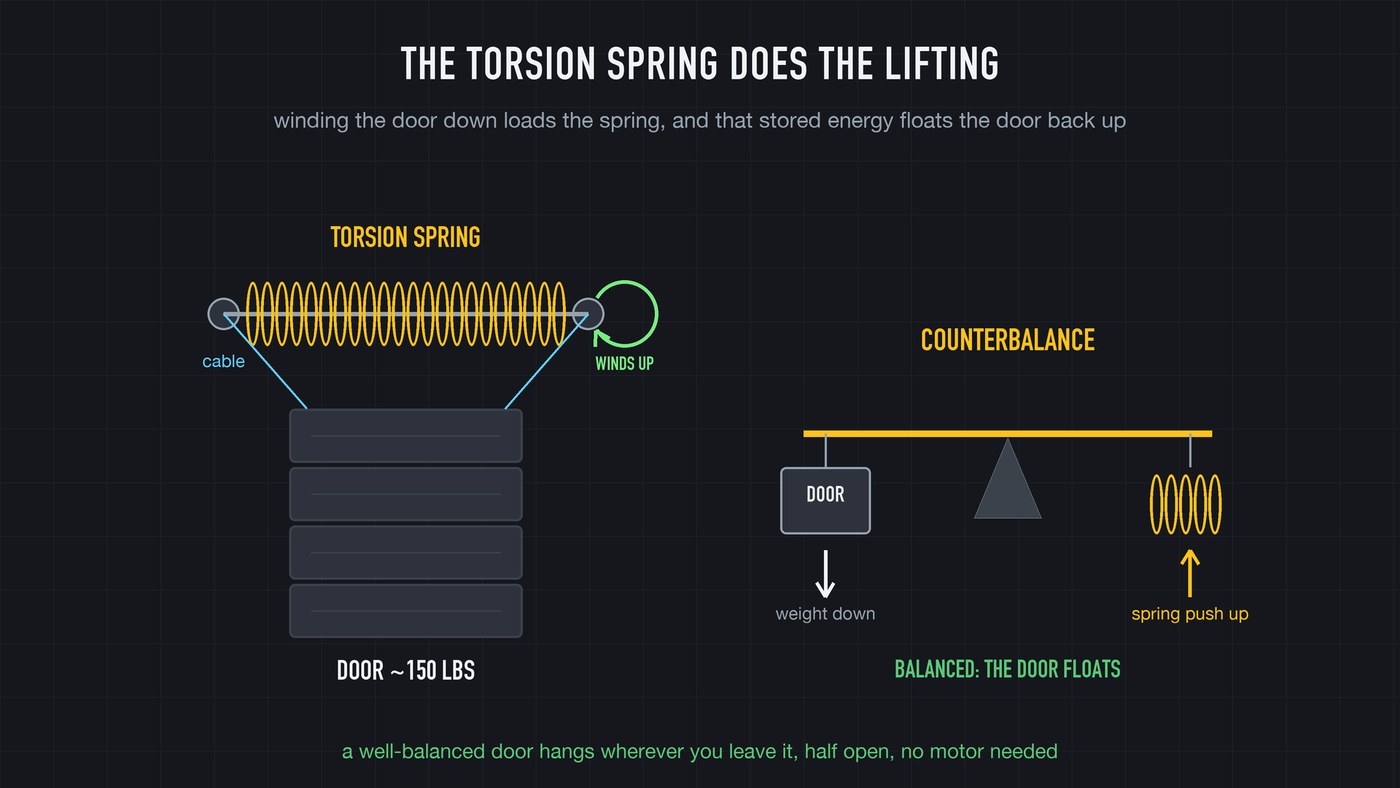
Above almost every sectional garage door there's a metal shaft, and wound tightly around it, one or two thick steel springs. That's the torsion spring. It is under enormous tension, and it is the single most important part in the entire system.
Here's the trick. When the door is all the way down, that spring is wound as tight as it gets, loaded with stored energy like a drawn bow or a wound-up clock. When the door goes up, the spring unwinds and releases that energy.
And the timing is not an accident. The door is heaviest to lift right at the bottom, when all of it is hanging straight down. That is exactly the moment the spring is wound tightest and pushing back hardest. As the door rises and gets easier, the spring gives up energy and eases off too. The spring's strength almost perfectly cancels the door's weight at every point in the travel.
03Why does a garage door float?
This is why a properly adjusted garage door feels almost weightless. Disconnect the opener, grab the door by hand, and a well-balanced 150-pound door will glide up with one hand and hang wherever you leave it, halfway open, not slamming down, not shooting up. It floats.
That floating is the whole point. It's called counterbalance. The spring stores the door's weight on the way down and pays it right back on the way up, so the net weight the system has to move is almost nothing. Cables running from the bottom of the door up to drums on the spring shaft translate the spring's twist into a steady pull that raises the door.
So by the time the motor gets involved, it isn't fighting 150 pounds. It's fighting maybe ten, just enough friction and imbalance to need a gentle push. That is a job even a weak motor can do all day.
The spring does the lifting. The motor does the steering.
04What does the motor actually do?
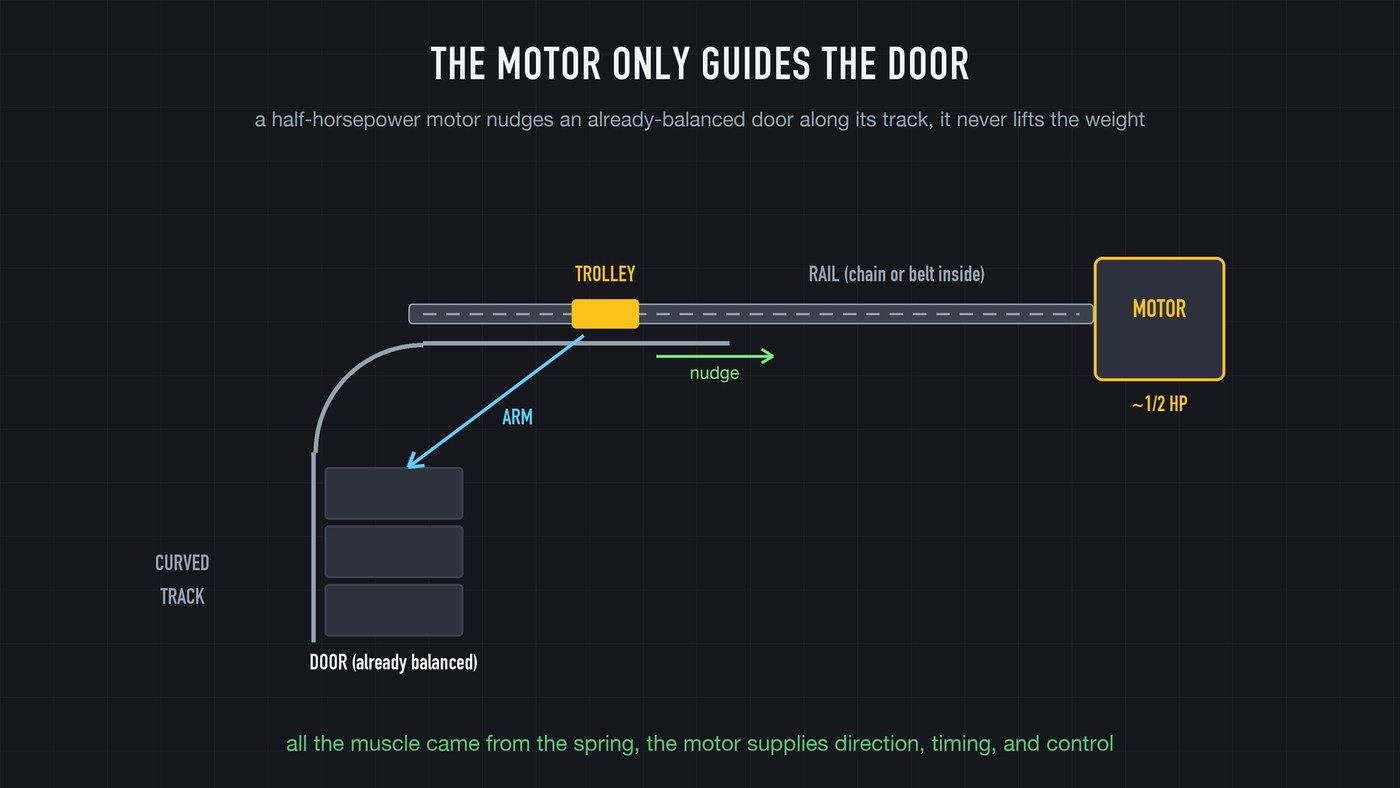
It runs a trolley along a rail. Down the center of the ceiling there's a rail with a chain, a belt, or a screw inside it. The motor spins that, and it drags a little carriage called the trolley back and forth. An arm connects the trolley to the top of the door. Motor runs forward, trolley pulls the arm, the door glides open. Motor reverses, trolley pushes it shut. That's it.
The motor is not a winch hauling up dead weight. It's more like a hand giving an already-balanced door a firm, steady shove along its track, then holding it in place so a gust of wind or a curious kid can't just slide it open.
All the muscle came from the spring. The motor supplies the direction, the timing, and the control. Which is exactly why, when you pull that red emergency cord and disconnect the trolley, you can move the whole door yourself by hand.
05How does it know not to crush anything?
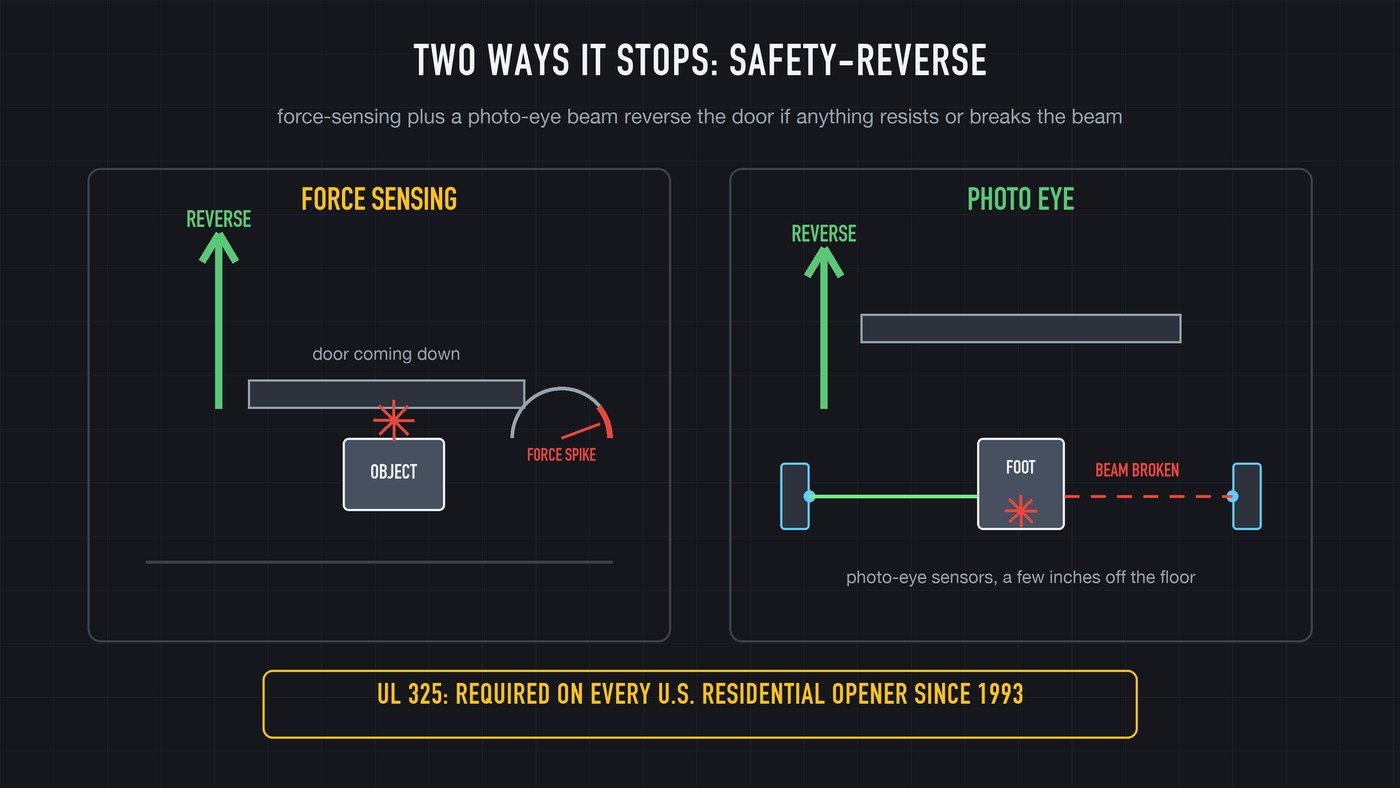
A door this heavy moving on its own is dangerous, and it used to be deadly. Older openers would keep closing on whatever was underneath them, and children were killed. So in the United States, every residential opener made after 1993 is required by law to have two independent ways to stop a door from crushing something.
The first is force sensing. The opener constantly watches how hard it's working. If the door hits something on the way down and the resistance suddenly jumps, the opener reads that as an obstruction and reverses.
The second is that little beam near the floor. At the bottom of the door track sit two small sensors facing each other, a few inches off the ground, firing an invisible infrared beam across the opening. If anything breaks that beam while the door is closing, a foot, a pet, a bike, the door instantly stops and rolls back up. One system feels the obstruction, one sees it, and either one alone will save you.
06Why can't a thief just record your remote?
Early garage remotes were embarrassingly simple. Each one sent a single fixed code, set by a row of little switches inside, and the opener opened for anyone who sent it. That code never changed, so a thief could park nearby with a cheap grabber, record your signal once, and replay it forever. Some devices could even brute-force every possible combination in minutes.
The fix was the rolling code, also called a hopping code. The remote and the opener share a secret and a synchronized counter. Every single time you press the button, the remote sends a different code, and the opener only accepts the next valid one in the sequence, then moves on.
Yesterday's captured signal is already dead. Replaying it does nothing. That one change shut down casual code theft almost overnight, and it's why a modern remote can't simply be recorded and reused.
Yesterday's captured signal is already dead.
07The catch: broken springs, phantom reversals, and blackouts
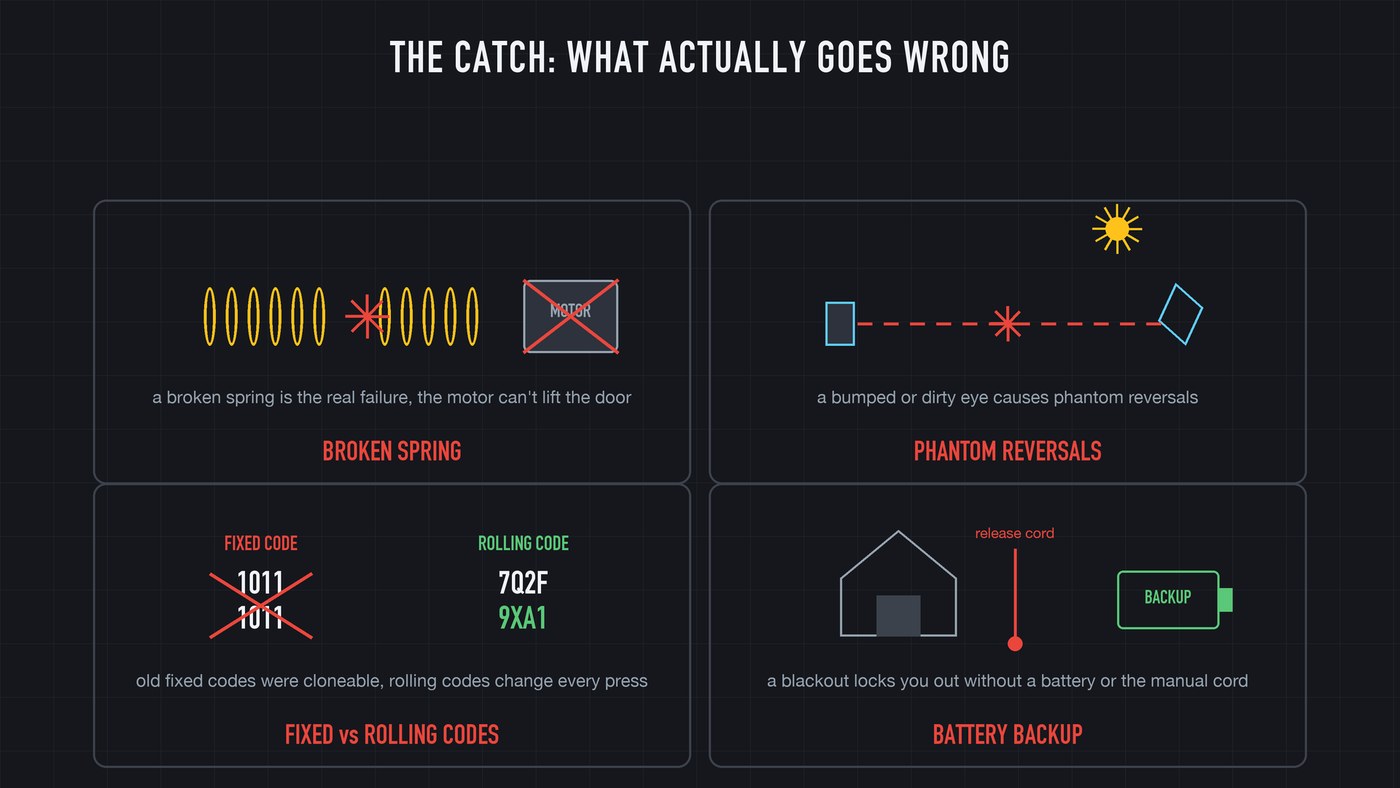
The broken spring is the real failure, and it's the dangerous one. That torsion spring holds enormous energy, and springs wear out, usually after some 10,000 cycles. When one snaps, it lets go with a bang like a gunshot. The counterbalance is gone, the door is suddenly its full dead weight, and that weak little motor cannot lift it. It'll strain, stall, and go nowhere, or lift a few inches and drop. This is why you never stick a hand near a wound spring and why replacing one is a job for someone with the right tools. A broken spring, not a broken motor, is what usually kills a garage door.
Phantom reversals come from the photo eyes. They're precise, and that cuts both ways. Bump one out of alignment, let a spider spin a web across it, or let low sun glare into the lens, and the opener thinks something's in the way, so the door starts down and stubbornly rolls back up. Nine times out of ten it's not broken, it's a sensor that needs cleaning or nudging back into line.
Smarter attacks exist too. Rolling codes killed the simple copy attack, but determined attackers found new angles, like jamming your signal while secretly recording a fresh code to replay later. Rare, but real. And older openers still running fixed codes are wide open.
The power outage can leave you stuck, because the opener holds the door and the motor drives the trolley. That's why the red manual-release cord exists, and why newer openers, required in some states, include a battery backup so the door still works when the power's out.
08Myth vs mechanism
Myth one: the motor lifts the door. It doesn't. It's too weak to, by design. The torsion spring above the door stores the door's own weight and hands it back, so the door floats, and the motor only nudges that balanced door along a rail. Pull the release cord and you can lift the whole thing with one hand, no motor at all.
Myth two: it's a dumb machine that just opens and closes. It isn't. It's watching the whole time. It feels how hard it's pulling, it sees a beam across the floor, and it changes its secret code on every press so nobody can steal it.
That's the whole thing. A wound-up spring does the lifting, a small motor does the steering, and a beam of light stands guard so the door never closes on the one thing it can't afford to.
- The opener's motor, often around half a horsepower, is too weak to lift the door and was never meant to.
- A tightly wound torsion spring stores the door's weight as it closes and pays it back as it rises, so a balanced door floats.
- The motor drives a trolley along a ceiling rail, steering and holding an almost weightless door.
- Since 1993, US openers must have two independent safety reverses: force sensing plus the photo-eye beam.
- Rolling codes send a new signal on every press, so a recorded code is useless; a broken spring, not the motor, is the usual killer.
More how it actually works
Frequently asked
How does a garage door opener work?
A torsion spring above the door does the lifting: it winds tight as the door closes, storing the door's weight, and unwinds to pay it back as the door rises. The motor just drives a trolley along a ceiling rail, pulling and pushing the balanced door by an arm and holding it shut.
Why does my garage door feel weightless when I lift it by hand?
That's the counterbalance working. The torsion spring's stored energy almost perfectly cancels the door's weight at every point in the travel, so a well-balanced 150-pound door glides up with one hand and hangs wherever you leave it.
What happens when a garage door spring breaks?
It snaps with a bang like a gunshot, the counterbalance disappears, and the door becomes its full dead weight, which the motor cannot lift. Springs typically wear out after some 10,000 cycles, and replacement is a job for someone with the right tools because the spring holds enormous energy.
Can someone copy my garage door remote signal?
Not easily on a modern opener. Rolling codes send a different signal on every press and the opener only accepts the next valid code, so a recorded signal is already dead. Old fixed-code remotes could be grabbed and replayed, and openers still using them are wide open.