 WHAMBOX
01Two sensors, two jobs
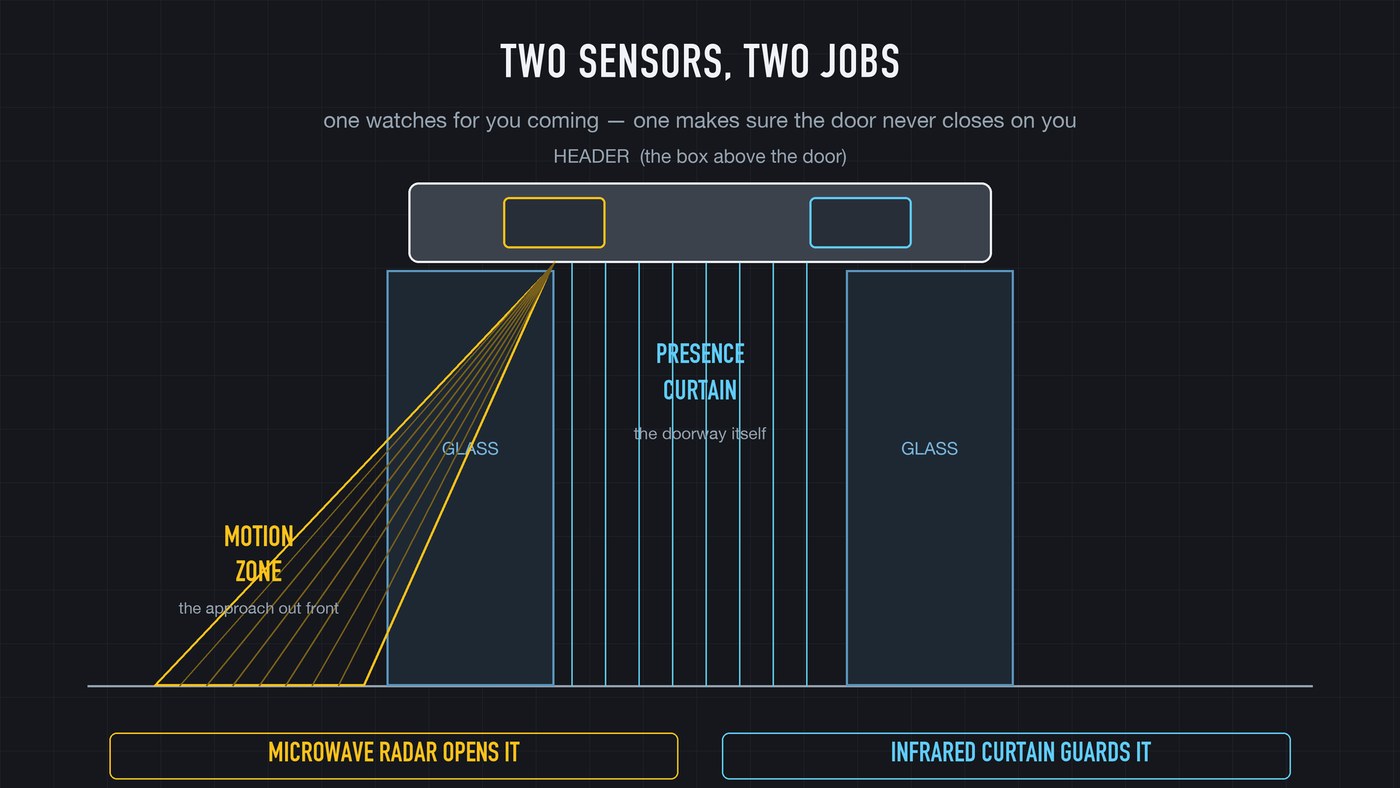
Above almost every automatic sliding door is a little black box, sometimes two. Inside are two separate sensors, and they are not paying attention to the same thing.
The first sensor's only job is to notice you coming and open the door. The second sensor's only job is to make sure the door never closes while someone is standing in the doorway. Open it, and don't crush anyone. That's the entire system.
Here's the key that unlocks everything: those two sensors run on totally different physics. The one that opens the door watches for motion. The one that protects you watches for presence, something simply being there. Almost every quirk of an automatic door comes down to the gap between those two words.
02How does the door know you're coming?
The sensor that opens the door is, in most commercial doors, a tiny radar. A real radar, the same basic idea as the one an officer points at your car. It's called a microwave motion sensor, and it works on the Doppler effect.
The sensor quietly beams invisible microwaves at the floor in front of the door. Those waves bounce off whatever's there and come back. If everything is still, they come back exactly as they left, same frequency, and the sensor shrugs. But the instant something moves toward it, the reflected waves come back slightly squeezed, at a slightly higher frequency. Move away and they come back stretched, lower. That shift is the Doppler effect, the same reason a siren sounds higher as it races toward you and drops as it passes. The sensor feels that frequency change and opens the door.
Now the catch, built right into the physics. A radar like this can only see motion. It physically cannot detect something that isn't moving, because a still object doesn't shift the frequency at all. So if you walk up, trigger the door, and then freeze, to that sensor you have vanished. The door never actually saw you. It saw you moving.
It also explains the annoying stuff. A car rolling past, a bird flying through, a bag blowing by, heavy rain: all of it is motion, and a motion sensor can't tell a customer from a crow. That's why doors sometimes yawn open for nobody.
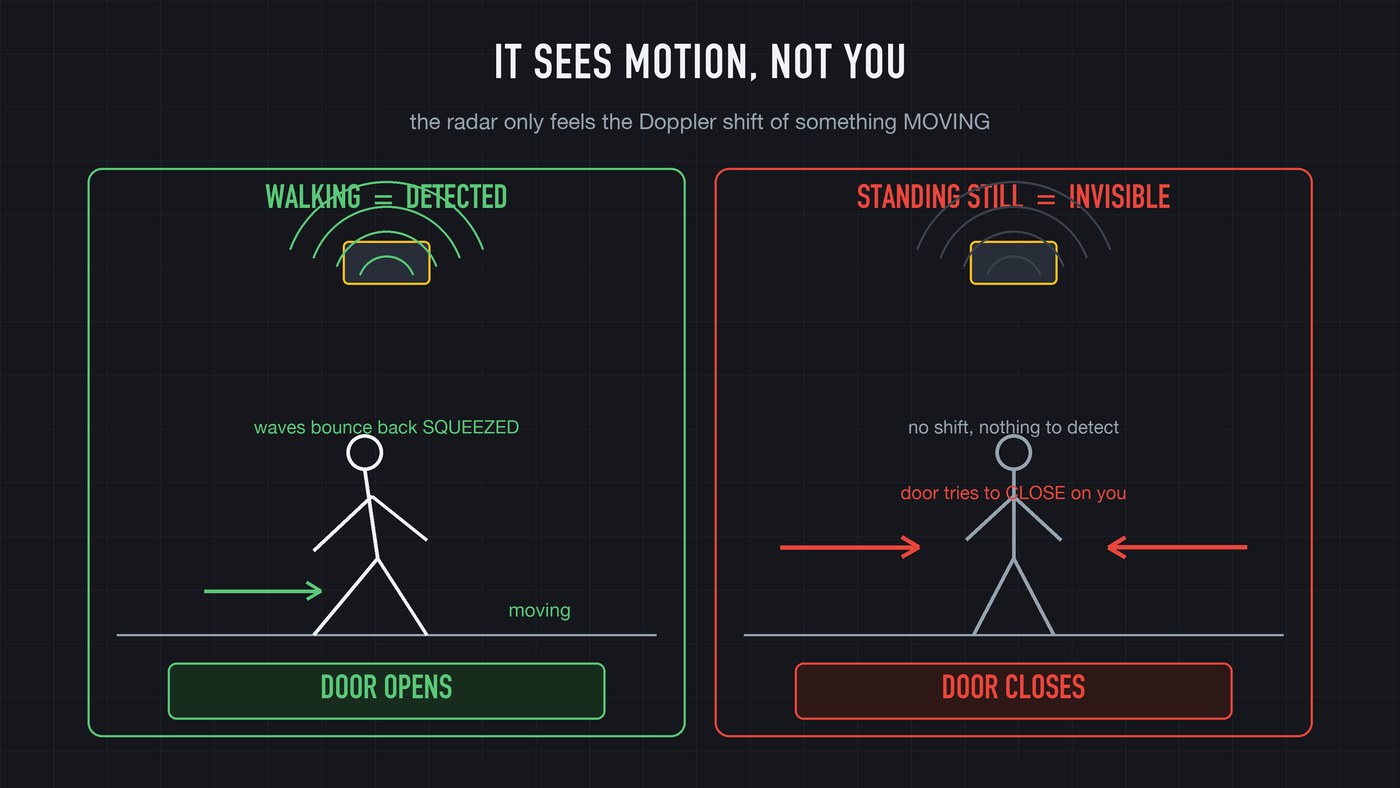
The door never saw you. It saw you moving.
03Why doesn't the door close on you?
If the opening sensor goes blind the second you stop moving, what keeps the door from guillotining the person standing in the doorway? A completely different sensor, using completely different physics.
This one is usually an infrared presence sensor. It projects a grid of invisible infrared beams straight down into the doorway, an invisible curtain hanging in the gap where the panels slide. The sensor knows exactly how that pattern should look bouncing off an empty floor. Put anything in that space, a foot, a shopping cart, a person standing dead still, and the reflection changes. The sensor sees the interruption and gives one simple order: do not close.
This is the sensor that saves you. As long as you're standing in that doorway, even frozen solid, it holds the door open. It doesn't care about motion at all, only that the space is occupied.
And now the trap is obvious. The presence curtain only covers the doorway itself, the narrow strip where the panels slide. The motion radar covers the approach out front. Stop moving in the approach zone, before you reach the doorway, and you fall into a dead spot: too still for the motion sensor to see, too far out for the presence sensor to guard. The door, having counted down its timer, closes right in your face.
04What actually moves the door?
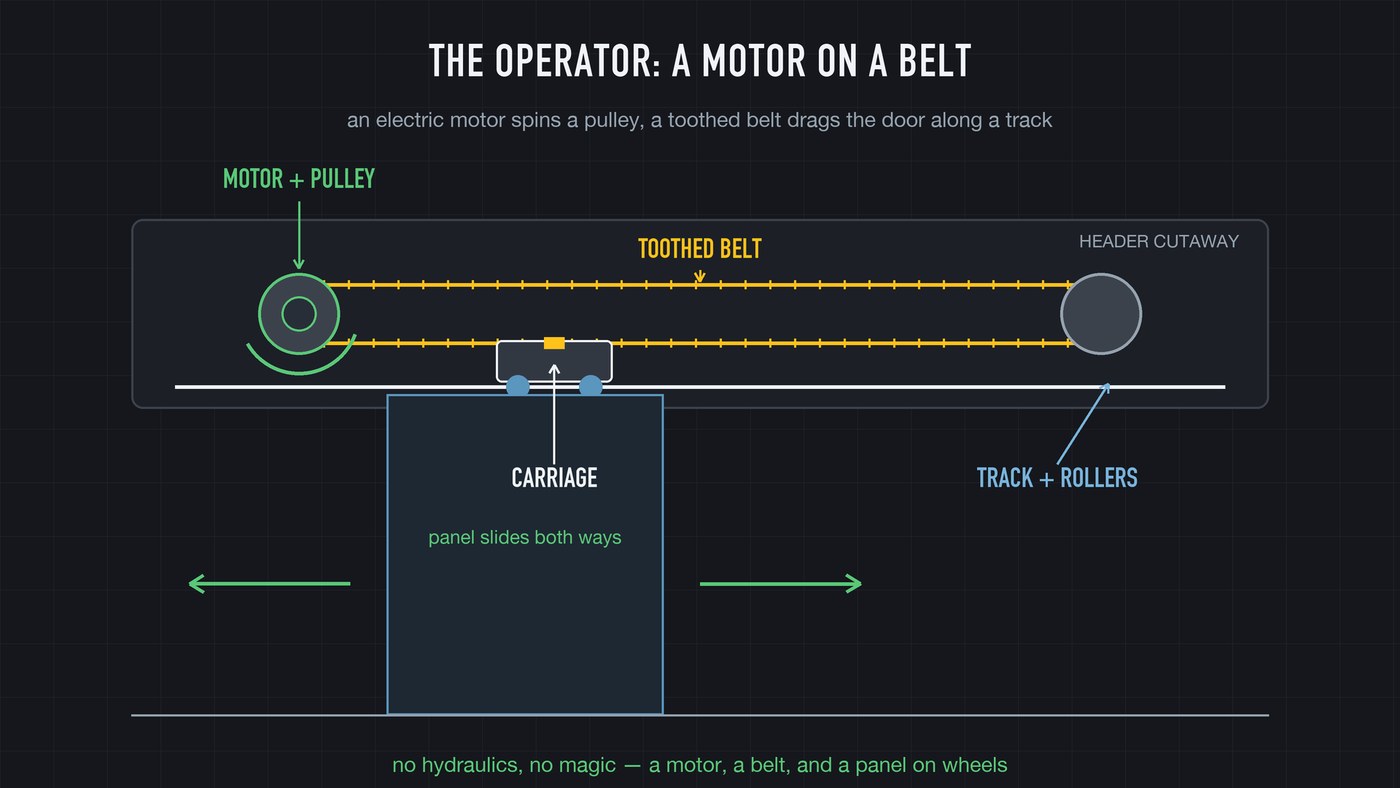
The sensors have decided the door should open. Now something has to physically move a heavy panel of glass, fast, smoothly, about a thousand times a day without complaint. That's the operator, the machine hidden in the header above the door.
Inside is an electric motor, and it doesn't shove the door directly. It turns a pulley, and around that pulley runs a loop of toothed rubber belt, basically a heavy-duty version of the timing belt in a car engine. The door panel hangs from a small carriage that rides along a track on rollers, and that carriage is clamped to the belt. Motor spins the pulley, belt moves, carriage slides, door opens. Spin the motor the other way and the door closes.
That's the entire mechanism. No hydraulics, no magic, just a motor, a belt, and a panel on wheels. Hanging the door from a track up top is why sliding doors glide so quietly and can be so heavy: all that weight rides on rollers hidden in the header.
05Why do automatic doors hesitate?
Between the sensors and the motor sits a small circuit board, the controller. It's the brain, and it's why a good automatic door feels smooth instead of violent.
When the motion sensor trips, the controller doesn't slam the motor to full power. It ramps up, accelerates the door open, then slows it as it nears fully open so it doesn't bang the frame. Then it starts a countdown, the hold-open time, usually a few seconds. If nothing else trips the sensors, it closes the door, again easing the speed down at the end so the panels kiss shut instead of clapping.
The controller is also why doors sometimes stutter: start to shut, then jerk back open. It's constantly rechecking that presence curtain, and if it catches anything in the doorway, even for a fraction of a second, it aborts the close and re-opens. Maybe your trailing foot, maybe a reflection. It isn't broken. It's built to err toward staying open. And if the door ever bumps something while closing, the motor feels the resistance and the controller reverses instantly. Same instinct as an elevator door.
06What happens in a power cut?
A door made of motors and circuit boards sounds like a death trap in a blackout or a fire. It isn't, and that's on purpose. It's the law.
Most commercial sliding doors have a break-out feature: the sliding panels are hinged so that if you push hard on them in the direction of escape, they swing open like a regular door, motor or no motor, power or no power. Fire codes demand a way out that doesn't depend on electricity.
Many doors also fail toward open. Plenty of designs are spring-loaded or hold a small battery, so when power is lost the door either drifts open or can be slid by hand with light pressure, rather than locking you in. The exact behavior depends on the building, but the golden rule never changes: in an emergency, a human has to get out with zero electricity. The clever sensing is a convenience. The escape route is mandatory.
07The trade-offs: false triggers, blind spots, and drift
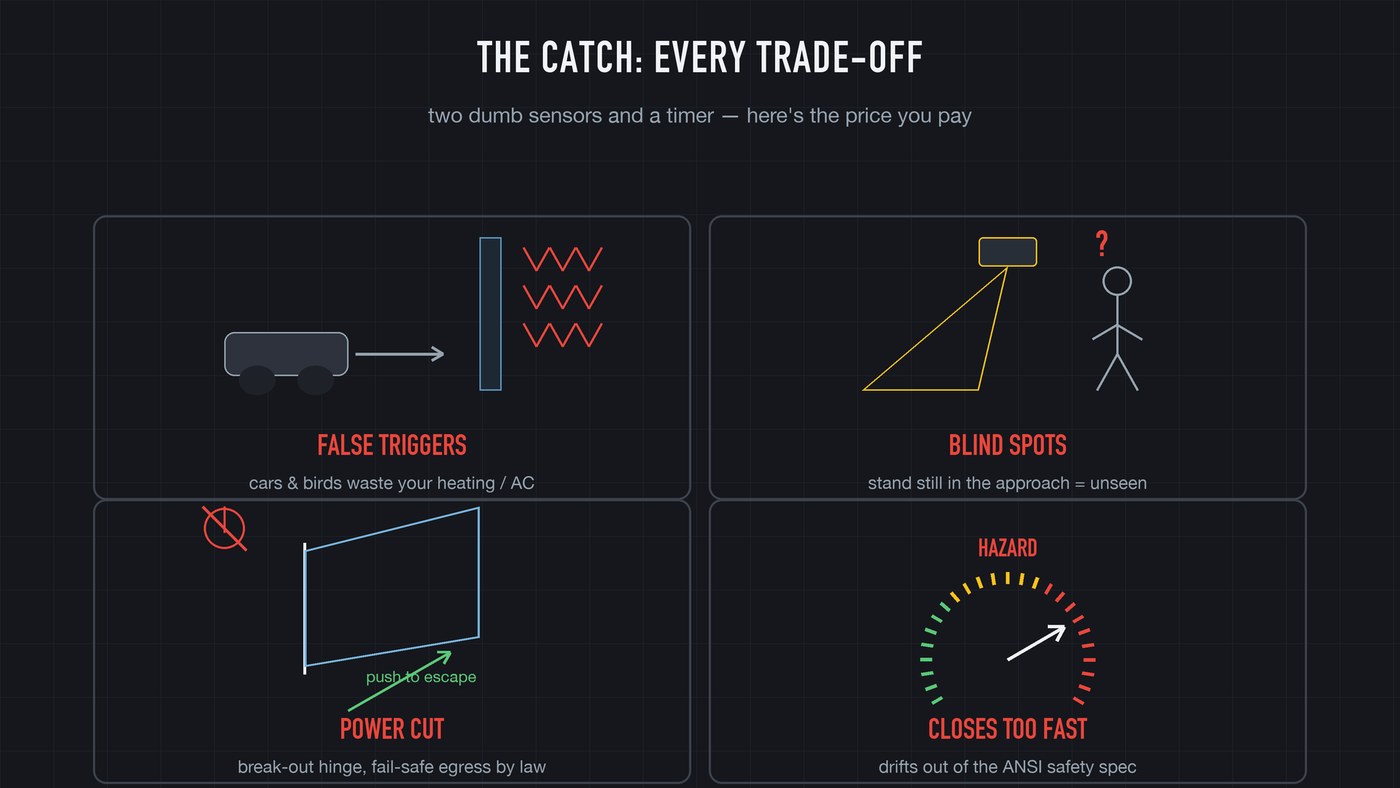
Living with automatic doors exposes every trade-off in the design. False triggers cost real money. The motion radar fires for anything that moves, and every phantom opening dumps heated or air-conditioned air straight outside. For a busy store in January, a door that gapes open for every passing car is throwing money into the parking lot, which is why you see vestibules, air curtains, and carefully aimed sensor zones fighting to rein it in.
Blind spots are baked in. Stand still in the approach and the motion sensor forgets you exist. Walk up very slowly and you can half-trigger it, which is why a door occasionally opens late, right as you reach it. It wasn't being rude. It barely registered you.
Sensors drift out of alignment. Those motion and presence zones are aimed at specific patches of floor, and bumping the housing, dirt, or age can shift them. A misaligned presence sensor is the dangerous one: if it stops watching the doorway properly, the safety net is gone, and that's when a door actually closes on someone. This is why automatic doors carry a legal requirement for regular safety inspection.
And closing speed is a compromise. Too slow wastes energy and jams up traffic. Too fast is a hazard. There's a whole safety standard, in North America it's ANSI A156.10, spelling out how fast these doors may open and close and how big the safety zones have to be. When a door feels like it closes too fast, it's usually drifted out of that spec and needs adjusting.
08Myth vs mechanism
Myth one: the door sees you. It doesn't. There's no camera, no eye, no recognition of a human being at all. One sensor feels motion by bouncing radar off you, the other feels presence by bouncing infrared off you. To the door you were never a person, just a moving blob, then a standing blob.
Myth two: it's one smart system. It's really two dumb ones stitched together. A motion detector that opens the door and goes blind the instant you hold still, and a presence detector that guards only the doorway and nothing beyond it. Every strange thing these doors do, opening for a bird, hesitating, closing on someone who paused too soon, falls straight out of the gap between those two.
That's the whole machine. A radar that only understands movement, an infrared curtain that only understands occupancy, and a belt-driven motor doing exactly what a little circuit board tells it. No eyes. No intelligence. Just two sensors that each know one thing, working the seam between them so smoothly you never noticed there was a seam.
Two sensors that each know one thing, working a seam you never noticed.
- An automatic door has no camera. Two sensors do everything: one opens, one protects.
- The opener is a microwave radar that uses the Doppler effect, so it only sees motion. Freeze and you vanish.
- An infrared presence curtain in the doorway holds the door open for anything simply being there, moving or not.
- A motor and toothed belt slide the panels; a controller eases the speed, times the hold-open, and reverses on contact.
- Break-out panels and fail-open designs mean you can always escape with zero electricity, and ANSI A156.10 caps how fast doors may close.
More how it actually works
Frequently asked
How does an automatic door know you're there?
It doesn't know you're a person. A microwave radar above the door beams invisible waves at the approach, and when something moves toward it, the reflected waves come back at a slightly higher frequency. That Doppler shift is what triggers the door to open.
Why do automatic doors close on people standing still?
The opening sensor is a motion radar, and a still object doesn't shift its signal at all. If you stop in the approach zone before reaching the doorway, you're invisible to the motion sensor and outside the infrared presence curtain that guards the doorway, so the door closes on its timer.
Why do automatic doors open when nobody is there?
The motion radar fires on any movement in its zone: a passing car, a bird, a bag blowing by, heavy rain. It can't tell a customer from a crow, so anything moving in the approach can trigger a phantom opening.
Do automatic doors work in a power cut?
You can still get out. Most commercial sliding doors have break-out panels that swing open like a regular door when pushed in the direction of escape, with no power needed. Many designs also fail toward open, using springs or a small battery so the door can be slid by hand.