 WHAMBOX
01There's a wire buried in the road
Next time you're stopped at a light, look at the pavement in front of your bumper. You'll often see faint rectangular or diamond-shaped lines sawed into the asphalt and filled with black sealant. Most people think it's a patched crack. It isn't. That's the outline of a wire loop, buried in a groove cut into the road.
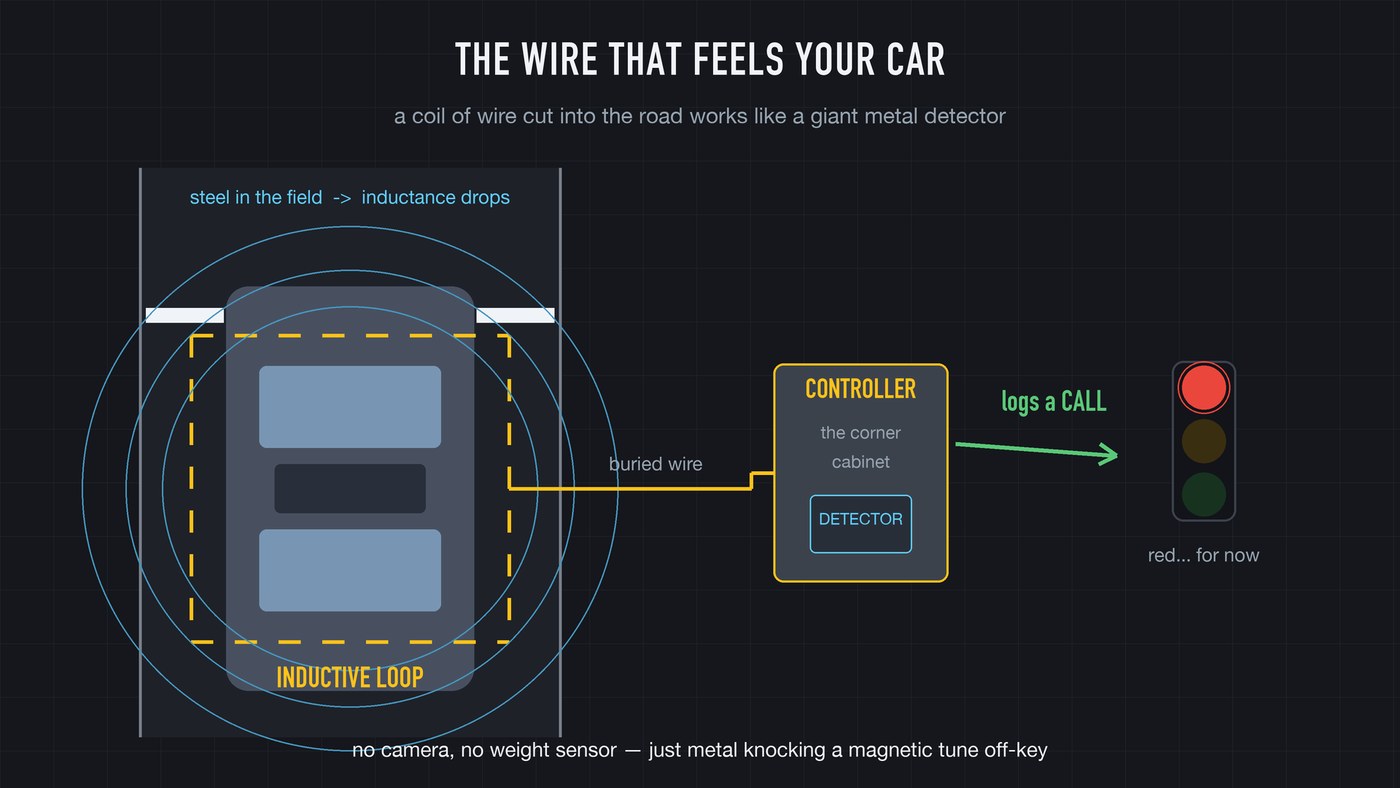
Down in that groove is a coil of wire, wound around a few times, with both ends running off to a metal cabinet on the corner. That cabinet is the brain of the intersection, and the loop is one of its senses.
Traffic engineers call it an inductive loop detector, and it has been the standard way roads detect cars for over fifty years. It doesn't see you and it doesn't weigh you. It feels the metal in your car through a magnetic field.
02How does the road detect your car?
Run electricity through a coil of wire and it creates a magnetic field around it. A coil also has a property called inductance, which is how strongly it resists sudden changes in the current flowing through it. Every coil has a natural inductance, and that number is the thing the road is measuring.
The cabinet doesn't just power the loop, it makes it hum, driving current back and forth through the coil thousands of times a second so the loop is constantly building and collapsing its magnetic field. Roll a car on top of it and your car is a huge slab of steel sitting inside that field. The field pushes tiny swirling currents, called eddy currents, into the metal of your car. Those little currents fight back against the loop's field, and the loop's inductance drops. The coil's rhythm speeds up.
The electronics watch that rhythm like a heartbeat. Empty road, steady beat. Car arrives, the beat jumps, and the detector flips a switch: something metal is here. It's the same principle as the metal detector at the airport or on the beach, just scaled up to the size of a car and paved into the ground.
It doesn't care about your paint or your passengers. It only feels metal.
03Is every traffic light on a timer?
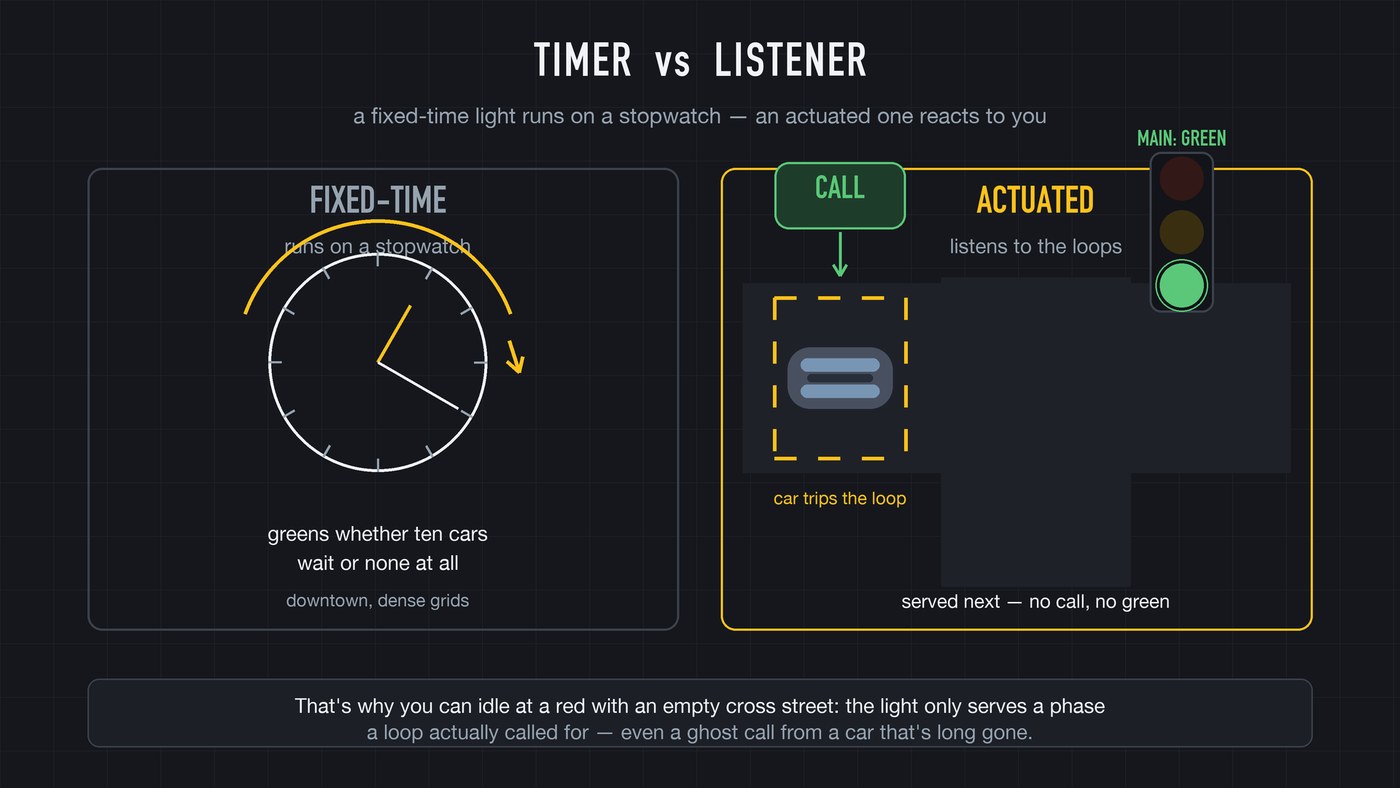
There are really two kinds of traffic lights. The first is fixed-time, sometimes called pretimed. It runs on a stopwatch and nothing else: green for this long, then yellow, then the other direction, around and around, whether ten cars are waiting or none. You find these downtown, in dense grids where there's always traffic anyway, so a fixed rhythm keeps everything flowing. This is the light people picture when they curse the dumb timer.
The second kind is actuated, and it's the one wired to those loops in the road. An actuated signal doesn't assume anything about traffic. It waits, it listens, and it responds to what the loops tell it. If nobody's waiting on the side street, it leaves the main road green and lets you keep rolling. The instant a car pulls up to the side-street loop, the light knows, and it starts arranging to give that car a turn.
Most suburban and highway intersections, the ones that seem to somehow know you arrived at 2 a.m. and change just for you, are actuated. They're not psychic. They felt you.
04How does the light decide who gets a green?
Inside that cabinet is a controller, and it thinks in two words: calls and phases. A phase is one movement getting its turn, say northbound traffic going straight. A call is a request for a phase, and a call is exactly what your car placed when it rolled onto the loop.
The sequence is simple. You pull up, the loop detects you, and the controller logs a call for your direction. It finishes serving whoever has the green now, respecting a minimum green time so nobody gets a two-second light, then it cycles around and serves your call. Green for you.
This also explains one of the most maddening things in driving: sitting at a red while cross traffic gets a green and no cars ever come. The controller had a call on that phase. Maybe a car that already turned, maybe a loop reading a car that's long gone, or on a semi-actuated setup the side street simply gets a guaranteed slice of every cycle. The light isn't taunting you. It's serving a request that, from where you sit, looks like nothing.
05Why won't the light change for my motorcycle?
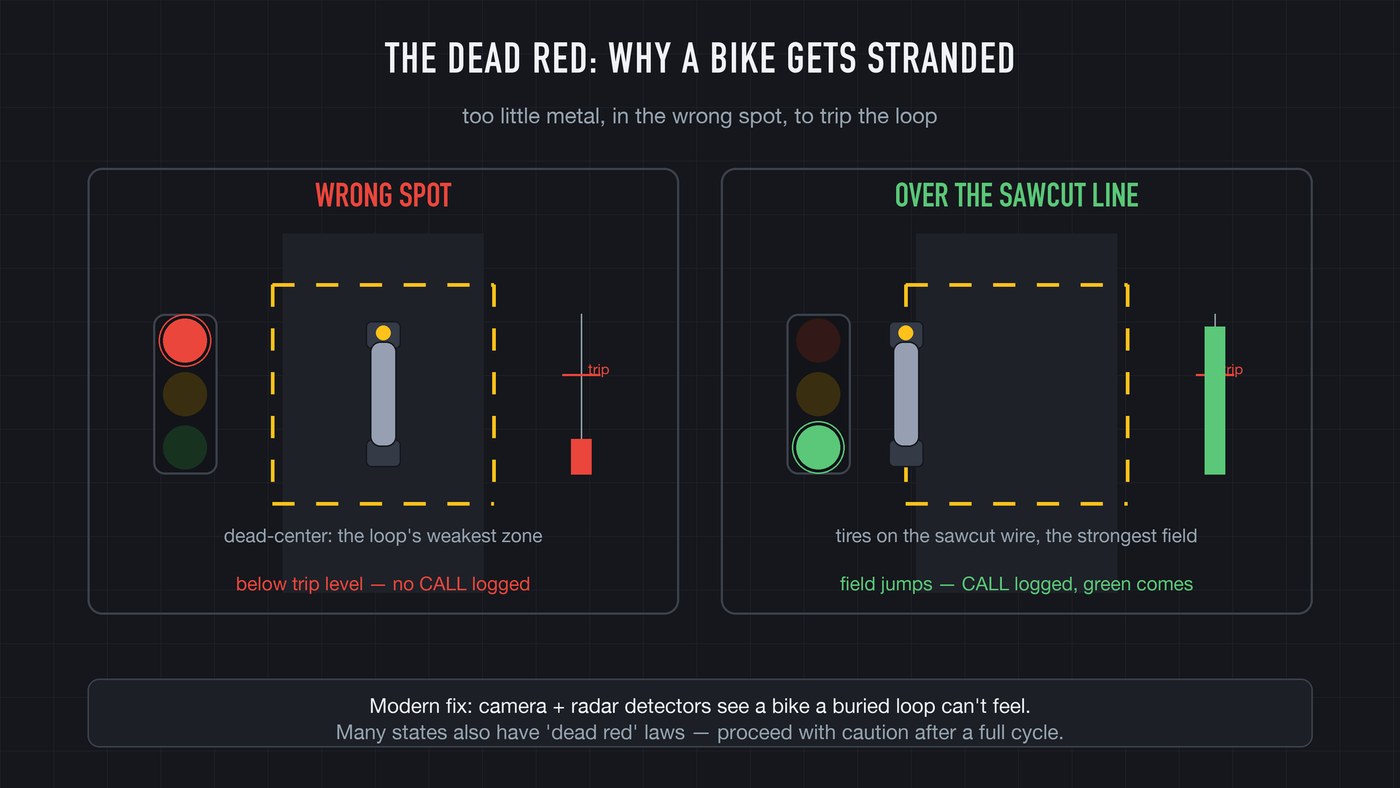
The loop feels metal, and it needs enough metal, positioned right, to be sure a vehicle is there. A car is easy. A motorcycle or a bicycle is a different story. It's not about weight, because the loop doesn't feel weight at all. A motorcycle has a fraction of a car's metal, and a bike might be aluminum or even carbon fiber with almost nothing the loop can grab.
Worse, riders naturally stop in the center of the lane, and that's often the deadest spot on the loop. The change is too small to cross the detector's threshold, so no call gets logged. The controller never learns you exist, and you sit through green after green for the cross street. Riders call it the dead red, and it's a real, documented problem.
There are fixes. Position matters most: stop your wheels directly over the sawed line of the loop, not in the middle of the lane, because the wire is where the field is strongest. Some places crank up loop sensitivity or paint a marker showing bikes exactly where to stop. And many states have passed dead red laws, sometimes called safe-on-red, that legally let a motorcyclist or cyclist proceed with caution after waiting a full cycle or two. If you ride, that's not a loophole, it's the law catching up to the physics.
06What are the cameras on traffic light poles for?
Loops have one big weakness beyond bikes: they're buried in the road, and roads crack, freeze, get repaved, and tear the wire apart. A dead loop means digging up pavement to fix it. So newer intersections are ditching wire for eyes.
Look at the poles and you'll often see small cameras or flat sensor boxes aimed down at the road. Video detection draws invisible boxes on the image, virtual loops, and when the picture inside a box changes because a vehicle rolled in, it registers a call. Same idea, no digging. Radar and laser sensors do it another way, bouncing signals off vehicles to detect and even count them, and they shrug off darkness and fog.
The upside is huge: no cutting the road, one sensor can cover several lanes, and some can tell a bike from a truck. The catch is they bring their own blind spots, because none of this is free.
07The catch: what actually goes wrong
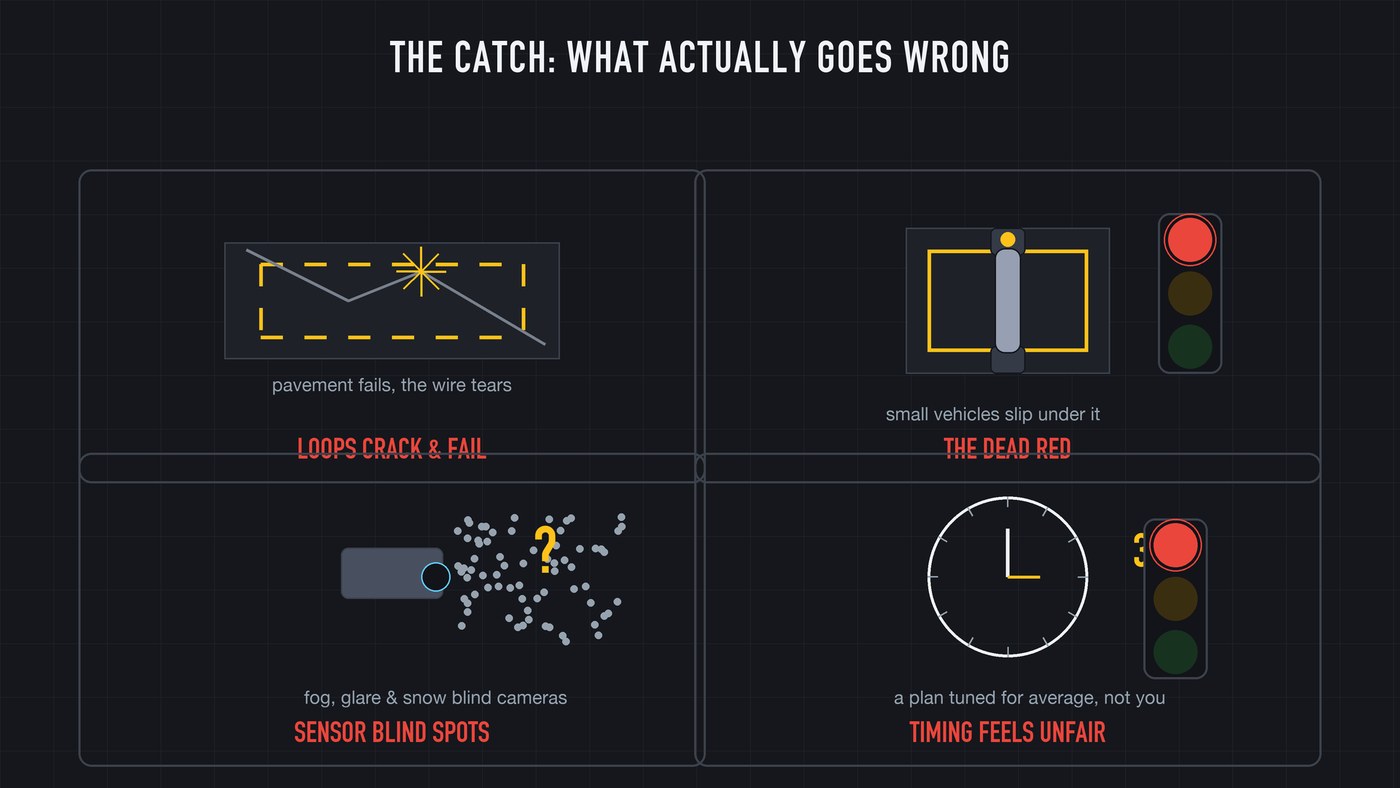
Loops crack and die. They live in pavement, and pavement fails. A broken loop usually fails blind, so the controller assumes a car is always there and gives that direction a call every cycle, or it fails the other way and never detects anyone. Either way you get an intersection that feels broken, because a sense of it is.
The dead red skips more than bikes. Any small or in-between vehicle can fall under the detector's threshold and get passed over. It's the loop's oldest complaint.
Cameras have bad days. Video detection struggles with exactly what your eyes struggle with: heavy fog, glare from a low sun, snow caking the lens, deep shadows at dusk. A camera that can't see the lane can miss a car or hallucinate one, throwing phantom calls just like a stuck loop.
And the timing itself can just feel unfair. Even a perfect sensor only feeds a plan a human engineer set: minimum greens, maximum waits, how big a gap in traffic ends a phase. Set that plan for average conditions and your particular 6 p.m., or your empty 3 a.m., can land on the wrong side of it. The light isn't malfunctioning. It's following a compromise, and you're the edge case it wasn't tuned for.
08Myth vs mechanism
Myth one: traffic lights are just timers counting down. Some are. But most of the ones you deal with out in the world are actuated, actively feeling for you through a wire in the road or a camera on a pole, and rearranging themselves around who actually showed up.
Myth two: it's watching you, like surveillance. The classic loop isn't watching anything. It's a coil humming a magnetic tune, and your car's metal knocks that tune off-key. That off-key note is the entire message: a hunk of metal is sitting here, give it a turn.
That's the whole thing. A loop of wire, a magnetic field, and the eddy currents your car stirs up just by being made of steel. The road isn't smart and it isn't spying. It's a metal detector doing one honest job, over and over, felt but never seen, right under your tires.
- Those saw-cut lines at the stop line are a buried wire loop: an inductive loop detector, the standard for over fifty years.
- Your car's steel induces eddy currents that drop the loop's inductance, and that change is the entire detection.
- Fixed-time lights run a stopwatch; actuated lights wait, listen, and serve calls from the loops.
- Motorcycles and bikes can miss the threshold entirely, the dead red, and stopping tires over the saw line is the fix.
- Newer intersections replace buried wire with cameras and radar, which skip the digging but bring their own blind spots.
More how it actually works
Frequently asked
How do traffic lights know a car is there?
Most use an inductive loop: a coil of wire buried in a groove at the stop line, driven with current thousands of times a second. A car's steel induces eddy currents that drop the loop's inductance, and the detector registers that change as a vehicle call. Newer intersections use cameras or radar on the poles instead.
Are traffic lights on timers?
Some are. Fixed-time signals, common in dense downtown grids, cycle on a stopwatch no matter what. Most suburban and highway signals are actuated: they hold the main road green until a sensor reports a car waiting, then arrange a turn for it.
Why doesn't the light change for my motorcycle or bike?
The loop feels metal, not weight, and a motorcycle or bicycle may not put enough metal in the field to cross the detector's threshold, especially stopped in the center of the lane. Stop with your wheels directly over the sawed line, where the field is strongest. Many states also have dead red laws letting riders proceed with caution after a full cycle.
Why am I stopped at a red light when no cars are crossing?
The controller is serving a call on that phase: a car that already turned, a faulty loop reporting a car that's gone, or a guaranteed slice of the cycle on a semi-actuated setup. The light is answering a request that looks like nothing from where you sit.