 WHAMBOX
01The cable isn't what you think
On top of most tall buildings sits a machine room, or these days a compact motor tucked into the shaft itself. From it, steel ropes run down and hold the car. But here's the part people miss: they don't just hold the car. They loop up and over a grooved wheel and back down the other side, where they connect to a heavy block of steel called the counterweight.
So it's not a car hanging off a cable. It's a car and a counterweight, tied together over a pulley, like two kids on a seesaw. That one design choice changes everything about how the machine works, how much power it needs, and why it's so hard to make it fall.
The cable is just the rope between the two riders. It's important, but it is not the trick. The trick is what's on the other end.
02Why doesn't the motor reel the cable in?
The wheel at the top is called the sheave, and it has grooves cut into it. The steel ropes lie in those grooves, and a motor turns the wheel. That's it. The motor doesn't reel the cable in like a fishing line. It just spins the wheel, and friction between the ropes and the grooves drags the ropes along with it. Turn the wheel one way, the car goes up. Turn it the other way, the car goes down.
This is called a traction machine, and the word traction means grip.
Now here's what's strange. That motor is far smaller than you'd expect for lifting a loaded elevator car up forty floors. A car full of people can weigh a couple of tons, and yet the motor sips power. It should be straining. It isn't, because the motor is almost never lifting the full weight of anything. That's the counterweight's whole job.
03What does the counterweight actually do?
The counterweight isn't random. It's engineered to weigh the same as the empty car plus about forty to fifty percent of a full load. Think about what that does. When the car is about half full, the two sides of the seesaw are almost perfectly balanced. The motor is barely moving weight at all. It's just nudging a system that's already in equilibrium, overcoming a little friction and a small difference.
So the motor doesn't lift a two-ton car. It lifts the difference between the car and the counterweight, which is small. When the car is heavy, the counterweight helps pull it up. When the car is light, the counterweight's extra mass helps pull it back down. Either way the motor only handles the leftover.
That's why you can move tons of people up a skyscraper on a motor that, relatively speaking, is modest. Take the counterweight away and you'd need an enormous engine and enormous cables for every trip. The counterweight is the reason tall elevators are even practical. But balance is about efficiency. It is not what keeps you safe. So what happens if the rope actually breaks?
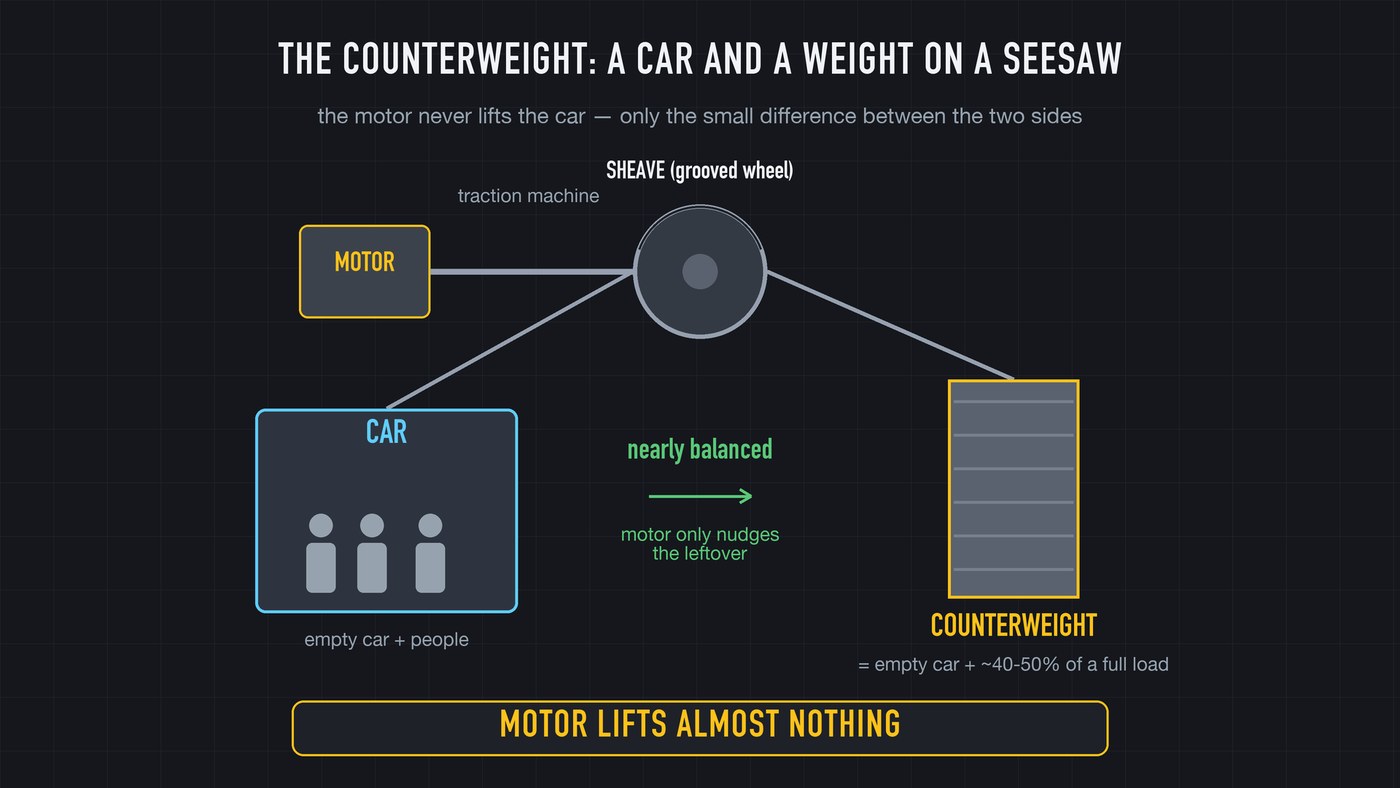
The motor doesn't lift the car. It lifts the difference.
04Can the cable actually snap?
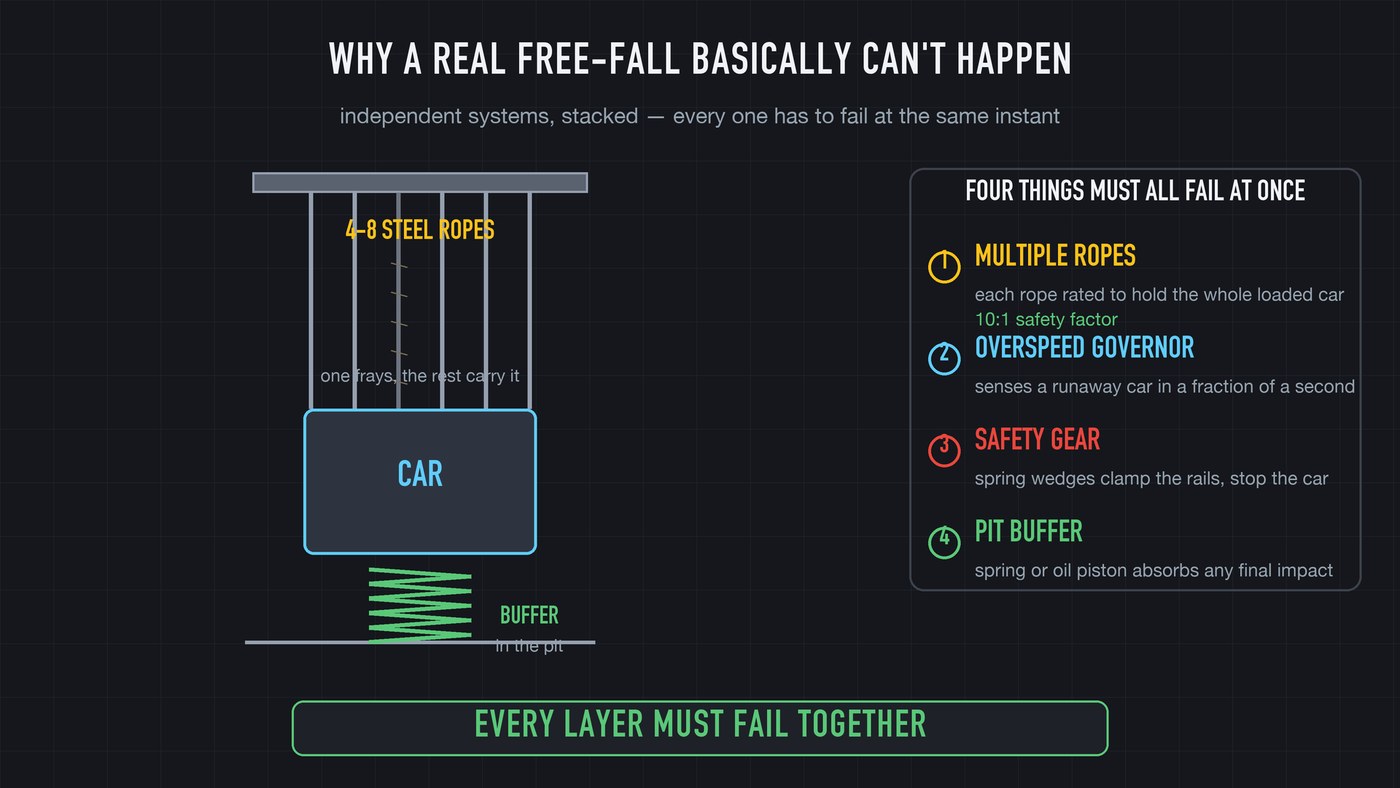
First, "the cable" is not a cable. An elevator hangs from multiple steel ropes running side by side, typically four to eight of them. And this is the key number: each individual rope is built strong enough to hold the entire fully loaded car by itself. All of them together give a safety factor of something like ten to one.
So one rope fraying doesn't drop the car. The others carry it, and inspectors catch the worn rope long before it matters.
For every rope to snap at the same instant, you'd need something so far outside normal operation it basically doesn't occur in a maintained elevator. The famous cases in history are almost always something else: a rope snapping under a freak condition, or sabotage, or catastrophic neglect. And even then, we don't rely on the ropes to be the last line of defense. Because a mechanic in the 1850s assumed the ropes would fail, and built the machine that saves you when they do.
05The 1853 brake that built the skyline
Before 1853, elevators existed, but only for freight, because everyone knew the rope could break and no one would risk their life on one. Then a mechanic named Elisha Otis had an idea: don't just make the rope stronger, make a brake that grabs the moment the rope lets go. In 1853 he started his company on it, and in 1854, at the New York World's Fair, he stood on an open platform high above a crowd and had an assistant cut the rope with an axe. The platform dropped a couple of inches and stopped. He tipped his hat. "All safe, gentlemen."
That single demonstration is why we trust elevators, and it's why we started building up instead of out.
Here's the mechanism. The car runs between two vertical steel tracks called guide rails. Bolted to the car is a set of spring-loaded steel wedges, the safety gear. As long as the rope holds tension, those wedges stay retracted. The instant tension is lost, springs drive the wedges outward against the rails, and the geometry is self-tightening: the faster the car tries to move, the harder they bite. The car doesn't fall. It grabs the walls and stops.
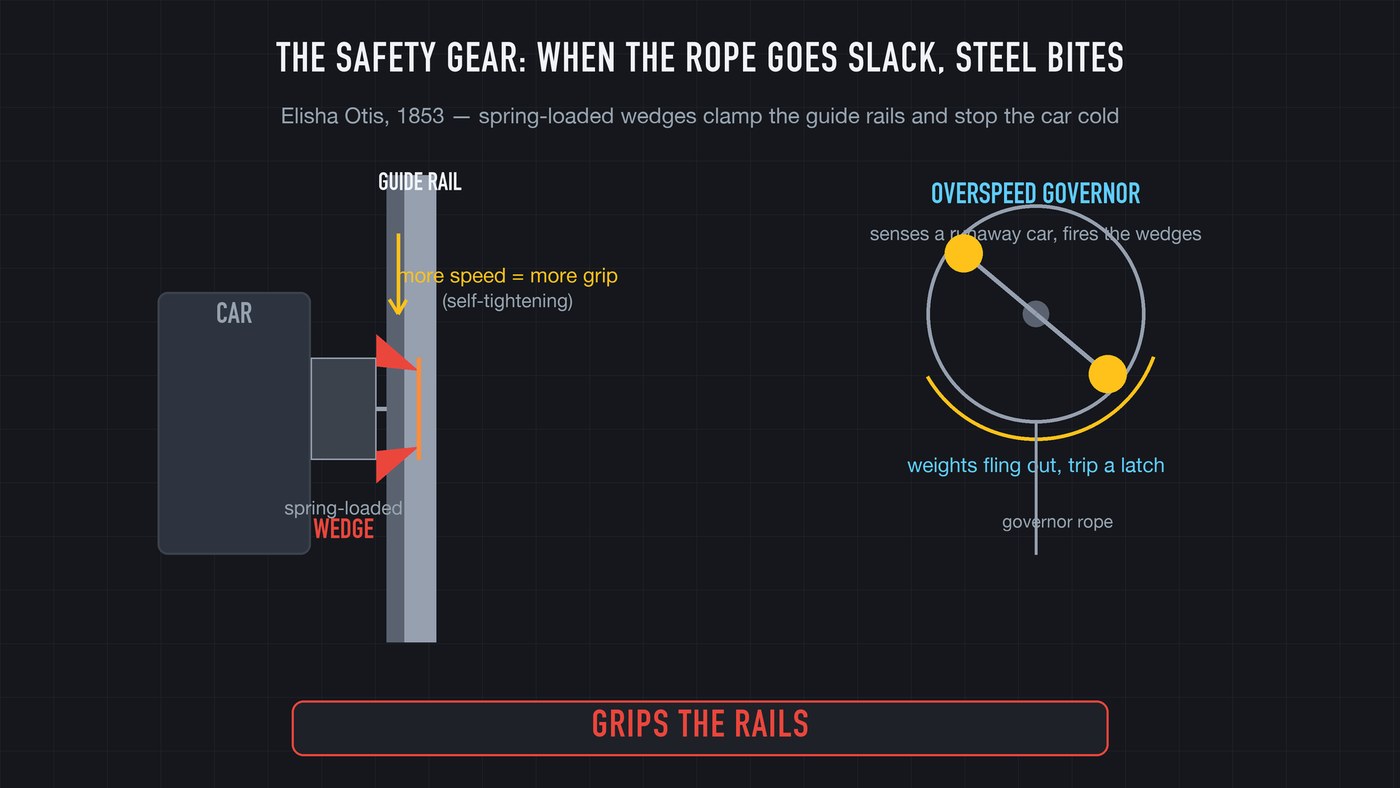
The car doesn't fall. It grabs the walls and stops.
06How does the car know it's falling?
The brake needs to know when to fire. That's a separate device called the overspeed governor, and it's beautifully simple. A small pulley near the top spins a separate governor rope clipped to the car, so it turns at the exact speed the car moves. Inside the governor are weights that swing out as it spins faster, exactly like the spinning-ball speed regulators on old steam engines.
Below normal speed, nothing happens. But if the car ever moves faster than it's allowed to, usually around a quarter over its rated speed, those weights fling out far enough to trip a latch. That grabs the governor rope, and the yank on that rope fires the safety gear into the rails.
So stack up the layers. The counterweight means the car isn't just dead weight waiting to fall. Multiple ropes each hold the whole car. If they somehow all failed, the car starts to speed up, the governor senses it in a fraction of a second and clamps the wedges to the rails. And if by some impossibility the car still reached the bottom, the pit has one last catch: a buffer, a heavy spring or an oil-filled piston, there to absorb the final impact.
07The trade-offs: getting stuck, slow rescues, and hydraulics
It's incredibly safe. That doesn't mean it's flawless, and the honest trade-offs are worth knowing.
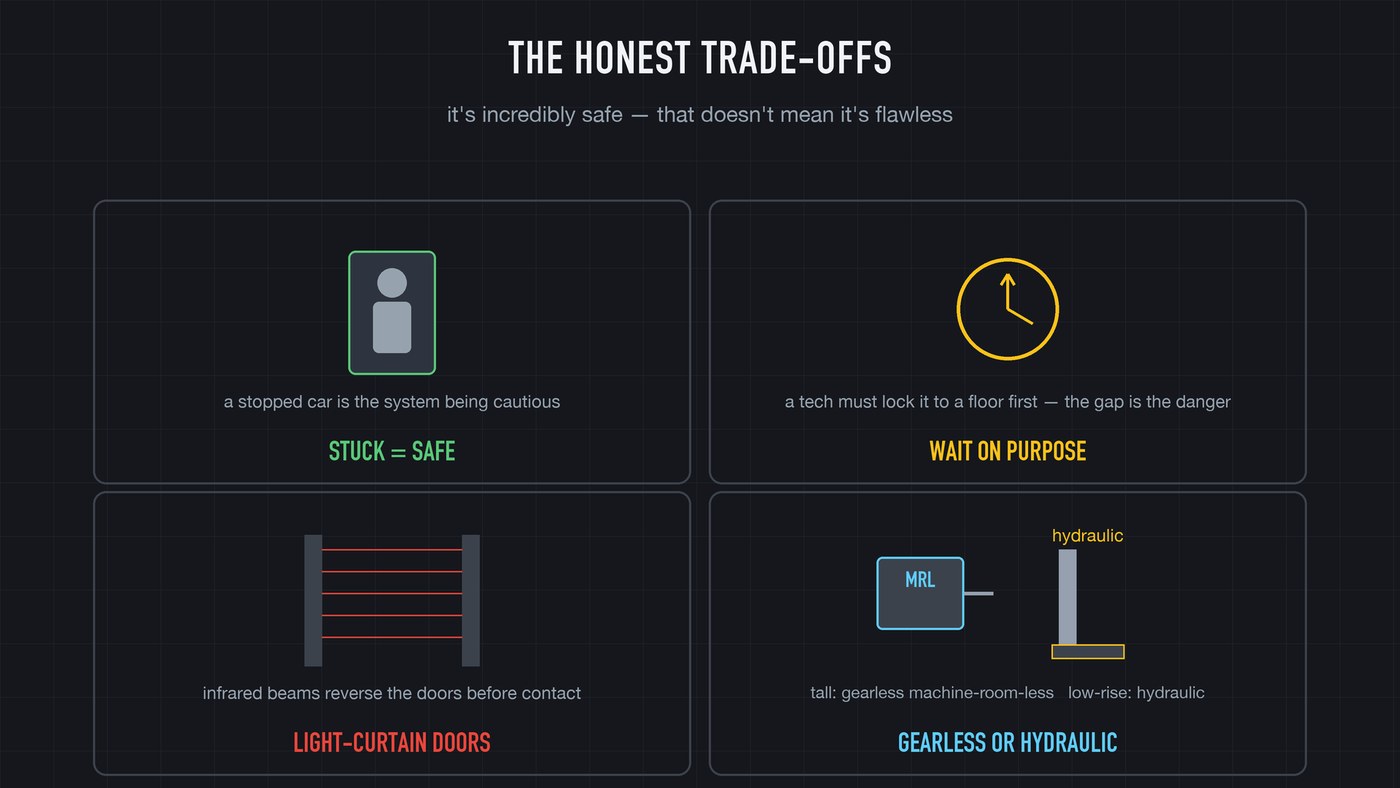
Getting stuck is common, and it is the safety systems doing their job. If a sensor reads anything wrong, a slightly open door, a power dip, an odd speed, the elevator's default is to stop and hold, not to keep moving. A stuck elevator is a working elevator being cautious. It is basically the safest place in the building.
And the waiting. Rescue takes long because the rules say a trained technician has to bring the car to a floor and confirm it's locked before the doors open. Forcing your way out puts you in the gap between the car and the shaft, which is the one genuinely dangerous move, so the system makes you wait on purpose.
The doors get their own guard. That invisible beam or grid of infrared sensors across the doorway means the doors reverse if anything breaks the beam. Older elevators used a physical bumper that had to touch you first; the light curtain reacts before contact.
And not every elevator even works this way. Tall buildings use the traction-and-counterweight system, increasingly as gearless, machine-room-less designs where a compact high-torque motor lives right in the shaft and drives the sheave directly. But short buildings, two to five floors, often use a completely different machine: a hydraulic elevator, where a pump pushes fluid to drive a piston that shoves the car up from below, and gravity lowers it. No counterweight, no overhead machine. It's cheaper for low-rise and slower, which is why you feel the difference in a small building.
08Myth vs mechanism
Myth one: the danger is the cable snapping and the car free-falling. In a maintained elevator that's the failure the entire machine is built to survive. Multiple ropes, each rated for the whole car. An overspeed governor watching every second. Spring-loaded wedges ready to lock the car to the rails the instant tension is lost. A buffer at the bottom as a last resort. Free-fall isn't the risk you should picture. It's the one thing the design is obsessed with preventing.
Myth two: a big strong motor is heaving that car up the shaft. It isn't. The counterweight does the heavy lifting by balancing the car, so the motor only nudges the small difference. Grip on a grooved wheel moves the ropes, balance carries the load, and a mechanical tripwire stands guard the whole way.
That's the whole thing. A car and a counterweight over a wheel so the motor barely works, several ropes that each hold everything, and a 170-year-old brake that trusts the rope to fail and catches you when it does. The cable was never the point. The catch was.
- An elevator is a car and a counterweight balanced over a grooved wheel; the motor only moves the small difference between them.
- The motor grips the ropes by friction on the grooved sheave. Traction means grip, not reeling in a cable.
- The car hangs from four to eight steel ropes, and each one alone can hold the fully loaded car, roughly a 10:1 combined safety factor.
- If rope tension is ever lost, spring-loaded wedges clamp the guide rails and stop the car. Otis proved it with an axe in 1854.
- An overspeed governor fires the brake if the car runs about a quarter over rated speed, and a buffer in the pit is the last resort.
More how it actually works
Frequently asked
How does an elevator work?
A motor at the top of the shaft spins a grooved wheel called the sheave, and friction drags the steel ropes along with it. The car hangs on one side of those ropes and a heavy counterweight hangs on the other, so the motor only lifts the small difference between the two instead of the car's full weight.
What happens if an elevator cable snaps?
Almost certainly nothing. An elevator hangs from four to eight ropes and each one alone is rated to hold the entire loaded car. If tension were somehow lost on all of them, spring-loaded wedges on the car clamp the guide rails and stop it, a brake design Elisha Otis demonstrated in 1854.
Why is being stuck in an elevator safe?
A stuck elevator is the safety systems working: if any sensor reads something wrong, the car's default is to stop and hold. Rescue is slow on purpose because a trained technician must bring the car to a floor and confirm it's locked, since forcing your way out into the shaft gap is the one genuinely dangerous move.
What is the difference between a traction and a hydraulic elevator?
Traction elevators use a motor, grooved sheave, ropes, and a counterweight, and they serve tall buildings. Hydraulic elevators use a pump that drives a piston to push the car up from below, with gravity lowering it. They're cheaper and slower, which is why low-rise buildings of two to five floors often use them.