 WHAMBOX
01Suck, squeeze, bang, blow: the four steps
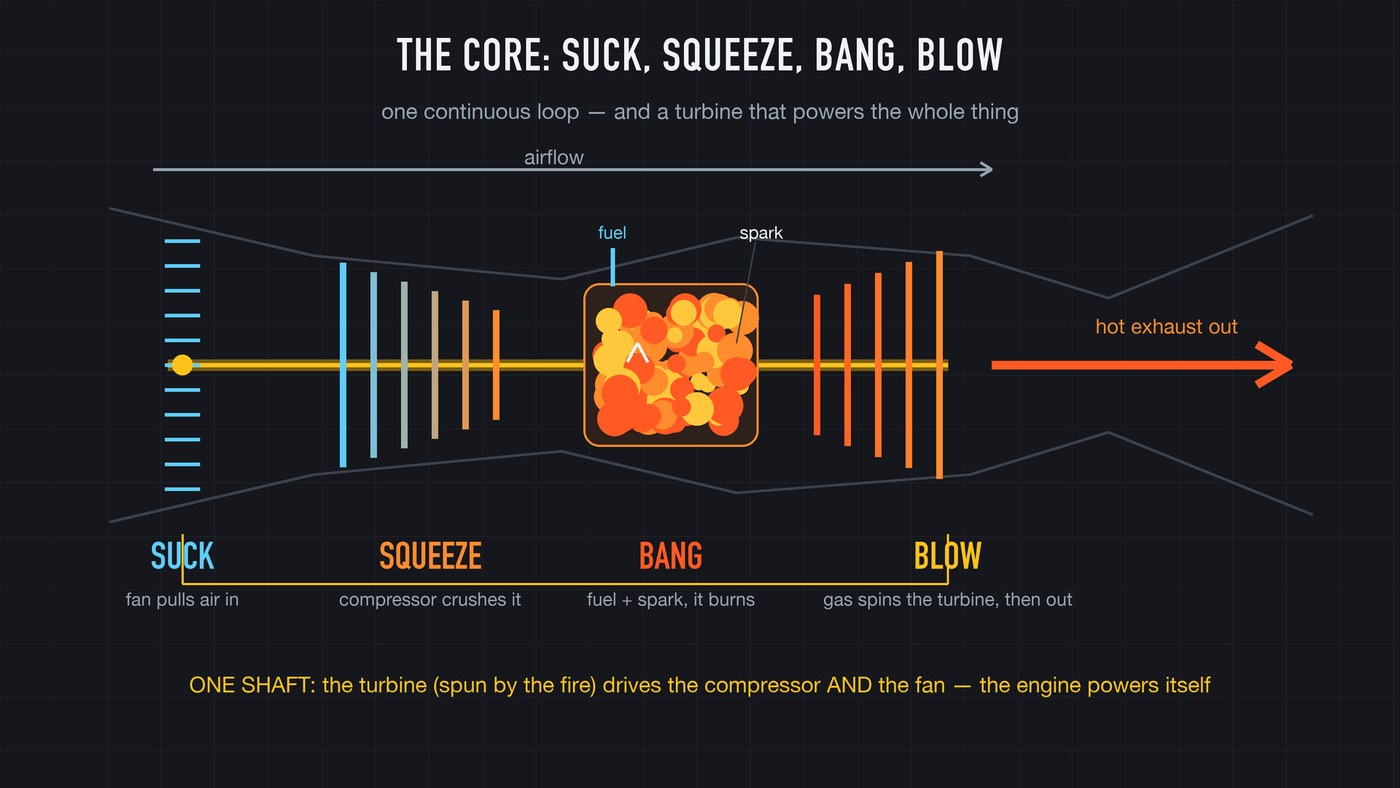
Engineers sum up a jet engine in four words. Suck: air is pulled in the front. Squeeze: it's crushed into a much smaller, higher-pressure space. Bang: fuel is sprayed into that squeezed air and lit, and it expands violently. Blow: the hot, high-pressure gas blasts out the back.
That core is in every jet engine ever built, from a fighter to a cruise missile to the engine hauling you on vacation. Four steps, one continuous loop, running thousands of times a second.
But that summary hides something. On the engine under an airliner's wing, the fiery blast out the back is not the main event. It's the sideshow. To find the main event you have to look at the very front.
02What actually pushes the plane?
At the front of an airliner engine is one enormous fan, sometimes eight, ten, even eleven feet across. Most people assume it's just an intake feeding the fire. It does do that, but that's its small job.
Its real job is to act like a giant ducted propeller. As it spins, it grabs an enormous slug of air and shoves it straight backward, and around 90% of that air never touches the fire at all. It flows around the outside of the burning core, through a smooth outer duct, and straight out the back. Cold air in, cold air out, just moving a lot faster.
That river of cold air is called the bypass, and on a modern engine it produces most of the thrust. This is what a high-bypass turbofan means: bypass because most of the air skips the fire, turbofan because a turbine spun by that fire is what drives the fan. The flames are the engine. The fan is the propeller.
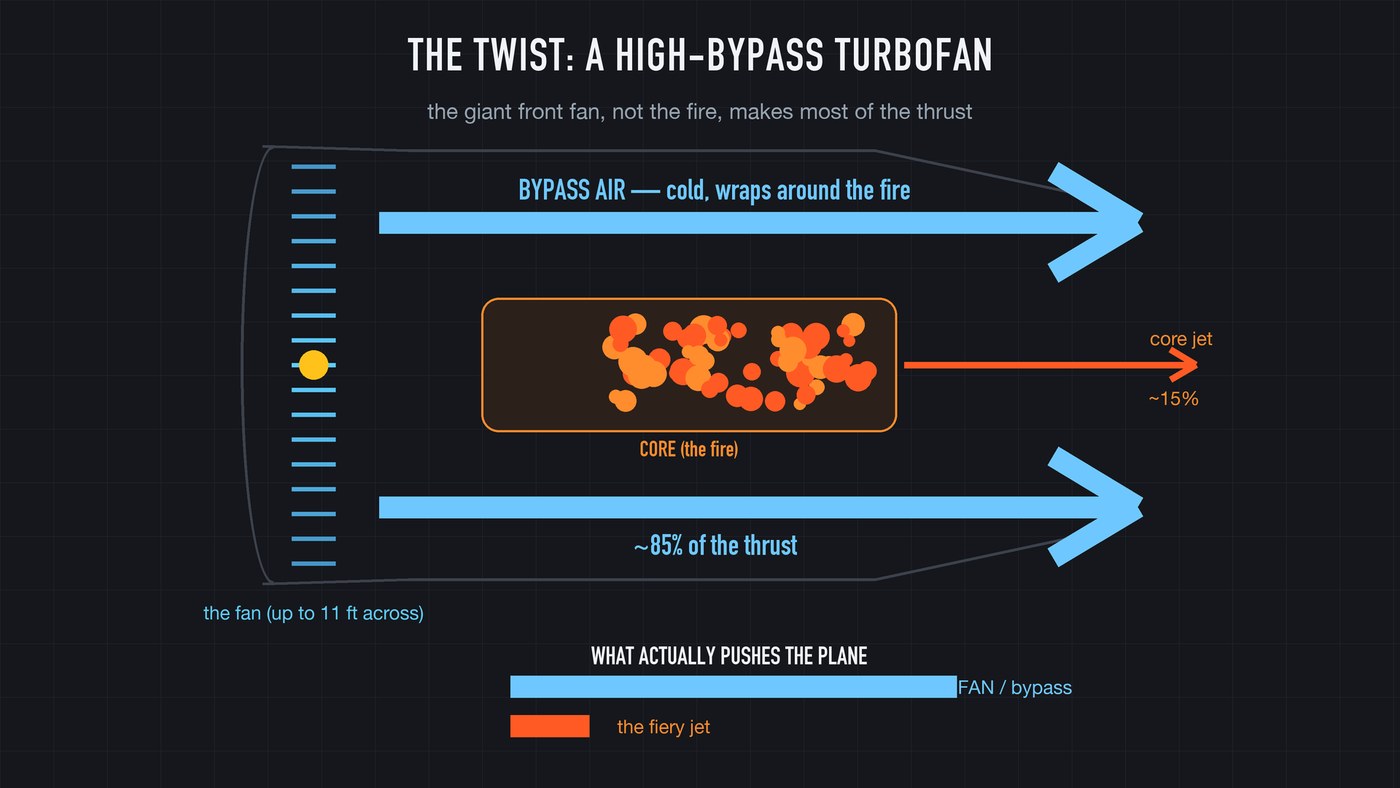
The flames are the engine. The fan is the propeller.
03How does the fire spin the fan?
Follow the small stream of air that does go into the core. It gets compressed, burned, and blasted backward as hot high-pressure gas. On the way out, that gas passes through a turbine: a set of blades that the exhaust spins on its way past, like wind through a windmill.
That turbine is mounted on a shaft running back up the middle of the engine, and the other end of that shaft is bolted to the fan and the compressor at the front. So the exhaust spins the turbine, the turbine spins the shaft, and the shaft spins the fan.
The loop closes on itself: the fire's exhaust powers the very machinery that feeds it air. Once running, it sustains itself, and the surplus goes into driving that huge fan. Which is why the burning core can be relatively small while the fan it drives is enormous.
04Why did jet engines get fat instead of pointy?
Old jets were slim tubes. Modern airliner engines are enormous fat cylinders, and that change is the bypass idea taken to its logical end.
There are two ways to make thrust: move a small amount of air very fast, or move a huge amount of air a little faster. Both push. But moving a huge amount of air a little faster is substantially more fuel-efficient, and it's dramatically quieter, because a slower exhaust stream mixing with still air makes far less noise than a fast one ripping through it.
So engine designers kept making the fan bigger and the proportion of air skipping the fire larger. Bigger fan, more air, less fuel per passenger, less noise. The engine got fat because fat is efficient, and that's why an airliner today is far quieter than a jet from the 1960s.
Move a lot of air a little faster, not a little air very fast.
05The trade-offs: birds, altitude, and why they can't just be bigger
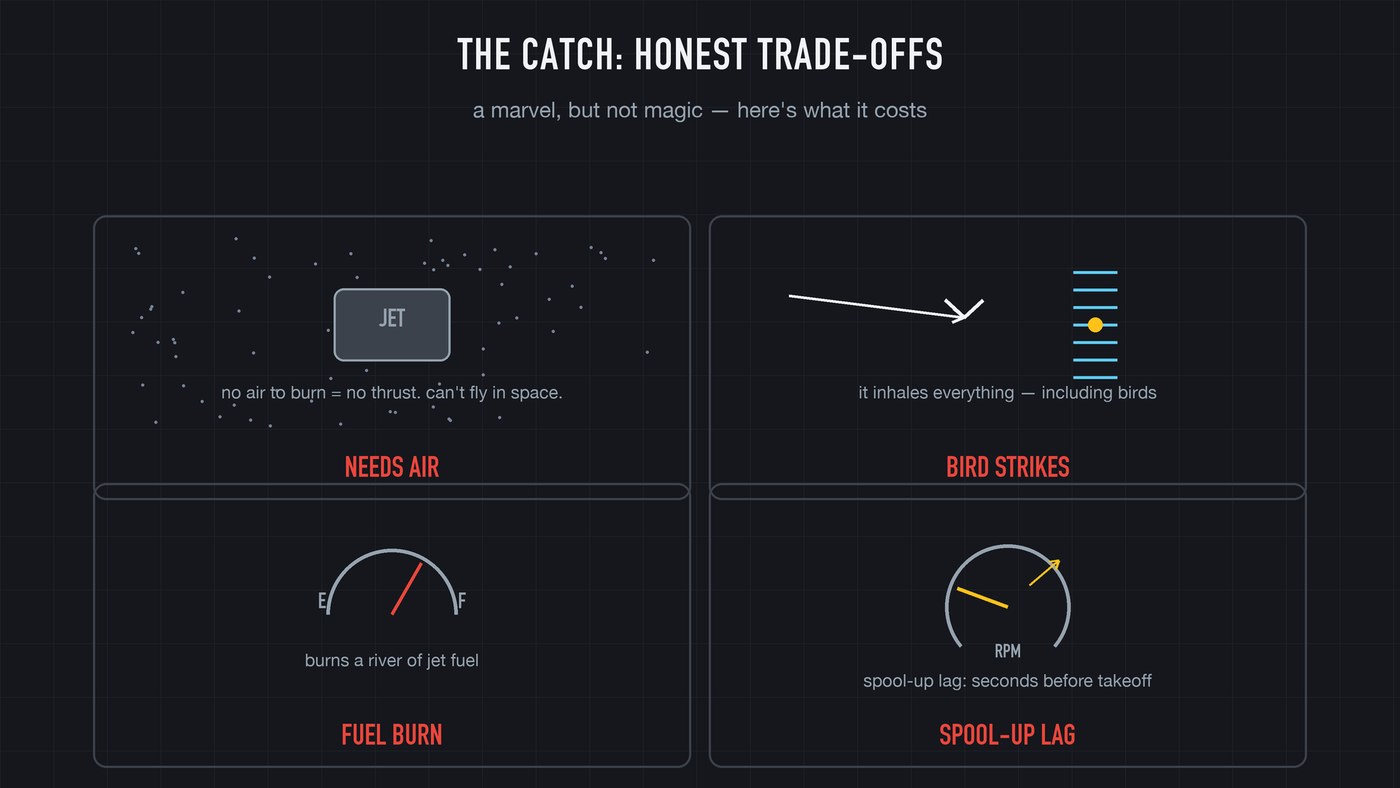
A huge fan at the front is a huge target. Bird strikes are a real engineering problem, which is why fan blades and casings are certified against ingestion tests, and why engines are built to contain a failed blade rather than let it escape.
Altitude helps more than people expect. Thin air at cruise means far less drag on the airframe, and the engine is designed to run efficiently up there. That's much of why airliners climb so high before settling into cruise.
And there's a limit on the fan. Make it too big and the blade tips approach the speed of sound, where efficiency falls apart, plus the engine has to physically fit under a wing with ground clearance. Bigger is better right up until geometry and physics say stop, which is why some newer designs put a gearbox between the turbine and the fan so each can spin at its own best speed.
06Myth vs mechanism
Myth one: the flames push the plane. On a modern high-bypass turbofan they mostly don't. Around 80-90% of the thrust is cold air shoved backward by the fan, and the core exhaust is a minority contributor.
Myth two: the fan is just an air intake. It's the propeller. The fire exists to spin it.
That's the whole machine. A fire whose only real job is turning a fan, and a fan that flies the plane. Next time one spools up on the runway, watch the front, not the back.
- A modern airliner engine is a high-bypass turbofan: most air skips the fire entirely.
- Roughly 80-90% of thrust comes from cold bypass air shoved backward by the front fan.
- The core burns fuel to spin a turbine, and that turbine drives the fan through a shaft.
- Engines got fat because moving lots of air slightly faster is more efficient and much quieter than moving a little air very fast.
- Fan size is capped by blade-tip speed and ground clearance, which is why geared designs exist.
More how it actually works
Frequently asked
How does a jet engine actually work?
It runs a continuous cycle: suck air in, squeeze it to high pressure, burn fuel in it, and blow the hot gas out the back. On an airliner that exhaust first spins a turbine, which drives a large front fan, and that fan shoves cold air backward to produce most of the thrust.
Does the fire push the plane forward?
Mostly no. On a modern high-bypass turbofan, roughly 80-90% of the thrust comes from cold air the fan pushes around the outside of the burning core. The fire's main job is spinning the turbine that drives the fan.
What does high-bypass turbofan mean?
Bypass refers to air that flows around the burning core instead of through it. High-bypass means most of the air takes that path. Turbofan means a turbine, spun by the exhaust, is what powers the fan.
Why are modern jet engines so big and round?
Because moving a large mass of air slightly faster is more fuel-efficient and much quieter than moving a small mass very fast. Designers kept enlarging the fan and the bypass ratio, so the engine got wider.