 WHAMBOX
01Your car pushes to stop, a truck lets go
Your car uses hydraulics. Press the pedal, you push brake fluid down a line, that fluid squeezes a piston against the wheel, and the harder you press the harder it grips. Simple, instant, unchanged for a century.
But it has one quiet weakness. If a hydraulic line springs a leak, you lose the fluid that does the squeezing, and the pedal sinks to the floor. In a two-ton car, backups handle that. In an eighty-thousand-pound truck, a brake that quits when a line breaks is a death sentence.
So heavy trucks flipped the whole idea around. Instead of using pressure to apply the brakes, they use pressure to hold them open, and let a spring do the stopping. Air is just the messenger. The muscle is steel.
02Where does the air come from?
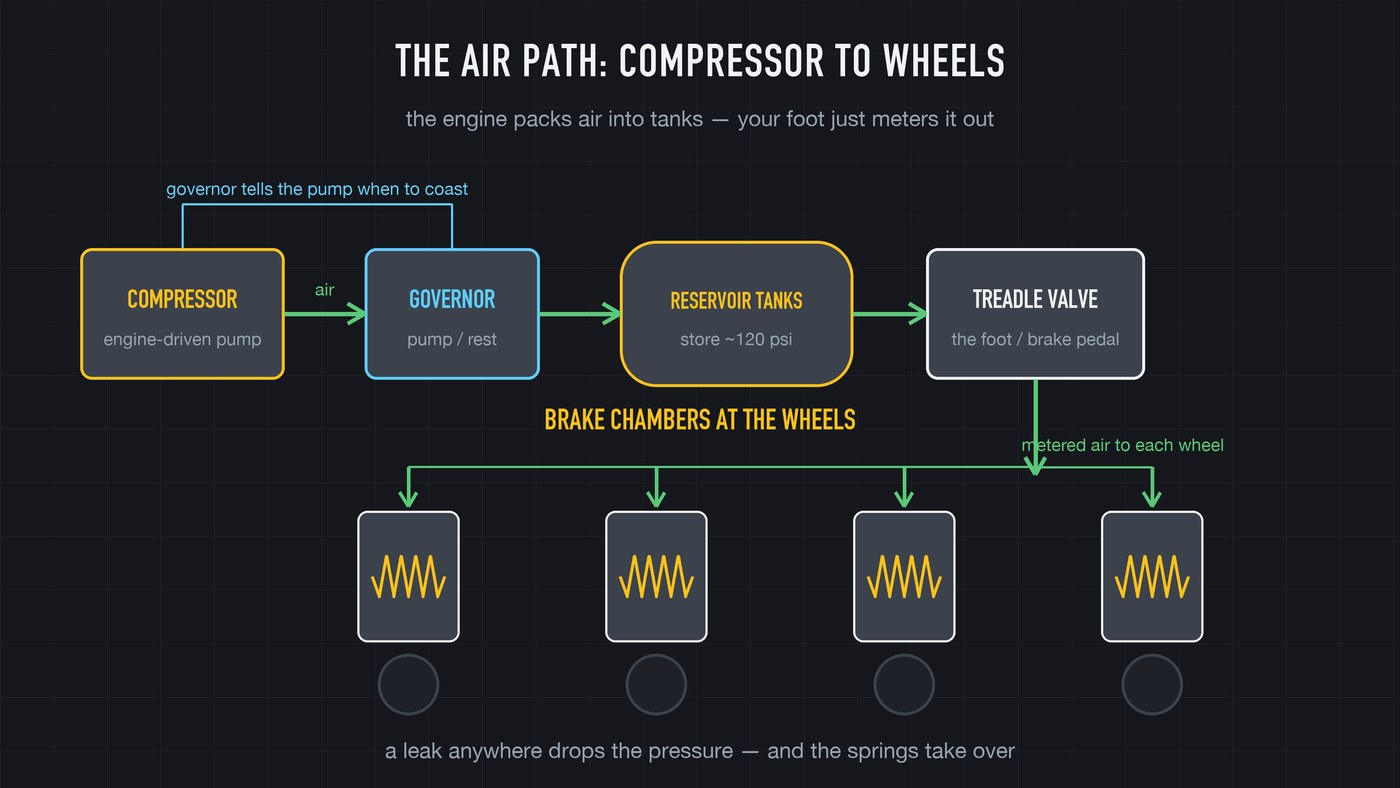
Bolted to the engine is an air compressor, spinning whenever the engine runs. It packs ordinary air into steel reservoir tanks under the truck, usually up to around 120 pounds per square inch. A governor watches that pressure: when the tanks hit the top number it tells the compressor to stop pumping and coast, and when pressure drops it kicks it back on. That's why a parked truck randomly puffs and hisses on its own. It's topping off its tanks.
This is the first trade-off of the whole system. Climb into a cold truck with empty tanks and you can't just drive. You have to sit and wait, sometimes a couple of minutes, while the compressor builds enough pressure to even release the brakes. A car turns the key and goes. A truck has to inhale first.
03The service brakes: air in to stop, air out to go
Now the normal braking, the kind at every stop light. Under the driver's foot is a valve called the treadle valve. It doesn't connect to the wheels mechanically. It's an air tap. Press it a little and a little air flows to the brakes. Press it hard and it opens wide and dumps a lot.
That air travels back to a chamber at each wheel, pushes on a rubber diaphragm, and the diaphragm shoves a rod that clamps the brake. Ease off the pedal and the valve lets that air escape.
These are the service brakes, and they work the way you'd expect: air in to stop, air out to go. Hold that thought, because the spring brakes are about to do the exact opposite.
04The spring brake is wired backwards
Right next to that service chamber sits a second chamber, and inside it is a spring. Not a dainty spring. A coiled slab of steel strong enough to lock the wheel of a loaded truck all by itself.
Here's the trick. That spring's natural resting state is jammed forward, pushing the brake on. To take the brake off, air pressure floods the chamber, presses a plate against the spring, and squashes it back out of the way. So on a moving truck, air is doing one full-time job you never think about: crushing that spring flat so the wheels can turn.
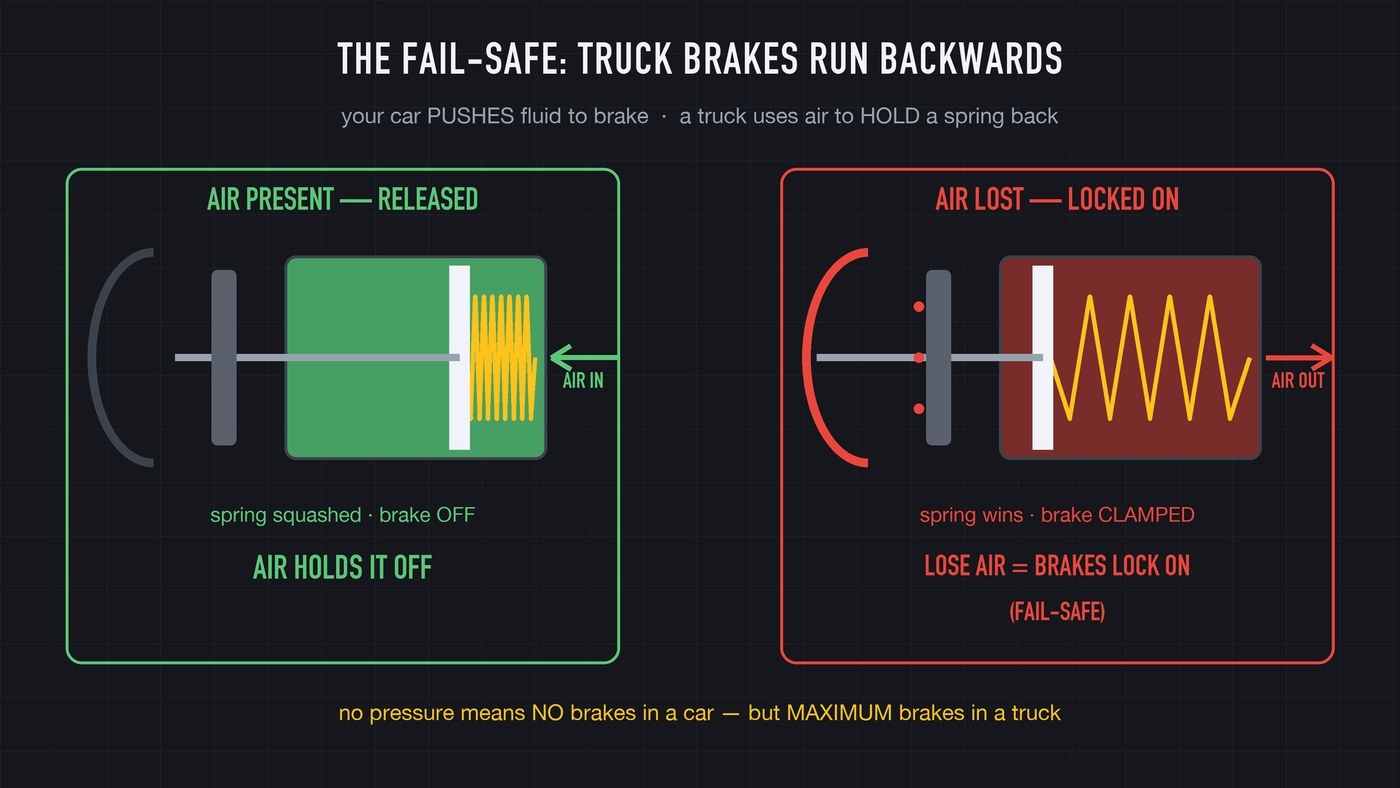
This is the part that runs backwards from everything your car does. In your car, no pressure means no braking. In a truck, no pressure means maximum braking, because the only thing holding that spring off is the air.
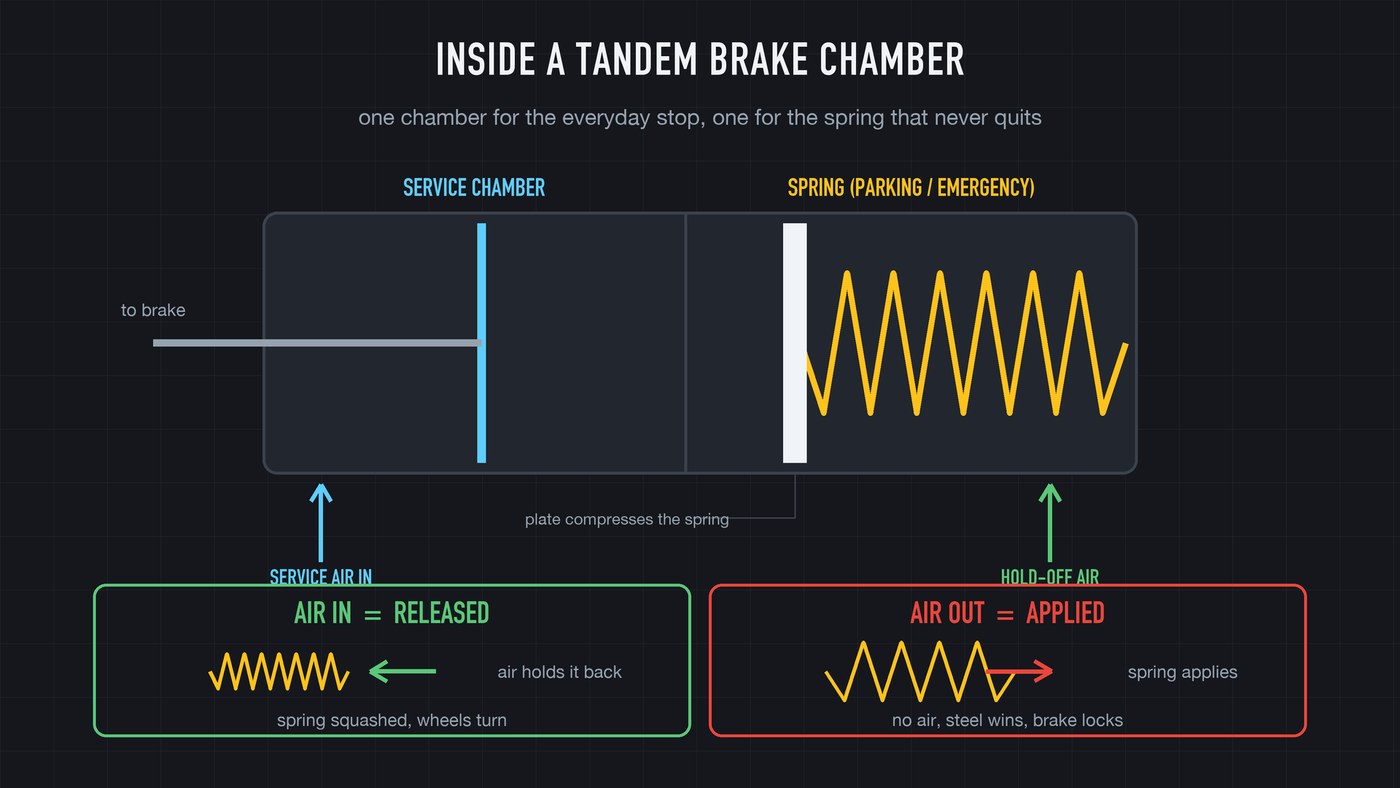
Take the air away, and steel wins.
05What happens when a truck loses its air?
Now you can see why the failure is the feature. Say a hose blows at seventy miles an hour and air starts screaming out of the system. As the pressure falls, the spring it was holding back starts to win. Past a set point, the spring brakes clamp down and bring the truck to a stop, whether the driver did anything or not. A leak doesn't disable the brakes. A leak is the brake command.
And this same spring is the parking brake. When a trucker parks, they pull a yellow knob that dumps the air out of the spring chambers on purpose, letting the springs grab and hold the truck still with zero air and zero effort, all day. To drive off, they push the knob in, air floods back, the springs compress, and the brakes release.
That yellow knob is the most important control in the cab, and it's just a valve that either feeds or dumps air to a spring.
06What's that loud pssshh sound?
Every time a bus kneels at a stop or a truck lets its brakes go, you hear that sharp pssshh. That's not a leak and it's not a problem. That's air being deliberately exhausted, dumped out of a chamber through a valve so the brakes can release or reset. A truck is constantly breathing: air in through the compressor, air out through these valves, and every exhale is that hiss.
But breathing has a cost. Air is squishy. It compresses. So when a trucker stabs the pedal, the air has to travel down the lines and build up before the brakes fully bite, a fraction of a second of lag that hydraulic car brakes just don't have. Add the driver's own reaction time, then eighty thousand pounds of momentum, and that's exactly why a big truck needs so much more room to stop. The air isn't slow. It just isn't instant.
There's one more layer: ABS. If a wheel locks and skids, you lose steering, and on a heavy truck a skid can jackknife the trailer. So speed sensors watch each wheel, and if one starts to lock, a valve rapidly pulses the air to that brake, releasing and reapplying many times a second, faster than any foot could move. The truck stops straight and still steers.
07The catch: what you must never do with air brakes
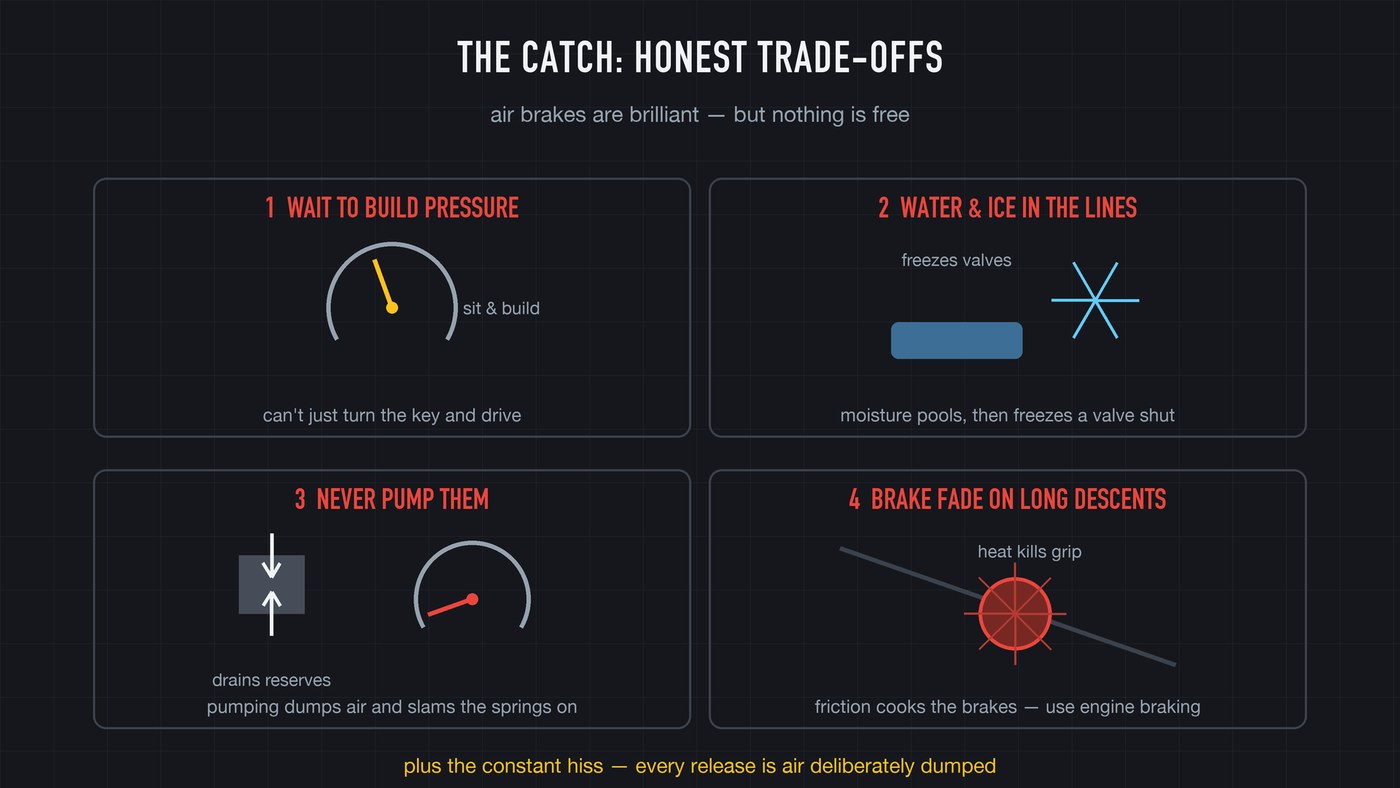
First, you can't pump them. In a car, if the brakes feel weak, instinct says pump the pedal. Do that on an air system and you're just dumping your air reserves. Drain the tanks faster than the compressor can refill them and the pressure crashes, which slams the spring brakes on. Pumping is the worst thing you can do. That's part of why ABS does the pulsing for you.
Second, water. Compressing air squeezes moisture right out of it, and that water collects in the tanks. Left alone it corrodes them, and in winter it can freeze inside a valve and jam a brake open or shut. That's why trucks run an air dryer, and why drivers drain their tanks. Skip it in a cold snap and a frozen line can strand a truck, or worse.
And the big one on long descents: brake fade. Ride the brakes down a long mountain grade and friction turns to heat. The brakes get so hot they stop gripping, and no amount of air brings them back until they cool. That's what those runaway-truck ramps are built for. The fix isn't more braking, it's engine braking and low gears to hold speed without ever cooking the brakes. Air brakes don't repeal physics. Heat still wins if you abuse it.
08Myth vs mechanism
Myth one: air pushes the brakes on. For everyday service braking, sure. But the safety brake, the one that actually saves lives, works the other way. Air holds it off. The spring does the stopping.
Myth two: losing air pressure means losing your brakes. It's the exact opposite. Losing air is what makes a truck brake. The whole system is built so that the natural failure, air escaping, is also the safest outcome: a full stop.
That's the genius of it. A machine designed so that when everything goes wrong, the answer is the same as when everything goes right. The truck stops. A spring that never quits, air that just holds it at bay, and a driver who only ever decides how much of that spring to let loose.
- Everyday service brakes work as expected: air in to clamp the brake, air out to release it.
- The spring brakes run backwards: a huge steel spring always pushes the brakes on, and air pressure is what holds it off.
- Losing air doesn't disable the brakes, it applies them. Past a set pressure, the springs clamp and the truck stops on its own.
- The yellow dash knob is the parking brake: it dumps the air so the springs hold the truck with zero air and zero effort.
- Air compresses, so braking has a slight lag, you must never pump the pedal, and heat can still fade the brakes on long grades.
More how it actually works
Frequently asked
How do air brakes work on a truck?
An engine-driven compressor fills tanks to around 120 psi. For normal stops, the pedal meters air to a chamber at each wheel, where it pushes a diaphragm that clamps the brake. The parking and emergency brakes work backwards: a powerful spring always pushes the brakes on, and air pressure holds it released.
What happens if a truck loses air pressure?
The brakes lock on instead of failing. Once pressure falls past a set point, the springs the air was holding back clamp the brakes and bring the truck to a stop, whether the driver does anything or not.
Why do trucks and buses make that loud hissing sound?
The pssshh is air being deliberately exhausted through a valve so the brakes can release or reset. It's not a leak. The system constantly takes air in through the compressor and vents it back out during normal operation.
Why can't you pump air brakes?
Pumping the pedal dumps your air reserves. If you drain the tanks faster than the compressor can refill them, the pressure crashes and the spring brakes slam on. ABS pulses the brakes for you, many times a second, without wasting air.