 WHAMBOX
01What do the three wires in an outlet do?
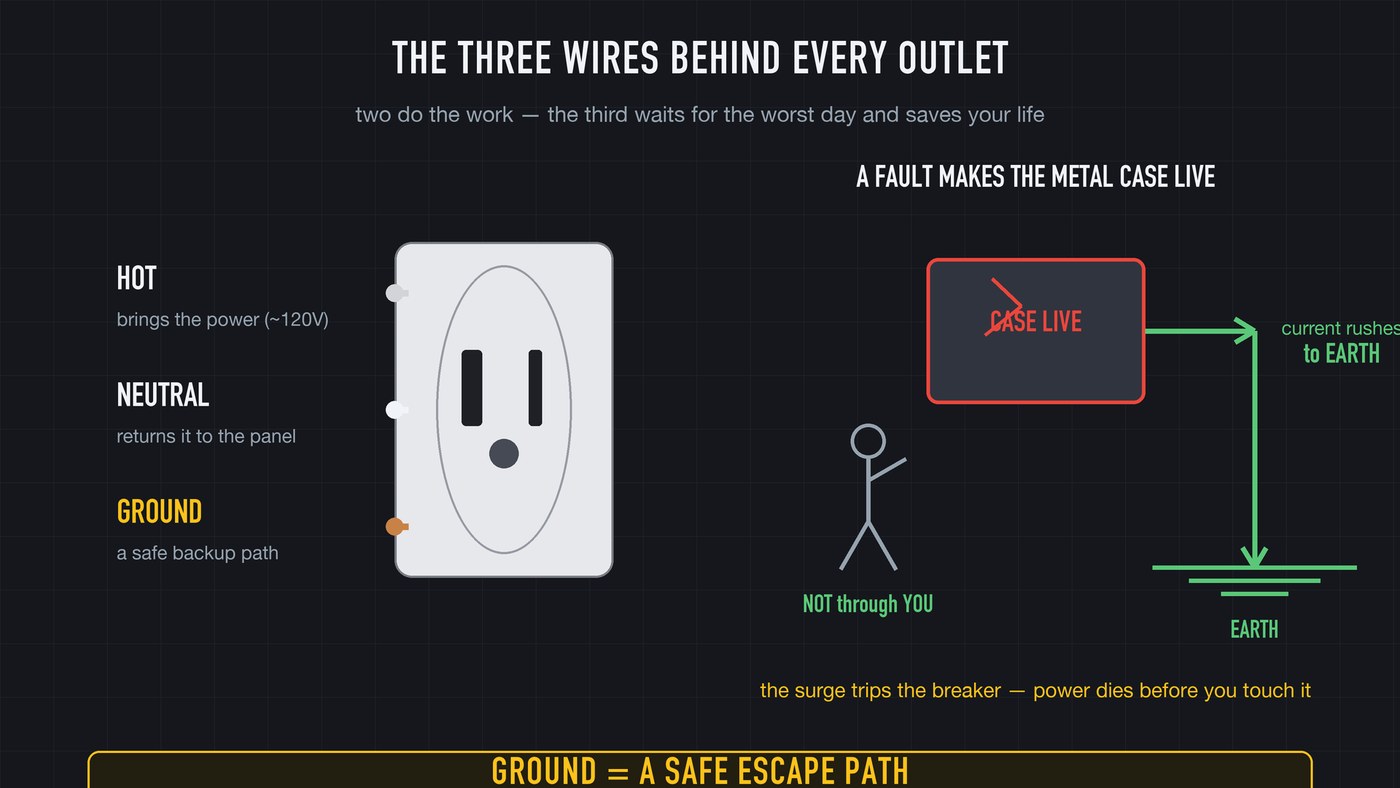
Pull an outlet out of the wall and you'll find three wires. The hot wire, usually black, is the live one carrying the electrical pressure, about 120 volts in a US home. It's the wire that will hurt you.
The neutral, usually white, is the return path. Electricity has to make a complete loop to do anything, so current flows out through the hot, through whatever you plugged in, and back through the neutral. Hot delivers, neutral returns.
The ground, bare copper or green, is the strange one: in normal use it does absolutely nothing. No current flows through it at all. It sits there built for the worst day of the outlet's life, and it earns its keep in a fraction of a second.
02Why is the neutral wire connected to the earth?
Switch on a lamp and you close a loop: current leaves on the hot, travels through the bulb, returns on the neutral. The same amount goes out as comes back, always. Hold onto that balance, because everything later depends on it.
Here's the part that surprises people. The neutral is tied to the earth back at your breaker panel, connected to a rod driven into the ground outside your house. So the neutral and the dirt under your feet sit at roughly the same electrical level, near zero. The hot wire does not: it's 120 volts above that.
Which means the earth, and anything touching it, including you standing on a wet bathroom floor, is somewhere electricity would love to flow if it ever got the chance. Everything that follows is about controlling that chance.
03What does the round third prong actually do?
Picture a metal appliance: a toaster, a drill, an old fridge. Imagine the hot wire inside works loose and touches the metal case. Without a ground, nothing looks wrong. The toaster still works. But the entire metal body is now live at 120 volts, silently waiting. The next person to touch it while touching anything grounded becomes the path to earth. That's the classic electrocution.
The ground prong connects that metal case straight back to earth. So if a hot wire touches the case, the electricity doesn't wait for you. It rushes down the ground wire, because that's a far easier path than a human body.
And here's the clever bit: that rush is a huge surge of current, and a huge surge is exactly what trips your breaker. The ground prong doesn't quietly protect you. It deliberately causes a short circuit to force the breaker to cut power before you ever walk in the room.
An escape hatch for electricity that would otherwise escape through you.
04How does a GFCI outlet work?
Near water, your outlet has TEST and RESET buttons. That's a GFCI, a ground fault circuit interrupter, and it's one of the great safety inventions of the last century.
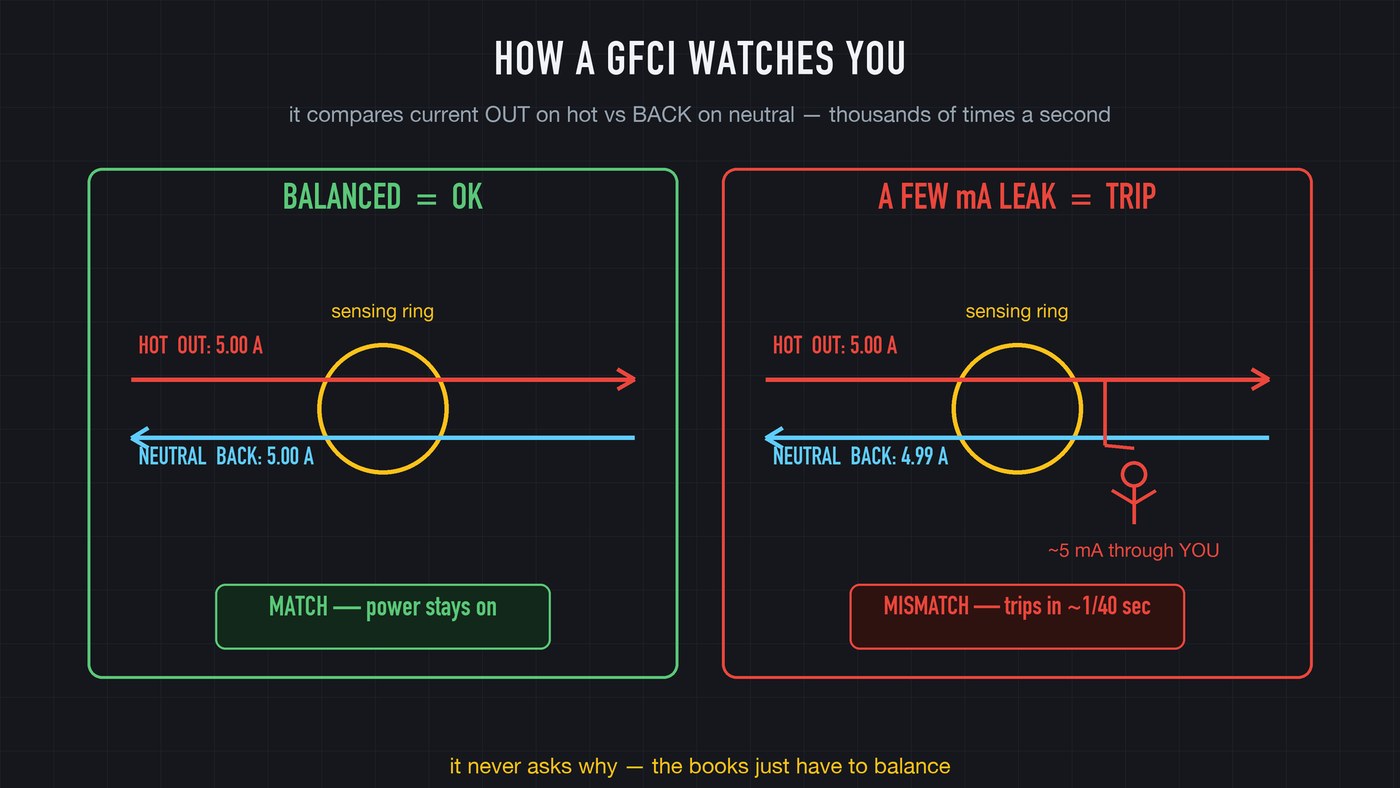
Remember the balance: current out on the hot should exactly equal current back on the neutral. A GFCI is an obsessive accountant living in the outlet. It compares the two thousands of times a second and checks that they match. As long as they match, everything is fine.
Now suppose some goes missing, leaking off through you because a hairdryer hit the sink and current is taking a shortcut through your body to the water and the ground. The books no longer balance. The instant that gap reaches about 5 milliamps, less than it takes to seriously hurt you, the GFCI throws a switch and cuts power in roughly one-fortieth of a second. Faster than you can flinch.
It never needs to know why the current vanished. It only knows the numbers don't add up. And the TEST button is how the outlet audits its own accountant: it creates a tiny fake leak to see if the mechanism trips. Press it monthly, because a GFCI that has quietly failed looks exactly like one that works, right up until you need it.
05Why can't a kid push a fork into an outlet?
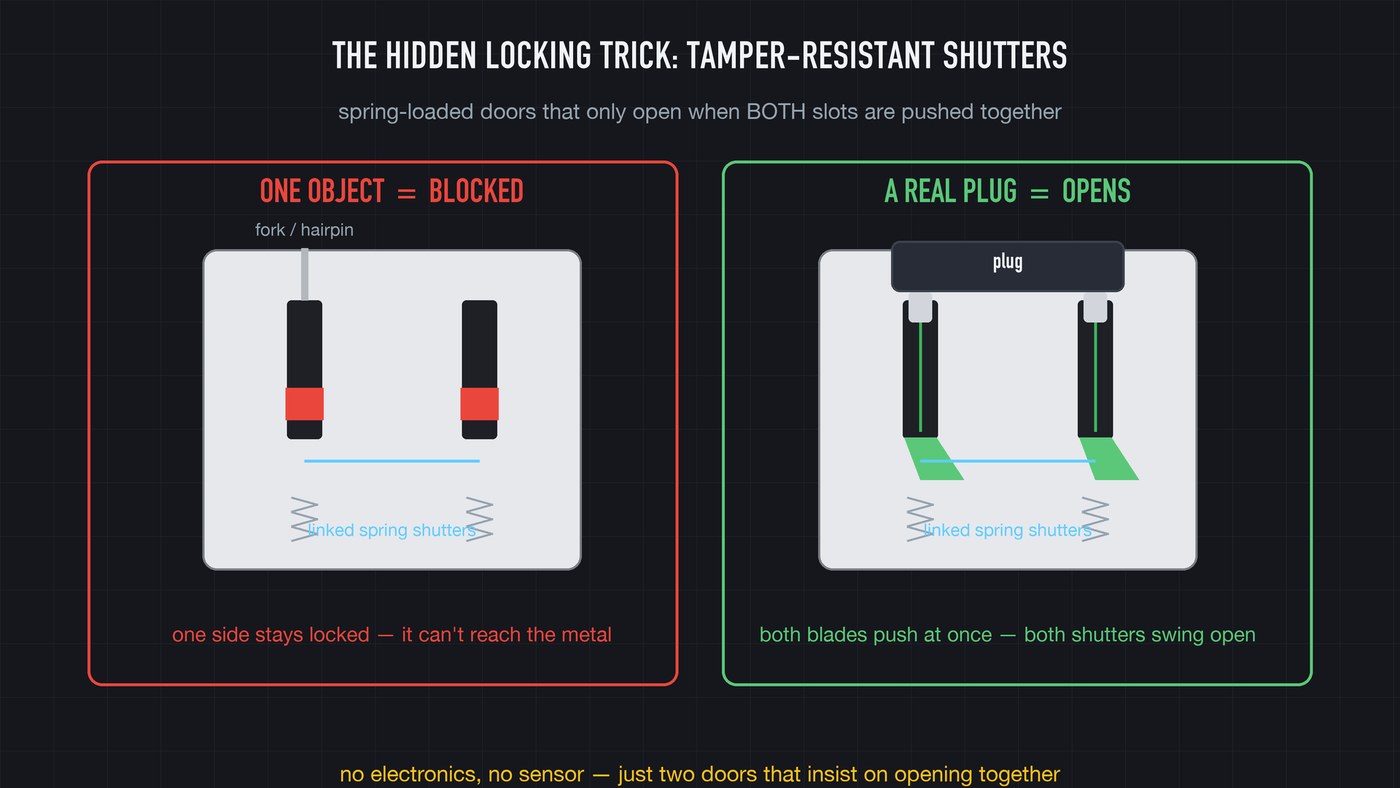
Try pushing a single plug blade into just one slot of a modern outlet. It won't go. But a normal two-prong plug slides right in. How does the outlet tell the difference?
Behind each slot is a spring-loaded plastic shutter. The trick is that the two shutters only open when both are pushed at the same time, with equal pressure. A plug's two prongs hit both slots together, so both release. A single fork or hairpin pushes only one side, that shutter stays locked, and because they're linked it blocks the whole thing.
This is a tamper-resistant receptacle, required in new homes for years. No electronics, no sensor. Just two little doors that insist on being opened together, like a two-key launch switch.
06The trade-offs: backstabs, nuisance trips, and overloads
Backstab wiring, where the wire is jammed into a hole in the back rather than wrapped around the screw terminal, is faster to install and a common source of loose connections that heat up over time. Screw terminals are the more reliable choice.
GFCIs sometimes trip for no visible reason. Long wire runs, damp conditions, and motor-driven appliances can all leak a tiny bit of current legitimately, and the GFCI can't tell a harmless leak from a dangerous one. That's the price of a device tuned to trip well below the level that hurts you.
And overloading a circuit is a different failure entirely. The breaker isn't protecting you there, it's protecting the wire in your wall from carrying more current than it can shed as heat. A tripped breaker is the system working, not failing.

07Myth vs mechanism
Myth one: the ground wire carries electricity away during normal use. It carries nothing at all, almost all the time. It exists for one fault, once, and its job is to make a big enough surge to trip the breaker.
Myth two: the GFCI detects shocks. It detects arithmetic. It compares two numbers and cuts power when they stop matching, which is why it works even when it has no idea a person is involved.
Springs, a sensing coil, and a couple of clever shapes, sitting quietly behind a plastic cover, keeping you alive on the one day it matters.
- An outlet has three wires: hot delivers, neutral returns, and ground normally carries nothing.
- The neutral is bonded to earth at the panel, which is why the ground under your feet is a tempting path for current.
- The third prong forces a deliberate short circuit during a fault so the breaker cuts power before you touch anything.
- A GFCI compares current out with current back and trips on a 5 mA mismatch in about 1/40 of a second.
- Modern outlets use linked spring shutters that only open when both slots are pressed together.
More how it actually works
Frequently asked
What does the third prong on a plug do?
It connects an appliance's metal case to earth. If a hot wire comes loose and touches the case, current floods down the ground wire instead of through a person, and that surge trips the circuit breaker and kills power.
How does a GFCI outlet know to trip?
It continuously compares the current leaving on the hot wire with the current returning on the neutral. If about 5 milliamps goes missing, meaning it's leaking somewhere else such as through a person, it cuts power in roughly one-fortieth of a second.
Why should I press the TEST button on a GFCI?
It creates a deliberate small fault so the outlet can verify its own tripping mechanism still works. A failed GFCI looks identical to a working one, so monthly testing is the only way to know.
Why won't a fork fit into one slot of an outlet?
Modern tamper-resistant outlets have spring-loaded shutters behind each slot that only release when both are pushed simultaneously. A two-prong plug does that; a single object doesn't, so the shutter stays closed.
Do GFCI outlets work without a ground wire?
Yes. A GFCI only monitors the balance between hot and neutral, so it can protect an older ungrounded two-prong circuit. That's the standard approach for adding protection in older homes.